Unit 7 Sports
Lead-in
Discuss the following questions.
- Do you find more average people are exercising regularly?
- Do you think talent alone determines why some professional athletes rise to the top while many others remain mediocre (平庸)?
Reading 1
Children Need Physical Education More than Ever
Before Reading
Listed in the box are some facts and statistics about obesity in the United States. Skim them and answer the following questions.
- Is obesity a serious problem in the United States? Why?
- What do you think are the causes for obesity? What should be done to avoid obesity?
- Do you think the information presented here is reliable?
Facts & statistics
Obesity
Data from 2009–2010 indicate that over 78 million US adults and about 12.5 million (16.9%) children and adolescents are obese. $ ^{1} $
Recent reports project that by 2030, half of all adults (115 million adults) in the United States will be obese. $ ^{2} $
Obesity rates in children 6 to 11 years old have decreased from 18.8% in 2003–2004 to 17.7% in 2011–2012; obesity rates for children 12 to 19 years old have increased from 17.4% to 20.5% in the same time period. $ ^{3} $
Human and Financial Costs of Obesity
Projections estimate that by 2018, obesity will cost the US 21% of our total healthcare costs — 344 billion annually. $ ^{4} $
Those who are obese have medical costs that are 1,429 more than those of normal weight on average (roughly 42% higher). $ ^{5} $
Obesity is also a growing threat to national security – a surprising 27% of young Americans are too overweight to serve in our military. Approximately 15,000 potential recruits fail their physicals every year because they are unfit. $ ^{6} $
References:
1 Ogden, C. L., Carroll, M. D., Kit, B. K., Flegal, K. M. Prevalence of Obesity in the United States, 2009–2010. U.S. Centers for Disease Control and Prevention, National Center for Health Statistics Data Brief, January 2012; Available at: $ \underline{\text{http://www.cdc.gov/nchs/data/databriefs/db82.pdf-PDF}} $.
2 Wang, Y Claire, McPherson, Klim, Marsh, Tim, Gortmaker, Steven L., Brown, Martin. Health and Economic Burden of the Projected Obesity Trends in the USA and the UK. The Lancet; 2011; Vol 378: 815–825.
3 Ogden, C. L., Ph. D; Carroll, M. D., MSPH; Kit, B. K., MD, MPH; Flegal, K. M., Ph. D. Prevalence of Childhood and Adult Obesity in the United States, 2011–2012. JAMA. February 26, 2014; Vol 311, No. 8. Available at: http://www.jamanetwork.com/.
4 National Association for Sport and Physical Education. 2010 Shape of the Nation Report. Available at: $ \underline{\text{http://www.shapeamerica.org/advocacy/son/upload/Shape-of-the-Nation-2010-Final.pdf-PDF.}} $
5 Centers for Disease Control and Prevention. Vital Signs: Adult Obesity. 2010. Available at: $ \underline{\text{http://www.cdc.gov/vitalsigns/AdultObesity/}} $.
6 American Heart Association. Teaching America's Kids About a Healthy Lifestyle. 2010. Available at: $ \underline{\text{http://www.heart.org/idc/groups/heart-public/@wcm/@adv/documents/downloadable/ucm}} $ 301728.pdf-PDF.
Children Need Physical Education More than Ever Kristen Jimenez
1 Nine times out of ten, students complain to their Physical Education teachers about being out in the hot sun, running around for no reason. Perhaps in lower level education, children see it as a means of escaping the classroom, but as we grow older, it's simply looked upon as a huge waste of time and energy. However, if we look at our education system, Physical Education is allotted an entire period of the day, maybe because it is essential to students, or at least, it should be. Most people tend to believe that physical activity is only necessary when large amounts of fat build up in the body over a period of time. Engaging in acts of physical activity from a young age is very important for both the mental and physical health of a child; the habits learnt in youth tend to continue onto adulthood, thus having an effect on the prevalence of
obesity and related illnesses in society. Teachers play a major role in ensuring that children, who will later grow into youths then adults, participate in physical activity from the very beginning of receiving an education.
2 The benefits of physical activity are vast. Physical activity has been associated with an increased life expectancy in adults so its importance is obvious, but its value in children sometimes needs to be justified. It is never too early to start teaching a child positive behaviors and habits; however, in middle childhood (ages 6–10) children tend to be in a stage of development where they are most likely to be taught healthy eating habits, develop exercise programs and have an interest in organized sports. Young people will carry established healthy behaviors throughout their lives such as better eating habits, but very few will actually fit exercise into their daily routines.
3 With schools now eliminating physical activity from their curriculums, more and more students begin to stray away from the idea of doing such activities. However, when approaching tertiary education level, students begin to look at these sporting activities as a way to perfect a developing skill so that it can further lead to possible career opportunities. Belize being a very minute competitor compared to the rest of the world is already discouraging to these youths who wish to pursue their futures in sports. Should schools completely eliminate physical activities, children will be restricted from even gaining an interest in sports; thus Belize as a developing country suffers from the lack of potential international athletes. When few Belizeans go out and make a name for themselves, we all benefit as a society.
4 Physical activity is one of the most important things we all can and should do to keep our body in healthy shape. By physical activity it doesn't only mean the vigorous weight lifting, running, aerobics, martial arts, games and sports, but also the modest thing such as jogging, walking, and swimming. There are many health conditions that don't require a pill to be swallowed every day on a routine basis but a tiny amount of time invested in physical activities is worth it. It is always anticipated that the more active we are, the more we will benefit. Physical activities are beneficial for both mental and physical health. It has also been considered as a tool for boosting social life.
5 People who see exercise as a total waste of time should understand that exercise is essential to life because it not only prevents us from being susceptible to diseases, but it also teaches us how to be disciplined in the sense that we have complete control over our bodies and its outcome. Today we live in an environment where we get more unhealthy foods and beverages for a lesser cost, which in turn promotes greater consumption, and unhealthier children, youths and adults.
New Words and Expressions
nine times out of ten occurring on average nine times for every ten instances of sth.; nearly always 十之八九;几乎总是
complain /kəm'pleɪn/ v. express dissatisfaction
or unhappiness about a situation 抱怨;发牢骚
look upon ... as consider (sb. / sth.) in a particular way, or as a particular thing 把……看作;视为
$ \underline{\text{allot}} $ /ə'lɒt/ v. give time, money, tasks, etc. to sb. / sth. as a share of what is available 分配;配给
(时间、钱财、任务等)
build up (cause to) increase, develop, or become gradually larger 增加;扩大
adulthood $ ^{A} $ /'ædʌlthud/ n. the state of being an adult 成年
prevalence $ ^{\triangle} $/'preveləns/ n. the fact that sth.
is very common at a particular time or in a
particular place 流行;盛行;普遍
expectancy $ ^{*} $ /ɪkˈspektənsi/n. hope; the state of expecting 期待;期望
life expectancy the average number of years that a person is expected to live 预期寿命;平均(期望)寿命
justify $ ^{A} $ /'dʒʌstɪfaɪ/ v. give a good reason for; explain satisfactorily 证明……有理(正确)
established /ɪˈstæblɪst/ a. already in use or existing for a long period of time 早已确立的;早已投入使用的
fit sth. into find or have sufficient space or time for sth. 将某物纳入……;把某物装进(某空间、时间)
eliminate $ ^{A} $ /ɪˈlɪmɪneɪt/ v. remove or get rid of completely 消除;剔除
stray $ ^{*} $ /streɪ/ v. begin to deal with or think about a different subject from the main one, without intending to 偏离;离题
tertiary $ ^{\triangle} $ /'tɜːʃəri/ a. third in order, importance, or value 第三的;第三位的;第三级的
tertiary education education at a university or college 高等教育
minute /maɪˈnjuːt/ a. extremely small 极小的 compared to in comparison with 与……比较
pursue $ ^{A} $ /pə'sju:/ v. try to achieve sth.; continue steadily with; carry on 追求;继续从事
Belizean /bəˈliːziən/ n. a person from Belize 伯利兹人
make a name for oneself make oneself become well-known 使自己成名;为自己赢得名声
vigorous /'vɪgərəs/ a. using a lot of energy and strength or determination 强有力的;积极的
weight lifting the sport of lifting heavy weights, either for exercise or in competition 举重运动
aerobics /eəˈrəʊbɪks/ n. a type of exercise intended to strengthen the heart and lungs 有氧健身运动
martial/ˈmɑːʃəl/ arts 武术(如功夫、柔道、空手道等)
invest $ ^{A} $ /in'vest/ v. spend time, energy, effort, etc. on sth. that one thinks is good or useful 投入(时间、精力等)
be worth it be sufficiently good, enjoyable, or successful to repay any effort, trouble or expense 有好处;值得做
consumption $ ^{A} $ /kənˈsʌmpʃən/ n. the act of using energy, food or materials; the amount used 消耗;消耗量
Proper Names
Kristen Jimenez / "Kristen hi'meineiθ/ 克丽斯滕·希门尼斯 Belize /bə'li:z/ 伯利兹(美洲国家)
Global Reading
- Study the reading skill in the box and work on the task below.
Reading Skill — Identifying the thesis statement
A thesis statement summarizes the author's argument of the whole academic text. It always appears in the introductory part and, more often than not, is restated in the conclusion. Like a GPS, the thesis statement lets the reader know the destination the author plans to take them to. All of the rest of the text should support this thesis statement.
Skim the text by reading the first and the last paragraph and identify the thesis statement.
- Choose from the list (a–d) the different ways the author uses to support her argument.
Note that there is more than one correct answer.
a) Demonstrating research and data
b) Making comparisons and contrasts
c) Giving examples
d) Illustrating cause-effect relationships
Close Reading
- Study the reading skill in the box and work on the task below.
Reading Skill — Recognizing cause and effect
An academic text often describes a cause-effect relationship between two events / ideas. This relationship can be described using different language patterns:
verbs or verbal phrases: cause, result in, bring about, lead to, give rise to, be related to...
nouns or noun phrases: impact, change, consequence, effect, source...
conjunctions: because ...
prepositions or prepositional phrases: on account of, as a result of, by, through...
other expressions: owing to ...
It is important to be alert to these patterns and understand the cause-effect relationship between two ideas / events. The cause part of the relationship may come before the effect, or vice versa, and the effect can become a cause leading to a second effect.
Read the following sentences from Reading 1, identify the cause and effect relationship (A, B or C) in each sentence by following three steps:
a) $ \underline{Underline} $ the language patterns that express "cause and effect" relationship.
b) Identify which "cause and effect" relationship (A, B or C) each sentence demonstrates.
c) Clarify what cause(s) and effect(s) there are in the sentence.
An example has been given for demonstration.
A cause $ \rightarrow $ effect
B effect ← cause
C cause $ \rightarrow $ effect / cause $ \rightarrow $ effect
Example:
Physical activity $ \underline{\text{has been associated with}} $ an increased life expectancy in adults $ \underline{\text{so}} $ its importance is obvious ... (Para. 2)
Answer: $ \underline{C} $ cause (physical activity) $ \rightarrow $ effect / cause (increased life expectancy) $ \rightarrow $ effect (physical activity is important)
- ... Physical Education is allotted an entire period of the day, maybe because it is essential to students, or at least, it should be. (Para. 1)
- With schools now eliminating physical activity from their curriculums, more and more students begin to stray away from the idea of doing such activities. (Para. 3)
- ... when approaching tertiary education level, students begin to look at these sporting activities as a way to perfect a developing skill so that it can further lead to possible career opportunities. (Para. 3)
- Belize being a very minute competitor compared to the rest of the world is already discouraging to these youths who wish to pursue their futures in sports. (Para. 3)
- Should schools completely eliminate physical activities, children will be restricted from even gaining an interest in sports; thus Belize as a developing country suffers from the lack of potential international athletes. (Para. 3)
- Today we live in an environment where we get more unhealthy foods and beverages for a lesser cost, which in turn promotes greater consumption, and unhealthier children, youths and adults. (Para. 5)
- The text has five paragraphs. Choose the correct subheading for each paragraph from the list (A–G).
( ) 1) Para. 1 A. Numerous benefits
( ) 2) Para. 2 B. Physical activity: vigorous or modest?
( ) 3) Para. 3 C. Doing sports as a profession?
( ) 4) Para. 4 D. A life-long advantage
( ) 5) Para. 5 E. Good habits developed early
F. Different views on PE class
G. Better control of our life
Critical Thinking
Discuss the following questions.
- Was there a time when you especially loved or hated Physical Education class? What do you think of sporting activities in college?
- Do you agree that the habit of exercising should be cultivated in children at a young age?
Language Enhancement
- The words in the box below are either active words or academic words marked in the Academic Word List (AWL). Choose the most suitable one to complete each sentence. Change the form where necessary.
adulthood complain consumption eliminate ensure
vigorous invest justify minute pursue
- There is no evidence for a strong association between moderate alcohol ___ and heart problems.
- Feeling depressed is common and you cannot _____ it totally from your life.
- One goal of the program is to encourage more students from low-income backgrounds to _____ careers in education.
- How much time you ___ in training determines what skills you will end up with in the future.
- The company has won many honors but it has to do more to ___ its leadership and competitiveness in the future.
- Heavy children tend to stay overweight into _____, which increases risks of diabetes and cardiovascular diseases at a younger age.
- When people _____ or are dissatisfied with their lives, they often blame others for their unhappy state of affairs.
- He takes _____ exercises for several hours a week to stay healthy.
- It is true he has been troubled by family matters, but that cannot _____ his long absence from work.
- The police carefully examined every corner of the room, and found _____ blood traces on the couch.
- If your new laptop is having some troubles within one year's use, ___, free servicing is available. (nearly always; Para. 1)
- Complete the sentences with phrases from Reading 1. Their meanings and paragraph numbers have been given in brackets.
- If a child is brought up to _____ life _____ a process of getting, he usually gets nothing but complaints when he reaches adulthood. (regard ... as; Para. 1)
- If you don't release your negative emotions, frustration and anger can _____ inside you, which may be detrimental to your health in the long run. (increase gradually; Para. 1)
- It's no good loading your life with endless work. You have to _____ some simple relaxation _____ your daily routine. (find time for; Para. 2)
- It seems quite often that some viewers' comments under a blog message ___ the writer's main subject. (move away from; Para. 3)
- The statistics showed an increase of 188,000 people in the work force in the second half of the year _____ the first half. (in comparison with; Para. 3)
- His personal ambition is to _____ by advising Chinese companies that enter overseas markets. (make himself become well-known; Para. 3)
3. Study the word building skill in the box and work on the tasks below
Word Building Skill — Conversion (II): adjective → verb
Verbs which are converted from adjectives can be:
• transitive verbs, meaning "cause sb. or sth. to be or become the quality denoted (表示) by the adjective", e.g. "calm" (make ... calm), "lower" (make ... lower)
• intransitive verbs, meaning "be or become the quality denoted by the adjective", e.g. "grey" (become grey), "dim" (become dim). Note that in some cases these intransitive verbs from adjectives can be used as transitive verbs as well.
Sometimes, a phrasal verb is derived from an adjective plus a particle, for example, "sober up" (become sober), "calm down" (become calm).
A. Pick out the verbs that are converted from adjectives in the following sentences, and write down their Chinese meanings
- ... students begin to look at these sporting activities as a way to perfect a developing skill.
(Para. 3, Reading 1)
- In their search for the optimal path to greatness, some believe that the path should be smoothed of all obstacles ... (Para. 1, Reading 2)
- The sea narrows into a strait, through which about 1,600 vessels (轮船) pass every year.
- You should not disturb him because he busies himself with writing a novel recently.
- His sense of loyalty blinded him to the truth.
- They are not as friendly with each other as they were, so relations between them have definitely cooled.
| Converted verb | Chinese meaning |
| 1) | |
| 2) | |
| 3) | |
| 4) | |
| 5) | |
| 6) |
B. Rewrite the following sentences by converting the underlined adjectives into verbs
Example: Thousands of workers joined the educational projects in an attempt to make them $ \underline{\text{better}} $.
Thousands of workers joined the educational projects in an attempt to $ \underline{\text{better themselves}} $.
- These wrong tendencies should be put $ \underline{\text{right}} $ to bring about a great advance in the publishing industry.
These wrong tendencies should be _____ to bring about a great advance in the publishing industry.
- The calmness and the steadiness of the professor's voice seemed to keep the audience quiet very quickly.
The calmness and the steadiness of the professor's voice seemed to _____ the audience very quickly.
- The severe economic crisis has made nearly ten thousand workers $ \underline{\text{idle}} $ and aroused much fear in the country.
The severe economic crisis has _____ nearly ten thousand workers and aroused much fear in the country.
- The disagreement over trade tariffs (关税) has made relations between the two countries go $ \underline{\text{sour}} $.
The disagreement over trade tariffs has _____ the relations between the two countries.
- You can't help but feel $ \underline{\text{humble}} $ when you enter this church.
You can't help but be _____ when you enter this church.
4. Study the translating skill in the box and work on the task below
Translating Skill — Translating relative clauses (III): merging
When it comes to translating relative clauses, merging refers to the practice of combining the main clause and the relative clause in English into a simple Chinese sentence, with the English relative clause becoming the predicate (谓语) in the Chinese translation.
When the main clause is a “there + be” structure or contains the verb “to be”, the main clause and the relative clause can be rendered into a simple Chinese sentence:
Source Text: ... there is an object that's pretty much guaranteed to arouse her interest. (Para. 1, Reading 2, Unit 6)
Translation: ……有一样东西八成能引起她的兴趣。
When the main verb in the relative clause is more important, the main clause can be condensed into a phrase, and the verb in the relative clause becomes the predicate in the Chinese translation:
Source Text: That's the range in which cats don't have to generate extra heat to keep warm or expend energy on cooling. (Para. 6, Reading 2, Unit 6)
Translation: 在这个温度范围内,猫儿不需要产生额外的热量来保暖,也不需要消耗能量降温。
Examine the following sentences from Reading 1 and their translations, and decide whether the relative clause in italics in each sentence has been translated into a premodifier, a postmodifier or a merged sentence.
- ... however, in middle childhood (ages 6–10) children tend to be in a stage of development where they are most likely to be taught healthy eating habits, develop exercise programs and have an interest in organized sports. (Para. 2)
Translation: ……但在童年中期(6—10岁)儿童往往会处于这么一种发展阶段——他们最有可能会学会健康的饮食习惯,制定锻炼计划,对有组织的运动产生兴趣。
- Belize being a very minute competitor compared to the rest of the world is already discouraging to these youths who wish to pursue their futures in sports. (Para. 3)
Translation: 对世界上其他国家而言,伯利兹是一个微不足道的竞争对手,这一点已经够让那些希望将来能往运动领域发展的青年人沮丧的了。
- Physical activity is one of the most important things we all can and should do to keep our body in healthy shape. (Para. 4)
Translation: 要想身体保持健康状态,有件很重要的事情是我们大家都能做而且应该做的,那就是进行体育锻炼。
- There are many health conditions that don't require a pill to be swallowed every day on a routine basis but a tiny amount of time invested in physical activities is worth it. (Para. 4)
Translation: 有很多健康问题并不需要每天按时服药,只需花一丁点儿时间进行体育锻炼就够了。
- People who see exercise as a total waste of time should understand that exercise is essential to life ... (Para. 5)
Translation: 那些认为运动完全是浪费时间的人们应该明白,运动对生活至关重要……
- Today we live in an environment where we get more unhealthy foods and beverages for a lesser cost ... (Para. 5)
Translation: 今天,在我们生活的环境里,我们能用更低的价格买到更多不健康的食物和饮料……
Reading 2
Attitude Makes a Champion
Before Reading
Discuss the following question.
As the saying goes, "Attitude is everything." Does it apply to you when doing sports?
Attitude Makes a Champion
1 On the path to greatness, why do some become champions while others fall short? Coaches, parents, and aspiring athletes have all sought to answer this question. In their search for the optimal path to greatness, some believe that the path should be smoothed of all obstacles, while others say that such challenges are instrumental to talent development. Now, a recent study suggests that what really distinguishes champions is how they face and overcome such obstacles.
2 “We’ve found that there are universal psychological characteristics amongst those who are aspiring to get to the top,” says Professor Dave Collins, lead author of the study, as well as Chair and Director of the Institute of Coaching and Performance at the University of Central Lancashire. “We have a good idea of what makes people excellent and how we can help them reach peak performance.”
3 By interviewing athletes from varied sports such as soccer, rowing, skiing, and combat sports, Collins and his collaborators sought to find distinguishing characteristics between the best of the best, the good, and those that didn't quite make the cut. For each participant, they collected information about career events, perceived challenges and the participant's reactions to such obstacles. Interview questions also explored participants' commitment to their sports and their interactions with coaches and families.
4 The results showed that elite performers expressed an internal drive and commitment to their sports that their “almost” great colleagues lacked. The elite approached training with a “never satisfied” attitude, whereas “almost” might avoid challenging training exercises. Following an injury or a failure to perform, high performers were determined to get back to their sports, stronger than ever. Low achievers, on the other hand, often expressed surprise at their failures, telling how they lost enthusiasm after such incidents.
5 Despite these differences in the athletes' attitudes, there was surprisingly little variation in the nature or number of the challenges themselves. All had roughly comparable traumatic incidents during their careers. More than the challenges themselves, the differences came down to how the athletes reacted to these obstacles and the champions' positive, "learn from it" attitudes.
6 "From our research, we're assembling a set of rules to guide what a coach should be doing and what skills an athlete should end up with," says Collins. "Furthermore, these characteristics hold true for other fields as well, from sports to music to any environment."
7 While challenge may be integral on the path to success, this research suggests that challenge is not sufficient in itself. An aspiring athlete's attitude towards challenge is what most distinguishes the champions from the rest.
(426 words)
New Words and Expressions
fall short not reach a particular level or fail to achieve sth. that one wants 达不到;不符合
aspiring $ ^{\triangle} $ /əˈspaɪərɪŋ/ a. hoping to be successful in a particular job, activity, or way of life 有志气的;有抱负的
optimal $ ^{\triangle\triangle} $ /ˈɒptɪməl/ a. the best or most suitable 最佳的;最适宜的
obstacle /ˈɒbstəkl/ n. sth. which prevents action, movement or success 障碍(物);妨碍;阻碍
instrumental $ ^{\star} $ /,instr $ \underset{\cdot}{u} $mental/ a. important in making sth. happen 起重要作用的
amongst /ə'mʌnst/ prep. among 在……之中;在……当中
lead author the first named author of a publication such as a research article 第一作者;首席作者
peak /piːk/ a. at the best, highest, or greatest level or amount of sth. 最好(高)的;巅峰状态的
varied $ ^{A} $ /'veərid/ a. of different kinds; diverse 各种各样的;各不相同的
combat /ˈkɒmbæt/ n. (a) struggle between opposing people or armies 战斗;格斗;斗争
combat sport a competitive contact sport with one-on-one combat 技击运动;搏击运动
collaborator $ ^{\star} $ /kəˈlæbərəɪtə(r)/ n. someone who works with other people or groups in order to achieve sth., esp. in science or art 合作者;协作者
distinguishing /dɪs'tɪŋgwɪsɪŋ/ a. making sb. or sth. clearly different from other similar people or things 有区别的
the best of the best 精英中的精英;最好中的最好
make the cut be among the players allowed to continue playing 过关;晋级
perceived $ ^{A} $ /pə'siːvd/ a. that can be seen, noticed or realized, esp. when it is not obvious 感知到的
reaction $ ^{A} $ /rɪˈækʃən/ n. what one says or does as a result of sth. that has happened; response 反应;回应
interaction $ ^{①} $ /ˌɪntərˈækʃən/ n. the act of having an effect on each other or sth. else by being or working close together 互相影响;互相配合
elite $ ^{*} $ /er'liːt/ a. selected as the best, the most skilled or the most experienced 出类拔萃的;精锐的
drive /draɪv/ n. a strong desire to do things and achieve sth.; great energy 干劲;魄力;积极性
whereas $ ^{A} $ /hwear'ez/ conj. in contrast or comparison with the fact that 但是;而;却
achiever /ə'tʃiːvə(r)/ n. a person who achieves the particular level of success that is stated 取得……成绩的人
enthusiasm /ɪnˈθjuːzɪæzəm/ n. a strong active feeling of interest and admiration 巨大的兴趣;热情
variation $ ^{A} $ /,veəri'eifən/ n. a change, especially in the amount or level of sth. 变化;变更;变动
comparable /'kɒmpərəbl/ a. similar to sth. else in size, number, quality, etc., so that one makes a comparison 类似的;相当的;可相比的
traumatic /trɔː'mætɪk/ a. relating to physical injuries or wounds to the body 创伤的;外伤的;损伤的
come down to have (sth.) as the most important part 可归结为
assemble $ ^{A} $ /ə'sembl/ v. gather or collect together into a group or into one place 集合;聚集;收集
hold true be true, remain true 适用;有效
sufficient $ ^{A} $ /sə'fɪʃənt/ a. enough; as much as is needed for a purpose 足够的;充足的
in itself used for emphasizing that what one says about one particular thing is true without even considering anything else; in nature 本质上;就其本身而言
Proper Names
Dave Collins /dɛvˈkɒlɪnz/ 戴夫·柯林斯
University of Central Lancashire /ˈlæŋkəʒə(r)/ 中央兰开夏大学(英国)
Global Reading
- Skim the text to find the thesis statement in the text.
- Paraphrasing (explained in Reading Skill in Unit 2) is communicating the same information in different ways to avoid repetition.
"Champion" is a key word in the text. Scan the text for different ways to express the idea of "a champion / champions" and "to become a champion".
Close Reading
- Answer the following questions to understand some key elements of the study mentioned in the text.
- Who did the study?
- What is the objective of the study?
- What type of people are the subjects of the study?
- What is the method used to collect information?
- Understand the results of the study by filling up the table with information from the text.
Results of the study: differences and similarities
| Champions | Other subjects | |
| attitude towards their sports | 1) ________ | |
| attitude towards training | 2) ________ | 3) ________ |
| attitude towards injury | 4) ________ | 5) ________ |
| nature and number of challenges | 6) ________ | |
Critical Thinking
Discuss the following questions and remember to give reasons or examples to support your opinion.
- Champions in some sports are more famous and make much more money than champions in other sports. Do you think it fair?
- Is it always important to win at sports?
Language Enhancement
- The boldfaced words are either active words or academic words marked in Academic Word List (AWL).
A. Match the words in the left column with their meanings in the right. Use the context of the words in the text to help you decide
__ 1) aspiring athletes (Para. 1) a. different; diverse
$ \underline{2} $ be smoothed of all obstacles (Para. 1) b. responses
$ \underline{3} $ amongst those who are aspiring (Para. 2) c. communications
$ \underline{4} $ athletes from varied sports (Para. 3) d. difference; change
$ \underline{5} $ perceived challenges (Para. 3) e. enough
__ 6) participant's reactions to such obstacles (Para. 3) f. problems; interferences
$ \underline{7} $ their interactions with coaches (Para. 3) g. noticed; realized
$ \underline{8} $ whereas (Para. 4) h. ambitious
___ 9) there was surprisingly little variation (Para. 5) i. among
$ \underline{ } $ 10) we're assembling a set of rules (Para. 6) j. but
__ 11) challenge is not sufficient in itself (Para. 7) k. collecting
B. Complete the sentences with the boldfaced words from Step A. Change the form where necessary
- If you see _____ as opportunities rather than difficulties, you can turn them to your advantage.
- My initial _____ to the news was relief, but as I thought more about it, doubt began to build up inside me.
- It is not enough to simply have _____ money; knowledge and planning are required to manage your wealth well.
- If one is more extroverted, he tends to like work where there are lots of _____ with others, both inside and outside the organization.
- Young and ___, he is determined to make a name for himself as a journalist in his early adulthood.
- Introverts are people who are quiet or like to spend time at home reading and doing their own things, ___ extroverts are those who enjoy meeting different kinds of people.
- He easily won the match since his opponent couldn't adapt to his _____ and fast-changing tactics.
- He said that the most notable feature of the data is how little _____ there has been in salt consumption in Britain in the past decade — and just about everywhere else, too.
- When all the favorable evidence is _____, it will be clear that Michael is innocent.
2. Complete the sentences with phrases from Reading 2. Their meanings and paragraph numbers have been given in brackets
- What counts is how things look from the perspective of the children — whether they feel
loved the same when they mess up or ___. (fail to achieve what they want; Para. 1)
- Any player who has _____ in the tournament rounds will be qualified to enter the national finals. (been allowed to continue playing; Para. 3)
- People talk about various reasons for the company's failure, but it all _____ one thing: a lack of leadership. (has ... as the most important part; Para. 5)
- We _____ some good, workable solutions for data processing, but we didn't really address the larger complexities we might face in programming. (came to an end with; Para. 6)
- Monkeys have long been used as a model for human brain studies, and so the results may also _____ for humans, though further research is needed to confirm that. (be true; Para. 6)
- There is no guarantee that we will succeed every time, but the trial creates value _____. (in nature; Para. 7)
3. Study the word building skill in the box and work on the tasks below
Word Building Skill — Conversion (III): verb → noun
Nouns which are converted from verbs can be used:
to denote the state of mind or feeling: "desire" (intense longing), "taste" (sense by which flavor is known)
to denote an event or activity: "attempt" (effort to do sth.), "search" (the act of searching)
as object of the given verb: "answer" (sth. that is answered), "find" (sth. that is found)
- as subject of the given verb: "cheat" (a person who cheats), "bore" (a person who causes boredom)
- as instrument of the given verb: "cover" (sth. with which to cover things), "wrap" (material for covering or packing sth.)
as manner of the given verb: "walk" (manner of walking), "lie" (the way or position in which sth. lies)
● as place of the given verb: "divide" (sth. that divides 分水岭), "rise" (small hill).
A. Pick out the nouns that are converted from verbs in the following sentences, and put down their Chinese meaning
- The results showed that elite performers expressed an internal drive and commitment to their sports ... (Para. 4, Reading 2)
- There is a decrease of nearly 6% in the number of visitors to the museum.
- If you want to fish here, you should apply for a permit from the local village.
- After the election there was a swift transfer of power in the country.
- Unfortunately, the patient has to wait because of a shortage of suitable kidneys for transplant.
- As an expert cinematographer (电影摄影师), he completed a particularly difficult scene in just two takes.
| Converted noun | Chinese meaning |
| 1) | |
| 2) | |
| 3) | |
| 4) | |
| 5) | |
| 6) |
B. Rewrite the following sentences by converting the underlined verbs into nouns. You may change the sentence structure where necessary
Example: He has $ \underline{\text{waited}} $ for three years to be admitted to the university. He was admitted to the university after a three-year wait.
- It's very lucky for us to $ \underline{\text{find}} $ such a good babysitter.
- This week carrots and cabbages are worth $ \underline{\text{buying}} $.
- She spent all her life trying to satisfy what her children $ \underline{\text{wanted}} $.
- Over fifteen companies $ \underline{\text{replied}} $ to our invitation.
- He noticed that the dates of the two meetings $ \underline{\text{conflicted}} $.
4. Study the translating skill in the box and work on the task below
Translating Skill — Translating relative clauses (IV): dividing
When the relative clause is not very close to the main clause, we can translate the relative clause into a separate sentence, adding connectives where necessary.
Source Text: The companionship pets offer can be especially beneficial to the elderly or the infirm, who often have trouble maintaining friendships. (Para. 13, Reading 1, Unit 6)
Translation: 宠物提供的陪伴对老年人或病弱的人而言尤其有益, $ \underline{\text{因为这两类人通常很难与他人维系长久的友谊}} $。
Source Text: Teachers play a major role in ensuring that children, who will later grow into youths then adults, participate in physical activity from the very beginning of receiving an education. (Para. 1, Reading 1)
Translation: 要保证儿童___他们将会变成青年,然后长大成人___从接受教育之初就参加体育锻炼,老师扮演着重要的角色。
Translate into Chinese the following passage that serves as a summary of Reading 2, paying special attention to the relative clauses.
On the path to greatness, why do some become champions while others fall short?
A recent study found there are universal psychological characteristics amongst those who are aspiring to get to the top. Elite performers expressed an internal drive and commitment to their sports that their “almost” great colleagues lacked. The elite approached training with a “never satisfied” attitude, whereas “almost” might avoid challenging training exercises. Following an injury or a failure to perform, high performers were determined to get back to their sports, stronger than ever. Low achievers, on the other hand, often expressed surprise at their failures, telling how they lost enthusiasm after such incidents.
While challenge may be integral on the path to success, this research suggests that challenge is not sufficient in itself. An aspiring athlete's attitude towards challenge is what most distinguishes the champions from the rest.
Translation:
Translation.
Part II LISTENING AND VIEWING
Listening:
Bigger Bodies Better in Pool
Before Listening
Discuss the following questions.
- Do you know about Michael Phelps? What achievements has he made at the Olympics?
- Do you think Michael Phelps' height and body are the key factors to his great success as the top swimmer in the world?
New Words and Expressions
Michael Phelps /'maɪkəl felps/ 迈克尔·菲尔普斯(美国游泳运动员)
tower over 高出;超过
mere /mɪə(r)/ a. 仅仅的;只不过的(用于强调小或微不足道)
mortal $ ^{\star} $ /'mɔːtəl/ n. a human, esp. an ordinary person with little power or influence 人;凡人;普通人
slip /slɪp/ v. move easily across or over sth. 滑行;轻快地移动
slender /'slendə(r)/ a. thin, esp. in an attractive or graceful way 修长的;苗条的;纤细的
mathematical /ˌmæθəˈmætɪkəl/ a. of or using mathematics 数学的
locomotion /ˌlæʊkəˈməʊʃn/ n. the act or power of moving from place to place 运动(力);移动(力)
drag / dræg/ n. 阻力
Listening Comprehension
Study the listening skill in the box and work on the tasks below.
Listening Skill — Note-taking (I): numbers
Note-taking is the practice of recording information. By taking notes, the listener records the important part of the information, freeing his / her mind from having to recall everything. To make clear notes, the listener should use headings, numbers, tables, diagrams, abbreviations, symbols, etc.
You should try to write down the numbers (e.g. Roman or Arabic numerals) in the note to make the information well organized and clear.
1. Listen to the comparison between winning swimmers and ordinary people and complete the following notes. Note the use of Arabic numerals that emphasize several key points
Comparison between winning swimmers and ordinary people:
• Michael Phelps 1) _____ mere non-Olympic mortals.
Winning athletes are getting 2) ___, 3) ___, and 4) ___.
● The average person's height increases by 5) ___.
● Winning swimmers are 6) _____ inches taller than swimmers in the past.
- Larger bodies fall 7) _____ and 8) _____ in the water and create a 9) _____ wave.
2. Listen again and choose the right answers
- What is the main idea of this audio clip?
a) Michael Phelps has been working so hard to get his great accomplishment at the Olympics.
b) If an athlete has a bigger body, it is possible for him to win the swimming contest.
c) Swimming is suitable for those who are strong in body and mind.
- Which of the following statements is NOT true according to the research?
a) The study of animal movement shows that height makes swimmers more competitive.
b) In the past swimmers should always lift their bodies out of the water for less drag.
c) A larger wave in the water prevents swimmers from moving forward quickly.
- What is the author's suggestion in the last part of the report?
a) Weight classes should be necessary for all sorts of sports.
b) Weight classes are especially good for boxing and wrestling.
c) The shorter guys also have a chance to win an Olympic swimming event.
Viewing: Why Some People Find Exercise Harder than Others
Before Viewing
Discuss the following questions.
- How can we benefit from doing physical exercise?
- Do you think physical exercise is a difficult task for you? Why or why not?
New Words and Expressions
intrigue $ ^{*} $ /ɪnˈtriːɡ/ v. arouse the curiosity or interest of; fascinate 激起……的兴趣(或好奇心);迷住
see eye to eye have the same opinion; agree 看法完全一致
tackle /'tækəl/ v. take action in order to deal with (采取行动)处理;应付;解决
delve /delv/ v. investigate or research sth. thoroughly in order to obtain information 钻研;探索
New Year's resolution /ˌrezəˈluːsən/ (在除夕或元旦做出的)新年决心
Valentine's /ˈvæləntəɪnz/ Day 情人节
mind's eye the mind as a means of imagining scenes or views 想象;心灵的眼睛
objective $ ^{A} $ /əbˈdʒektrɪv/ a. based on facts rather than feelings or opinions 客观的;基于事实的
measurement /'meʒəmənt/ n. a size, length, or amount known by measuring sth. (量得的)尺寸;大小
circumference /səˈkʌmfərəns/ n. 圆周;周长
waist-to-hip ratio /'reɪʃəʊ/ 腰臀围比例
indicator $ ^{A} $ /'indikeitə(r)/ n. a sign that shows the condition of sth. 标志;迹象
finish line a line that marks the end of a race (赛跑的) 终点线
in tandem /'tændəm/ working or happening together or at the same time 协同地;联合地
Viewing Comprehension
Study the listening skill in the box and work on the tasks below.
Listening Skill — Note-taking (II): diagrams
A diagram is a symbolic representation of information, displaying ideas through visualization. Generally, mind maps, line graphs, bar charts, engineering blueprints, and architects' sketches are all examples of diagrams. You can try to draw your own diagram to better record the essential information during the listening.
- Watch the video clip and complete the notes in the following diagram.
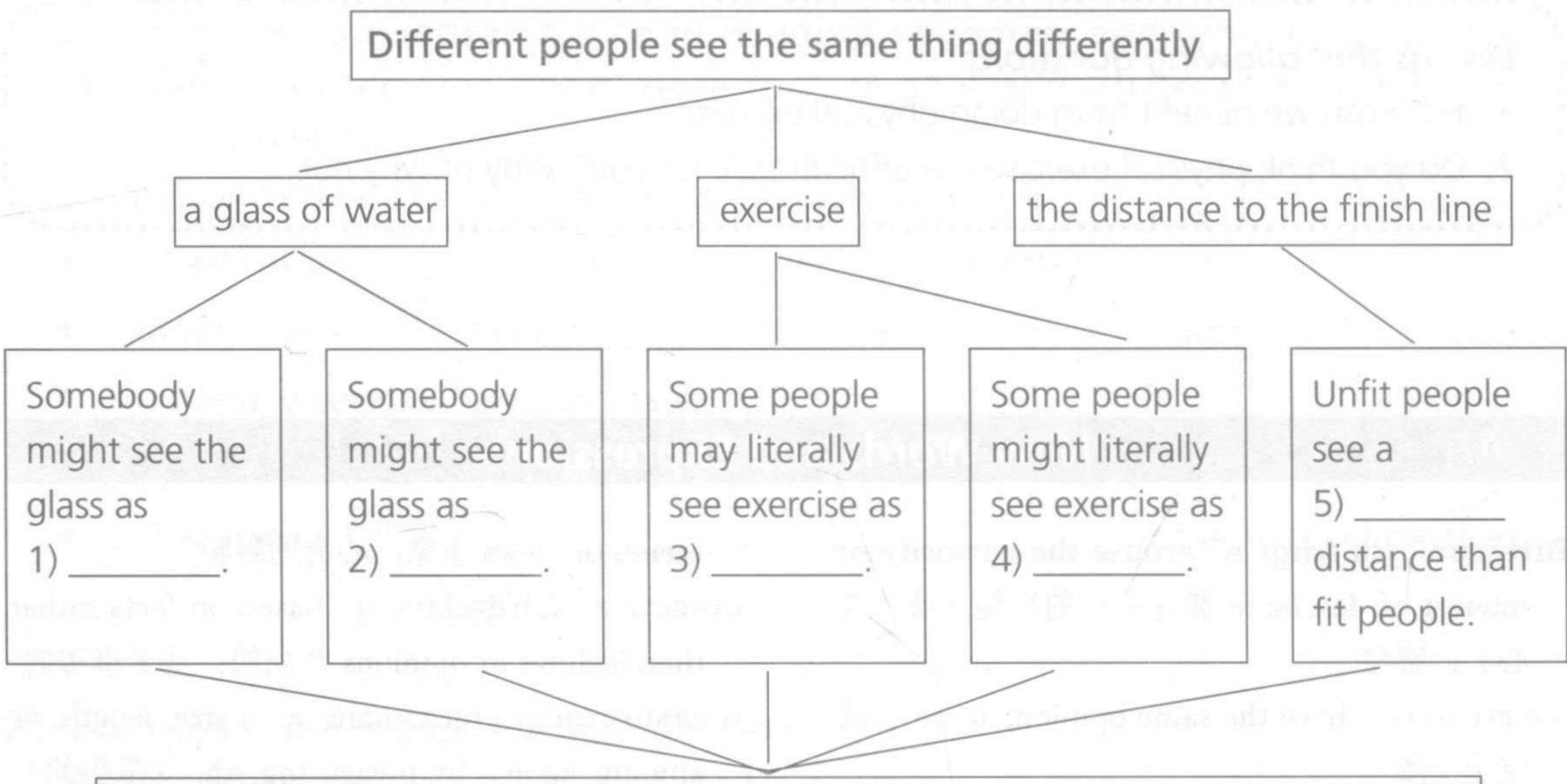
Conclusion: 6) _____ work together to change how we see the world.
- Watch again and decide whether the following statements are true (T) or false (F).
☐ 1) The speaker and her research team wanted to study the problem of people's health and fitness.
☐ 2) The speaker holds that our mind's eye might influence our way of seeing exercise.
☐ 3) A higher waist-to-hip ratio is an indicator of being more physically fit.
☐ 4) The states of people's bodies and minds can change how they see the environment.
Critical Thinking
Discuss the following questions.
- If there is a glass of water that is filled halfway, do you see the glass as half full or half empty?
Can you learn anything from this?
- If you want to lose weight, will you be determined to achieve your goal? If you failed, what might be the reasons?
Part III SPEAKING
If the introduction of a presentation helps the audience get acquainted with you and what you are going to talk about, the main body is the "real" presentation, which shows the content of your subject that you have carefully prepared beforehand. In this unit, you are going to learn how to present the main body in a clear way.
Presenting the main body
The time you are allowed to do the presentation determines how much information can be included in the main body. Usually the time is limited, so you need to restrict the content that you want to convey — only presenting the important and relevant points. Then you organize these points in a coherent and logical sequence, like the writing of a text. In the process of delivering, you have to use “signposting language” to signal to the audience what you are doing or what you are going to do. This kind of language may sound redundant (多余的) in a text, but in oral presentation it is quite necessary and useful.
• Organizing different parts
There are several common patterns to organize different parts of the main body: the chronological (按时间顺序的) order, the spatial (空间的) sequence, the classifying pattern, the comparing-contrasting pattern, the problem-solution pattern, the cause-effect pattern and the advantage-disadvantage pattern, etc.
Information can be organized in the chronological order according to the sequence when it happened or will happen. The earliest event will be illustrated first, then the following ones. This organizational pattern is suitable to describe the history or development of something like a theory, a technology or a fashion.
Information can also be arranged in the spatial sequence according to its physical position. This type of pattern is used to describe different places (e.g. cities or countries) or different steps in a process of making or doing something.
The classifying pattern is effective in organizing the information that can be classified into several groups. Each distinctive category constitutes one part of the main body.
The comparing-contrasting pattern organizes information on the basis of how things are similar to or different from each other. It is especially helpful when the audience are familiar with one topic, then through comparison or contrast, they can easily understand the other topic.
The problem-solution pattern places the subject, i.e. a certain problem, in the first part; after that will be the solution(s), i.e. the means to deal with the problem. It is useful for drawing people's attention to some social problems and call for their action to solve them. It may also be persuasive when you want to advocate (主张) your plan in a business presentation.
The cause-effect pattern arranges the topics in the sequence of causes first and effects second or the other way round too. The presenter will initially state the reasons why something takes place, then he / she will go on to illustrate the consequence it may lead to. Such pattern makes clear the inner relationship between various factors.
The advantage-disadvantage pattern organizes information according to the pros and cons of a subject. It is effective to give audience an objective demonstration of both sides of a topic, hence helping them develop an unbiased view.
Note that if you are going to present a complicated topic, you may combine various patterns to arrange information in the main body of the presentation.
Using signaling language when necessary
In an oral presentation, it is essential for the presenter to use signaling language to explicitly tell the audience what he / she is going to do, e.g. "I'd like to talk about ... first.", "Let's look at this picture." Thus, listeners can easily follow the presenter and pay attention to the subsequent part. Such language is often called "signposting language". The use of signaling language is a defining feature of presentations. No matter which organizational pattern you adopt in the main body of your presentation, you will need to start a new point, move from one point to another and refer to slides. On these occasions, you may use the following signaling language to guide your audience.
Introducing a new point:
Now let's talk about the first problem / reason / effect / advantage ...
In this part of my presentation, I want to focus on ...
Let's start by looking at ...
Turning to another point:
Let's move on / turn to another solution / cause / place / drawback
Now that we've discussed ..., I'd like to talk about...
The next point I want to consider is...
There is another example / reason ...
This brings us to another point...
Referring to a slide or the information on the slide:
Let's look at this slide.
As we can see from the slide ...
Having a look at this picture / graph / chart ..., we can find ...
As shown in the picture / table / box ...
1. Work with your partner. Decide which pattern (a–g) in the box you can use to organize the main body if you are going to give a presentation on topics 1–7
a) chronological order
b) spatial sequence
c) classifying pattern
d) comparing-contrasting pattern
e) problem-solution pattern
f) cause-effect pattern
- How to Cope with Air Pollution
g) advantage-disadvantage pattern
- The Development of the Internet
- Chinese Higher Education vs. British Higher Education
- Should We Keep a Pet?
- The Urban Planning of 10 Cities
- Types of Processed Foods
- Addiction to Our Smart Phones
2. Complete the following body of a presentation with the expressions in the box. The topic of this presentation is "A Comparison of Gym and Outdoor Exercise". You may need to capitalize the first letter of some expressions when filling in the blanks
as we can see here
take a look
in the graph
these are the findings of
let's move on
this brings us to the next point
I'd like to start by talking about doing exercise in the gym. 1) _____ at this slide. As shown 2) _____ , gym members, on average, do six hours more exercise a week than non-members. 3) _____ a recent study: gym members tend to have "lower heart rates, smaller waists and higher levels of cardiovascular fitness". So it is doubtless that gym exercise greatly enhances people's health. Then how about doing exercise outdoors? Does it have similar positive effects on people? 4) _____: outdoor exercise. 5) _____ to the next slide. According to another research, outdoor activity has different health benefits. 6) _____ (the presenter pointing to the slide): it can "boost vitamin D levels, reduce tension and depression, and make you feel more refreshed and positive about life".
3. Give a short presentation with the information on the two slides below. Use the following guidelines to help your presentation:
● Think of reasons and examples for each point on the slides.
Use signaling language to guide the audience.
Be a confident presenter and avoid undesirable manners.
- Benefits of Cycling
• Easy and cheap
Environment-friendly
Health benefits
— Keeping fit
— Lowering cancer risks
— Reducing heart diseases
Slide 1
- Risks of Cycling
• Exposure to polluted air
• Dangers on the road
- Over-cycling injuries
Part IV WRITING
Plagiarism is the act of using another person's words or ideas without acknowledging the source. It is a serious academic offence and may lead to unfavorable consequences like failing an assignment or a course, or even being expelled from university. Therefore, it is of vital importance to credit the source of ideas or work that you have referred to in your writing. Doing so will not only help avoid plagiarism, but also add support to your argument. The use of others' words or ideas is called citation, while the mentioning of the source information is known as referencing. Citation and referencing are the defining characteristics of academic writing. There are different conventions of referencing formats, which will be introduced in Unit 8. In this unit, we will focus on how to cite someone else's ideas or work.
Avoiding plagiarism (I)
In academic writing, it is inevitable to use information from books, journal articles (期刊论文), websites, etc. For instance, you may reinforce your point of view by citing other scholars' research findings as evidence. Or you want to defend your opinion by comparing it with the ideas of others. Generally speaking, there are three approaches to citing the work or ideas from another person, i.e. quoting, paraphrasing and summarizing.
• Quoting
Quoting is to repeat another person's words in exactly the same way and put them in quotation marks (引号). In fact, direct quotations should not be used too often since it does not require much cognitive work: you simply collect what others have said and do not incorporate (融入) your own understanding. Only quote when necessary, such as in the following situations:
➢ when there is memorable or striking language in the original text;
➢ when you could not find better words to restate the idea;
➢ when citing words from an authority can add weight to your point.
Paraphrasing(重述;改述)
In contrast to direct quoting, paraphrasing is an indirect way to present someone else's ideas by using your own words. The skill of paraphrasing is valued more highly by scholars because it demands the ability to fully understand the cited information, extract (提取) the core idea and synthesize (整合) it into your own writing. In other words, paraphrasing does not mean just changing the original words with synonyms or rearranging sentence structures, although the paraphrased sentence has the different form from the original one. Sometimes you may find if you focus your effort on changing the vocabulary or grammatical structure of the original
sentence, you only develop the technique to "hide" the sentence instead of incorporating the information into your own thought and your particular writing style. So what makes a good paraphrase? There are three most important guidelines:
keeping the same meaning;
➢ using your own words and style;
showing your understanding.
• Summarizing
Summarizing, like paraphrasing, is an indirect citing of others' work or ideas that requires your own words and understanding. Their chief distinction is that summarizing is used to present the main points of a long text, such as one or several paragraphs of an essay or even an entire article, while paraphrasing always involves a shorter text, like a sentence or a short paragraph, and emphasizes a particular point. A good summary should be concise and capture all the key information, hence it puts high demands on the writer's capability to extract main ideas from the source and put them into a logical order.
Useful language: reporting verbs
Reporting verbs are the verbs used to report on other people's work or opinions, which are crucial for a successful citation. There are a variety of reporting verbs for you to choose from, but their usage and meanings may differ. Some verbs express the neutral stance (立场) of the writer on the cited words, such as say, define, describe, while other verbs show the writer's favor or disagreement of an idea, e.g. demonstrate, claim, allege (声称). The following box displays a collection of frequently used reporting verbs in academic writing:
| acknowledge | admit | allege | argue | assert |
| believe | conclude | consider | criticize | define |
| demonstrate | discover | discuss | emphasize | explain |
| explore | express | identify | illustrate | indicate |
| maintain | mention | outline | propose | regard |
| reveal | say | show | state | suggest |
- If you want to cite the following information from an article or a book, which form of citation would you use, $ \underline{\text{quoting, paraphrasing or summarizing}} $? Discuss your reasons with your partner.
- Outdoor activity can boost your vitamin D levels, reduce tension and depression, and make you feel more refreshed and positive about life — especially if you run through a forest.
- Gym is the best place to exercise.
- Physical activity is one of the most important things we all can and should do to keep our body in healthy shape. By physical activity it doesn't only mean the vigorous weight lifting, running, aerobics, martial arts, games and sports, but also the modest thing such as jogging, walking, and swimming. There are many health conditions that don't require a pill to be swallowed every day on a routine basis but a tiny amount of time invested in physical activities is worth it. It is always anticipated that the more active we are, the more we will benefit. Physical activities are beneficial for both mental and physical health. It has also been considered as a tool for boosting social life. (Para. 4, Reading 1)
- Regularly engaging in sports activities seems to be an effective remedy for reducing symptoms of depression. It is also cost-effective and has very few side effects. However, it still has to be examined whether and above all to which extent sport and physical activity can be a complement or even an alternative to medication for slight depressions.
- Use your own words to paraphrase the following sentences. Try to keep the original meaning and exhibit your own understanding.
Example:
Physical activity has been associated with an increased life expectancy in adults ... (Para. 2, Reading 1)
→ Doing exercise makes people live longer.
→ Doing exercise makes people live longer.
- Sometimes people feel they need to set aside hours to feel the benefits of exercise.
- Study after study has shown that incentives can help you stick to your exercise plans.
- Moderate exercise is now recommended even for women who did not exercise before becoming pregnant.
- Regularly engaging in sports activities seems to be an effective remedy for reducing symptoms of depression.
- Write a summary for Para. 2 in Reading 1 "Children Need Physical Education More than Ever". Use the following guidelines to help your writing.
- First, figure out the main idea of this paragraph. Identifying the topic sentence may be helpful.
- Then rewrite the idea in your own words, using reporting verbs if possible, e.g. The writer argues that children should do more exercise.
The benefits of physical activity are vast. Physical activity has been associated with an increased life expectancy in adults so its importance is obvious, but its value in children sometimes needs to be justified. It is never too early to start teaching a child positive behaviors and habits; however, in middle childhood (ages 6–10) children tend to be in a stage of development where they are most likely to be taught healthy eating habits, develop exercise programs and have an interest in organized sports. Young people will carry established healthy behaviors throughout their lives such as better eating habits, but very few will actually fit exercise into their daily routines. (Para. 2, Reading 1)
一