Unit 2 Social Networks
social photos profile search groups network media e friends community
Lead-in
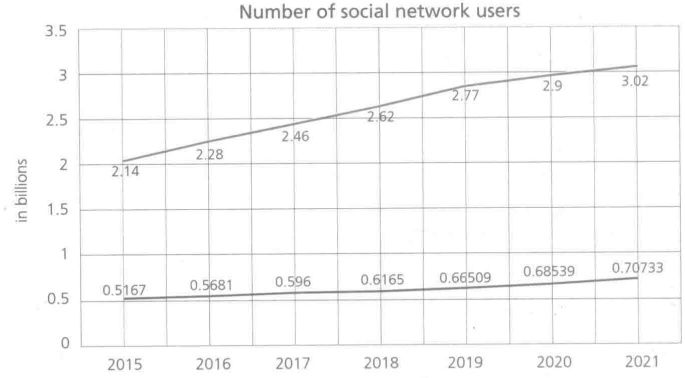
- Look at the graph below about the number of social network users. Then answer the following questions.
- What do the figures on the vertical axis (纵坐标) represent?
- What period of time does the graph cover?
- What overall trends does the graph show?
- Why do you think people use social networks? Do they often use a computer or a mobile phone for social networking?
- Do you know some popular social networks in China and in the world?
Reading 1
The More Time That Children Chat on Social Media, the Less Happy They Feel
Before Reading
Discuss the following questions.
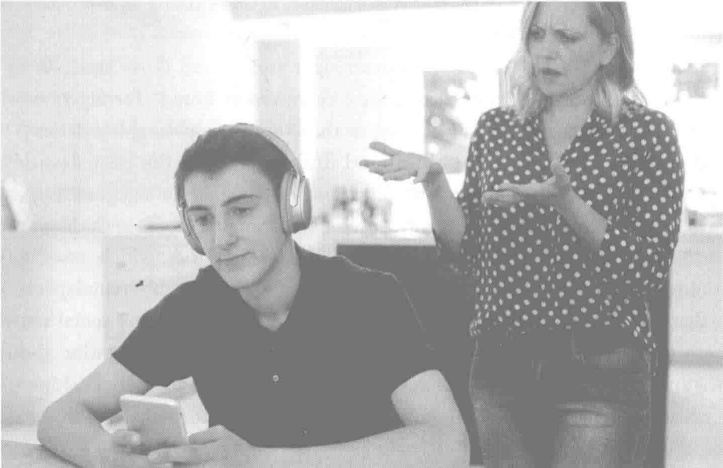
- Do you spend a lot of time on social media like WeChat each day?
- Do you think social media adds happiness to your life?
The More Time That Children Chat on Social Media, the Less Happy They Feel
Jamie Doward
1 Perhaps Facebook should carry a health warning. A study has revealed that the children who spend more time on online social networks feel less happy in almost all aspects of their lives.
2 The research by a team of economists at the University of Sheffield, to be presented at this week's Royal Economic Society annual conference in Bristol, shows that the more time children spend chatting on Facebook, Snapchat, WhatsApp and Instagram, the less happy they feel about their school work, the school they attend, their appearance, their family and their life overall. However, they do feel happier about their friendships.
3 Economists found that spending just one hour a day on social networks reduces
the probability of a child being completely happy with his or her life overall by around 14%. They found that this was three times as high as the estimated adverse effect on well-being of being in a single-parent household — and larger than the effect of playing truant.
4 The findings are likely to stoke the debate about the upsides and downsides of social media.
5 More than 90% of 16- to 24-year-olds use online social networks and while most sites stipulate a minimum user age of 13, few apply any checks. A BBC survey found that more than three-quarters of 10- to 12-year-olds have social media accounts. A report by the media watchdog Ofcom found that more than half of children aged as young as three and four use a tablet while one in seven has their own device.
6 The amount of time that children between eight and 11 and those aged 12–15 spend online has more than doubled in a decade, the Ofcom report found. Teenagers now spend nearly three and a half more hours a week online than they do watching television.
7 Social networking has altered childhood dramatically in the past decade and is becoming a concern for politicians and organizations responsible for safeguarding children. The NSPCC cited social media as a major cause of the dramatic increase in the numbers of children admitted to hospital after self-harming. The new research, which asked 4,000 10- to 15-year-olds to rate from one to seven how happy they were with different aspects of their lives, reveals that girls are more adversely affected than boys, as online social networking makes them feel less happy about specific areas of their life, in particular about their appearance and the school they attend. Boys were less happy with their friendships.
8 The research suggests that going online makes children more likely to make negative social comparisons with others.
9 “The problem with making comparisons in online media is that people tend to portray themselves in an idealized state,” said Philip Powell, one of the economists who conducted the research. “There is evidence that people think other people are happier than them after interacting with them online because we tend to post videos and chat that present this positive image.”
10 Powell and his team split the data so that they could compare the effects of going online on children with low and high self-esteem. Unsurprisingly, perhaps, they found the effects were worse for those who lacked confidence.
11 Powell said cyberbullying could be another explanation for links between unhappiness and children's use of social media. "There's evidence the longer young people spend online the more likely they are to be victims of bullying," he said.
12 However, the economists were surprised to find nothing to support the popular theory that time spent on social networks had an adverse effect on children because it left them less time to do other, potentially more rewarding, activities.
13 “Our findings show that social media use can be detrimental on average to young people and this is consistent with a number of findings in previous studies,” Powell said. “We can’t say any social media is bad but we can say that the more social media children use, the higher the likelihood that they will be dissatisfied with different domains of their life and their life overall.”
New Words and Expressions
economist $ ^{\text{®}} $ /ɪˈkɒnəmɪst/ n. a person who studies or writes about economics 经济学家;经济专家 adverse $ ^{*} $ /ˈædvɜːs/ a. negative and unpleasant; not likely to produce a good result 不利的;有害的;反面的
play truant /'truːənt/ stay away from school without permission 旷课;逃学
stoke /stəʊk/ v. make (sth.) increase or develop more quickly 煽起;激起
upside $ ^{*} $ /ʌpsaid/ n. the more positive aspect of a situation that is generally bad(糟糕局面的)积极的一面;正面
downside $ ^{*} $ /ˈdaʊnsaɪd/ n. the disadvantage or less positive aspect of sth. 缺点;不利方面
stipulate $ ^{*} $ /'stipjulert/ v. state clearly and firmly that sth. must be done, or how it must be done规定;明确要求
account /əˈkaʊnt/ n. an arrangement in which a person uses the Internet or e-mail services of a particular company(互联网、电子邮件等的)账户;账号
watchdog $ ^{*} $ /'wɒtʃdɒg/ n. a person or group of people whose job is to check that companies are not doing anything illegal or ignoring people's rights 监察人;监察团体
tablet $ ^{*} $ /'tæblit/ n. a flat, rectangular computing device that is used for connecting to the Internet, watching videos, reading books, etc. 平板电脑
safeguard $ ^{*} $ /'seɪfɡɑːd/ v. protect sth. / sb. from loss, harm or damage; keep sth. / sb. safe 保护; 保障
self-harm /'self'hɑːm/ v. 进行自我伤害
adversely $ ^{*} $ /'ædvɜːsli/ ad. negatively and unpleasantly; harmfully 不利地;有害地
in particular especially or particularly 特别;尤其
portray*/po:treɪ/ v. describe or show sb. / sth. in
a particular way, esp. when this does not give a
complete or accurate impression of what they
are like 将……描绘成;给人以某种印象;表现
idealized /aɪˈdɪəlaɪzd/ a. imagined or represented as being perfect, ignoring any imperfections that exist or may exist in reality 理想化的
post /pəʊst/ v. put information or pictures on a website(在网站上)发布(信息或图片)
self-esteem $ ^{*} $ /ˌselfɪˈstiːm/ n. a feeling of having respect for one's own character and abilities 自尊(心)
unsurprisingly /ʌnsəˈpraɪzɪŋli/ ad. not surprisingly; as one expected 不令人吃惊地;意料之中地
cyberbullying $ ^{*} $ /ˈsaɪbəbʊlɪŋ/ n: 网络欺凌
bullying $ ^{*} $ /ˈbʊlɪŋ/ n. behavior that frightens or hurts someone weaker by making threats or insults or by using force 欺凌;霸凌
potentially /pəʊˈtenʃəli/ ad. possibly true in the future, but not true now 潜在地
domain $ ^{A} $ /dəʊ'meɪn/ n. an area of knowledge or activity, esp. one that sb. is responsible for 领域;范围;范畴
Proper Names
Jamie Doward /'dʒeɪmɪ 'daʊəd/ 杰米·道尔德
Facebook /ˈfeɪsbʊk/ 脸书(美国社交网站)
the University of Sheffield /ˈsɛfiːld/ 谢菲尔德大学(英国)
Bristol/bristol/布里斯托尔(英国英格兰西南部港市)
Snapchat /'snæptʃæt/ 色拉布(美国“阅后即焚”照片分享应用)
WhatsApp / wotsæp/ 瓦次普(美国即时通讯应用)
BBC British Broadcasting Corporation 英国广播公司
Ofcom /'pfkəm/ Office of Communications 通信管理局(英国)
NSPCC National Society for the Prevention of Cruelty to Children 全国防止虐待儿童协会(英国)
Philip Powell / filip.pauel/ 菲利普·鲍威尔
Global Reading
- Skim the text and answer the question.
With regard to children's health, is the author's attitude towards social media positive, negative or neutral?
2. Skim the text and complete the summary
The text discusses the impact of 1) _____ on children and the author's argument is that children will feel 2) _____ if they 3) _____ . In order to support that argument, the author cites 4) _____ from a study, and quotations from 5) _____ , one of the scientists engaged in the research.
Close Reading
- Statistics are cited in an academic text as evidence to support the author's argument in a paragraph. In the table below, write down the specific argument that the listed statistics support.
| Para. | Statistics | The argument supported |
| 3 | ● one hour a day; around 14%● three times | 1) _____2) _____3) _____4) _____ |
| 5 | ● more than 90% of 16- to 24-year-olds; more than three-quarters of 10- to 12-year-olds● more than half of children; one in seven | 5) _____6) _____ |
| 6 | ● more than doubled; nearly three and a half more hours a week | 6) _____ |
| 7 | ● 4,000 10- to 15-year-olds | 6) _____ |
- Circle the correct information to complete the following statements.
- According to the research, boys / girls feel more negatively affected by online social networking.
- The research concludes that online social comparisons result in more / less confidence among children.
- Usually people post things online that represent the positive / negative part of their lives.
- Overall, online social networking affects low-esteem children / high-esteem children more.
- Another source of unhappiness with online social media is bullying / financial problems.
- There is / is not a close relationship between more time spent on social networks and less time spent on other more rewarding activities.
Critical Thinking
Discuss the following questions.
- Do you agree that the more people chat on social media, the less happy they feel? Explain your answer with reasons and / or examples.
- Do you think the author may have worried too much?
Language Enhancement
- Using appropriate synonyms may help you paraphrase ideas, avoid repetition and add variety to your writing. Write down as many synonyms as possible of the underlined words in the sentences. The first one has been given as an example.
| Sentence | Synonyms |
|---|---|
| 1) Many fear that budget cuts will have an $ \underline{\text{adverse}} $ effect on education. | damaging; negative; bad; unfavorable; unpleasant; unhelpful; harmful; undesirable; detrimental |
| 2) The $ \underline{\text{upside}} $ of moving would be a shorter commute to work. | |
| 3) The $ \underline{\text{downside}} $ of the camera is that the batteries have to be replaced often. | |
| 4) This one small event $ \underline{\text{altered}} $ the course of history. | |
| 5) You need to $ \underline{\text{safeguard}} $ your computer against viruses. | |
| 6) Heavy rains, in the central valley $ \underline{\text{in particular}} $, have driven up the price of vegetables. | |
| 7) The lawyer $ \underline{\text{portrayed}} $ his client as a victim of child abuse. | |
| 8) The movie portrays an $ \underline{\text{idealized}} $ version of middle-class life. | |
| 9) No $ \underline{\text{previous}} $ experience is necessary for the job. | |
| 10) Childcare is no longer solely a female $ \underline{\text{domain}} $. |
- Study the word building skill in the box and work on the tasks below.
Word Building Skill — Blending(缩合法)
Blending is the word formation process in which a new word is formed by using the parts or the full form of two words and combining their meanings. There are four types of blending according to their morphological (形态的) structures.
The front part of the first word + the back part of the second word: "brunch" (breakfast + lunch) (早午餐)
The first word + the back part of the second word: "workfare" (work + welfare) (工作福利)
The front part of the first word + the second word: “Eurasian” (European + Asian) (欧亚的;欧亚混血的)
The front part of the first word + the front part of the second word: “satcom” (satellite + communications) (卫星通信). Sometimes this type of blending can be recognized as clipping (see Unit 1), but generally if the new formed word takes a simple word stress in its pronunciation, it is blending.
A. Write down the structure of the blending words (blends) in the following table. Then translate them into Chinese. The first one has been done as an example. Consult the dictionary where necessary.
| Blend | Structure | Chinese meaning |
| 1) smog | smoke + fog | 雾霾 |
| 2) motel | ||
| 3) Chinglish | ||
| 4) hazmat | ||
| 5) telethon | ||
| 6) webinar | ||
| 7) edutainment | ||
| 8) biorhythm | ||
| 9) psywar | ||
| 10) bookmobile |
B. Complete the sentences with the blends in Step A. Change the form where necessary
- Donations raised during the four-hour _____ will go to the Ministry of Civil Affairs, the Red Cross Society of China and the China Charity Federation, according to the director.
- It is necessary to check the time length and major topic of your ___, because you are inviting participants from other countries and different time zones.
- Interrogation (审讯) is a type of _____ between the police questioners and criminal suspects.
- The biological clock is also called ___. It ties up with people's minds, and controls people's behavior.
- A(n) _____ accident can cause great destruction to society and this kind of accident is usually associated with criminal and terrorist activities.
- If teachers purposefully and flexibly apply the concept of _____ to classrooms, it will increase the fun of teaching, cover the shortage of textbooks, and have a better effect on learning.
- Study the translating skill in the box and work on the task below.
Translating Skill — Choosing the predicate (谓语) (I): collocating with the subject and the object
Besides reproducing the meaning of its Chinese equivalent, the predicate verb in the English sentence should also collocate with the subject and the object, if there is one. It should be borne in mind that sometimes the literal translation of an acceptable collocation in Chinese may not make sense in English.
Source text: 这一证书 $ \underline{\text{课程}} $分在三年中学完。
Translation: This certificate $ \underline{\text{course}} $ will be spread over three years. (not "This certificate course will finish learning / studying ...")
Source text: 这件事告诉我们,他为人不诚实。
Translation: This $ \underline{\text{incident}} $ showed that he was dishonest. (not "This incident told us ..." ) Source text: 秦朝第一位皇帝秦始皇于公元前221年统一 $ \underline{\text{六国}} $。
Translation: Qin Shihuang, the first emperor in the Qin Dynasty, conquered $ \underline{\text{the other six states}} $ in 221 BC. (or "unified the nation", not "unified the other six states")
Source text: 从这次讲座中,我们学到了许多美国历史方面的 $ \underline{\text{知识}} $。
Translation: We obtained / gained / got a lot of $ \underline{\text{knowledge}} $ of American history from the lecture. (not "learned / studied much knowledge ..." )
Translate into English the following paragraph, choosing the predicate verb of each sentence carefully.
手机是一项伟大的发明,但手机似乎也给我们的日常生活造成了一些麻烦。会议室门口通常贴着一条公告:请与会者关闭手机。可是,会议室里手机铃声仍然响成一片。我们都是普通人,并没有多少特别重要的事情,但我们也不会轻易关掉手机。打开手机象征着我们与这个世界的联系。手机在某种程度上反映出我们的“社交饥渴症”(thirst for socialization)。
Translation:
二
Reading 2
Screen Time Guidelines Need to Be Built on Evidence, Not Hype
Before Reading
The letter “Screen-based lifestyle harms children’s health” was published by The Guardian on December 25, 2016, signed by 40 people — writers, psychologists, and charity leaders. Read the letter and answer the questions below.
Screen-based lifestyle harms children's health
A decade ago our first multiple-signatory (多人签名的) “toxic childhood” press letter described how children’s health and well-being were being undermined by the decline of outdoor play, increasingly screen-based lifestyles, a hyper-competitive schooling system and the unremitting (持续的) commercialisation of childhood.
Despite widespread public concern, subsequent policymaking has been half-hearted, short-termist (短视的) and disjointedly (不连贯的) ineffective. The above factors continue to affect children adversely ... Physical health problems like obesity continue to escalate (逐步上升), and mental health problems among children and young people are approaching crisis levels. As well as the intense distress caused to families, there are obviously longer-term social and economic consequences for society as a whole.
If children are to develop the self-regulation and emotional resilience (弹性) required to thrive in modern technological culture, they need unhurried engagement with caring adults and plenty of self-directed outdoor play, especially during their early years (0-7). We therefore urge the government to take immediate action, including:
The development of a coherent, well-funded approach to care and education from pre-birth to age seven, including a kindergarten stage for three- to seven-year-olds emphasising social and emotional development and outdoor play.
- National guidelines on screen-based technology for children up to the age of 12, produced by recognised authorities in child health and development.
Without concerted (协同一致的) action, our children's physical and mental health will continue to deteriorate, with long-term results for UK society that are frankly unthinkable.
- What problems do these people worry about?
- According to this letter, what do children need in order to succeed in the modern technological society?
- What is the purpose of this letter?
- What do you think of the two suggestions in italics (斜体)? Give reasons for your answer.
Screen Time Guidelines Need to Be Built on Evidence, Not Hype $ ^{1} $
1 Moral panic about the impact of new technologies on our behavior and development is not new. Socrates railed against the dangers of writing for fear that it would nurture “forgetfulness in the learners’ souls, because they will not use their memories.” One source of contemporary anxiety is “screen time”. Recently, a letter signed by a group of writers, psychologists and charity heads raised concerns that childhood health and well-being in the UK is declining, in part due to “increasingly screen-based lifestyles”. The signatories argued that the policy response to these concerns, first raised over a decade ago, has been half-hearted and ineffective.
2 As a group of scientists from different countries and academic fields with research expertise and experience in screen time, child development and evidence-based policy, we are deeply concerned by the underlying message of this letter. In our opinion, we need quality research and evidence to support these claims and inform any policy discussion. While we agree that the well-being of children is a crucial
issue and that the impact of screen-based lifestyles demands serious investigation, the message that many parents will hear is that screens are inherently harmful. This is simply not supported by solid research and evidence. Furthermore, the concept of “screen time” itself is simplistic and arguably meaningless, and the focus on the amount of screen use is unhelpful. There is little evidence looking at the impact of the context of screen use, and the content that children encounter when using digital technologies — factors that may have a much greater impact than sheer quantity alone.
3 If the government were to implement guidelines on screen-based technology at this point, as the authors of the letter suggest, this would be on the basis of little to no evidence. This risks the implementation of unnecessary, ineffective or even potentially harmful policies. For guidelines to have a meaningful impact, they need to be grounded in robust research evidence and acknowledge that children's health and well-being is a complex issue affected by many other factors, such as socioeconomic status, relational poverty, and family environment – all of which are likely to be more relevant for children's health and well-being than screens. For example, there is no consistent evidence that more screen time leads to less outdoor play; if anything, the evidence indicates that screen time and physical outdoor activity are unrelated, and reductions in average time spent in outdoor play over time seem to be driven by other factors. Policy efforts to increase outdoor play that focus on screen time are therefore likely to be ineffective.
4 Any simplistic approach to issues facing childhood health and well-being is inappropriate, and a focus on screen time is not evidence-based. Divisive and disturbing rhetoric that takes a casual approach to evidence is unhelpful at best and, in our opinion, damaging. Digital technologies are part of our children's lives, necessarily so in the 21st century. We agree that further research is necessary, and urge the government and research funding bodies to invest in this, so that clear policy and better guidelines for parents can be built on evidence, not hyperbole and opinion.
(516 words)
New Words and Expressions
guideline $ ^{\textregistered} $/gaidlan/ n. a rule or an instruction that is given by an official organization explaining how to do sth., esp. sth. difficult 指导原则;准则
hype /haɪp/ n. talk or writing that is intended to make people excited about or interested in sth. or sb. 天花乱坠的广告宣传;炒作
rail /reɪl/ against complain about sth. / sb. in a
very angry way 怒斥;责骂;抱怨
for fear that because of anxiety about; in case that 由于担心……;因为怕……
forgetfulness /fəˈgetfʊlns/ n. the condition of tending to forget things 健忘;遗忘
in part to some degree; partly 在某种程度上;部分地
signatory /'signətəri/ n. a person, a country or an
organization that has signed an official agreement(协议的)签署者;签署方;签署国
half-hearted /'hɑːfˈhɑːtɪd/ a. done without enthusiasm or effort 不热心的;不尽力的;冷淡的
ineffective /ˌɪnɪˈfektɪv/ a. not resulting in or able to produce good or intended effects 未能产生预期效果的;不起作用的
expertise $ ^{\star\textcircled{A}} $/eksp3:tiz/ n. expert knowledge or skill in a particular subject, activity or job 专门知识;专门技能;专长
claim / kleɪm/ n. a statement that sth. is true or real, esp. one that other people may disagree with 声称;(尤指他人可能反对的)主张;断言
crucial $ ^{®} $ /'kruːʃəl/ a. extremely or very important 决定性的;至关重要的
investigation $ ^{①} $/m.vesti'geiʃən/ n. a scientific or academic examination of the facts of a subject or problem 科学研究;学术研究
solid /'spɒlɪd/ a. that one can rely on; having a strong basis 可靠的;可信赖的;坚实的
simplistic $ ^{*} $/sim'plistik/ a. making a problem, situation, etc. seem less difficult or complicated than it really is(把问题、局面等)过分简单化的
arguably /'ɑːɡjuːəblɪ/ ad. used to say that a statement is very possibly true even if it is not certainly true 可论证地;可能;大概
context $ ^{®} $/kontekst/ n. the surrounding conditions in which sth. takes place (事情发生的)场合;环境;周围情况
encounter $ ^{®} $/in'kauntə(r)/ v. meet sb., or discover or experience sth., esp. sb. / sth. new, unusual or unexpected 偶然碰到;意外地遇见
sheer /ʃɪə(r)/ a. pure; unmixed with anything else; nothing but 全然的;纯粹的
ground/graund/ v. provide a basis or reason for (sth.) 使(论点等)基于……;以……为依据
robust $ ^{*} $ /rəʊˈbʌst/ a. successful or forceful and not likely to fail or weaken 坚实的;强有力的
relational /rɪˈleɪʃənəl/ a. existing or considered in relation to sth. else 有关的;相关的
relevant $ ^{A} $/'relævent/ a. directly connected with the subject 有关的;切题的
if anything used to make a statement that strongly disagrees or contrasts with a preceding statement 甚至正相反;甚至还不如说
inappropriate $ ^{①} $/ˌɪnəˈprəʊpriət/ a. not suitable; not appropriate 不适合的;不恰当的
divisive /dɪˈvaɪsɪv/ a. causing people to be split into groups that disagree with or oppose each other 造成不和的;引起分歧的;制造分裂的
rhetoric $ ^{\triangle} $/'retərɪk/ n. speech or writing that is intended to influence people, but that is not completely honest or sincere 华而不实的言语;花言巧语
at best in the most favorable conditions or according to the most favorable judgment 在最有利的情况下;据最好的估计
necessarily /'nesisərli/ ad. in a way that is necessary and cannot be avoided 必然地;不可避免地
funding $ ^{①} $ /ˈfʌndɪŋ/ n. money provided, esp. by an organization or government, for a particular purpose; the act of providing money for such a purpose(提供)基金;(提供)资金
hyperbole /haɪˈpɜːbəli/ n. language that describes sth. as better or worse than it really is 夸张
Global Reading
- Study the reading skill in the box and answer the questions below.
Reading Skill — Identifying the structure of an academic text (I): introduction and conclusion
An academic text is generally a three-part essay: introduction, main body and conclusion.
The introduction always includes an explanation of the situation as well as the aim of the essay or the author's position. This first part in the academic text shows that the author has already understood the topic and that he / she will discuss it fully in this text.
The conclusion is a summary of the main ideas of the text together with a restatement of the author's position. This last part in the text is not to provide any new information, but to give an overall conclusion of what has been mentioned.
- What does the first paragraph of the text introduce? Is the authors' position clearly presented?
- Does the last paragraph summarize the main ideas of the text and restate their position?
2. Study the reading skill in the box and work on the tasks below
Reading Skill — Identifying the structure of an academic text (II): main body
The main body is the main part of an academic text. It consists of a number of paragraphs / sections that support the author's position / argument presented in the introduction and repeated in the conclusion. Usually one paragraph / section has just one main idea which is supported by analysis, evidence or examples.
To understand the main body is to identify the main idea in every paragraph / section. You may need to distinguish the main idea from the supporting evidence (see also "Recognizing the topic sentence and supporting evidence" in Unit 3, Book 1).
A. Read the main idea statements (1–6) below. Then skim the text and write the paragraph number (1–4) next to the statement. Note that there are two extra statements
Para.____ 1) The current worries are similar to some ancient ones.
Para.____ 2) Policies need to be made to address the latest concerns.
Para.____ 3) All good policies should be based on thorough research and study.
Para.____ 4) Some concepts need to be clarified before we claim screen time is affecting children.
Para.____ 5) The government should invest in research into the impact of too much screen time.
Para.____ 6) A number of factors have to be taken into consideration when we study children's well-being.
B. Answer the question
Do the main ideas in the main body support the authors' position?
Close Reading
- Answer the following questions.
- What is the claim made in the letter mentioned in Para. 1?
- According to the authors, what is needed before a claim is made and a new policy created?
- Do the authors agree that screens are inherently harmful to children's health? Give reasons.
- What is the authors' attitude towards the term "screen time"?
- What is more important than the quantity of screen time?
2. Choose words from the text to complete the summary
Policies concerning children's health and well-being
Before any policy is released, we must first have 1) _____.
Meanwhile, children's health and well-being must be understood as a 2) _____.
matter that depends on a range of factors.
The policy to reduce screen time and increase outdoor playtime will be 3) _____ because of two reasons. First, there is not any 4) _____ supporting the opinion that more time spent on screens means less time spent outdoors. Secondly, it seems that less time spent outdoors is caused by 5) _____ rather than screen time.
Critical Thinking
Read the following three statements taken from the text. Write
✓ if you agree,
x if you disagree, or
? if you are not sure.
Think of an example or reason for your answer.
( ) 1. Screen time and physical outdoor activity are unrelated.
( ) 2. Digital technologies are part of our children's lives, necessarily so in the 21st century.
( ) 3. Context and content may be more important factors than time alone when it comes to technology use during childhood.
- The underlined words in the sentences are often used in daily conversations and hence are not formal. Replace them with the more formal ones in the box, which are more appropriate in academic contexts.
| approach | arguably | context | crucial | encounter |
| expertise | guidelines | implementing | inappropriate | ineffective |
| investigations | nurture | reduction | robust | solid |
- There are strict $ \underline{\text{rules}} $ regulating the use of chemicals in food, yet some producers neglect them in order to gain more profits.
- As a record company director, his business is to $ \underline{\text{develop}} $ young talent.
- All the staff opposed the new technique — it is $ \underline{\text{useless}} $ at best and at worst dangerous.
- This scientist claims that he has found a new $ \underline{\text{method}} $ to treat cancer.
- They offer guidance on how to tap into the $ \underline{\text{expert knowledge and skills}} $ of local colleges and universities.
- Creativity is more important than technical skills in $ \underline{\text{carrying out}} $ this innovative program.
- The minister advocated a $ \underline{drop} $ in military spending at the conference.
- Signing this contract with the other party is $ \underline{key} $ to the future of our company.
- In most cases it is the parents who get blamed for their children's $ \underline{\text{unsuitable}} $ behavior.
- The report should be considered within its social $ \underline{\text{setting}} $.
- In different stages of our life, we $ \underline{meet} $ different kinds of problems.
- His writing combines $ \underline{\text{strong}} $ evidence with facts and statistics.
- The formerly $ \underline{\text{strong}} $ economy has begun to weaken.
- Although first written in 1951, this description of the content and impacts of constitutions is $ \underline{\text{possibly}} $ still the best.
- The findings were the outcome of a large amount of scientific $ \underline{\text{studies}} $ done over three years.
2. Study the word building skill in the box and work on the tasks below
Word Building Skill — Acronymy (首字母缩略法)
An acronym is a word formed as an abbreviation from the initial components in a phrase or a word, e.g. "TOEFL" (Test of English as a Foreign Language) and "kg" (kilogram). There are two types of acronyms according to pronunciation and morphological structures.
- acronyms which are pronounced as a sequence of letters, also called alphabetisms (字母法)
The letters represent full words: "UN" (the United Nations)
The letters represent elements in a compound or just parts of a word: "TV" (television)
- acronyms which are pronounced as a word, e.g. "UNESCO" [juːˈneskəʊ] (the United Nations Educational, Scientific and Cultural Organization) (联合国教科文组织)
A. Write down the full compounds of the acronyms in the following table. Then translate them into Chinese. The first one has been done as an example. Consult the dictionary where necessary
| Acronym | Compound | Chinese meaning |
| 1) BBC | British Broadcasting Corporation | 英国广播公司 |
| 2) NATO | ||
| 3) WHO | ||
| 4) Radar | ||
| 5) SUV |
| 6) CEO | ||
| 7) ATM | ||
| 8) IELTS | ||
| 9) GRE | ||
| 10) MBA |
B. There are some frequently used acronyms in correspondences (信函) or e-mails in the following table. Write down the full compounds of the acronyms. Then translate them into Chinese. The first one has been done as an example. Consult the dictionary where necessary.
| Acronym | Compound | Chinese meaning |
| 1) CC | carbon copy | 抄送 |
| 2) FYI | ||
| 3) C/O | ||
| 4) PS | ||
| 5) AKA | ||
| 6) BTW | ||
| 7) FAQ | ||
| 8) ASAP |
3. Study the translating skill in the box and work on the task below
Translating Skill — Choosing the predicate (II): tense and subject-verb agreement
Chinese is an uninflected (无屈折变化的) language and conveys meaning through word order, adverbs or shared understanding of the context. The concept of time in Chinese is not handled through the use of different tenses and verb forms. By contrast, in English much information is carried by the use of auxiliaries (助动词) and by verb inflections (屈折变化): is / are / were, eat / eats / ate / eaten, etc. When translating from Chinese into English, we need to choose the right tense for the verb according to the context.
Source text: 他做实验时心不在焉,几乎引起化学药品爆炸。
Translation: His absent-mindedness during the experiments nearly caused an explosion of the chemical.
Source text: 高科技领域的一个突破,带动一批产业的发展。
Translation: One breakthrough in the high-tech field promotes / will promote the growth of several industries.
We also need to see to it that the predicate verb in the English sentence agrees with the subject both in person and number.
Source text: 这种例子她的书里有很多。
Translation 1: $ \underline{\text{Examples}} $ of this abound in her book.
Translation 2: Her $ \underline{\text{book}} $ abounds with examples of this.
Translate into English the following paragraph, paying attention to the verb tenses and the subject-verb agreement.
微博(microblog)就相当于是中国的推特(Twitter)。在汉语里,“微博”的发音像是“围脖”,写一条微博通常称为“织围脖”。微博可以写任何内容,从批判性的评论到情绪和感受的表达均可。微博博主(microblogger)会有一群粉丝去浏览他们的网页并给予相应评论。许多微博博主认为,这种新媒体已经在许多方面改变了他们的生活。用户发现,和传统媒体相比,微博让获取信息和交友更加容易。此外,只要愿意,人们可以随时随地记录自己的想法。
Translation:
$ \begin{array}{l}\hline \\ \\ \hline \\ \hline \\ \hline \\ \hline \\ \hline \\ \hline \\ \hline \\ \end{array} $
Part II LISTENING AND VIEWING
Listening:
The Rise of the Emoji
Before Listening
Discuss the following questions.
- What do you know about emojis?
- Are there any problems with emoji communication?
New Words and Expressions
emoji /ɪˈməʊdʒi/ n. 表情符号
thumbs-up /θʌmzʌp/ n. (表示赞成或满意的)翘拇指
non-verbal /nɒnˈvɜːbəl/ a. not involving words or speech 不使用言语的;非言语的
pictorial/pik'tɔriəl/ a. using or containing pictures 用图片的
Listening Comprehension
Study the listening skill in the box and work on the tasks below.
Listening Skill — Note-taking (V): Cornell notes (康奈尔笔记法)
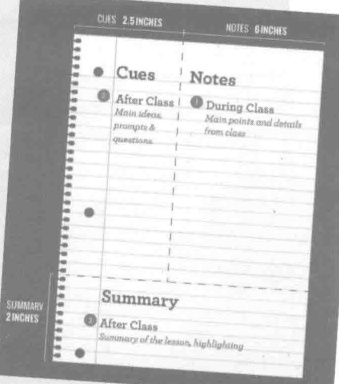
The Cornell notes system is a note-taking system devised in the 1950s by Walter Pauk, an education professor at Cornell University. To make a Cornell note, you can divide a page into three sections: one for notes, one for cues, and one for a summary. To be more specific, you write important information or main ideas in the Notes section; then write key words or some questions in the Cues section, which is for your future reviews; finally, summarize each page of notes in the Summary section, which helps to increase understanding of the topic.
The Cornell notes system is effective in promoting students' ability of synthesizing (综合;结合) and evaluating. See the picture sample of the Cornell notes for a better understanding.
- Listen to a report about emojis. Then fill in the blanks of the following Cornell notes. In the Notes section, you should write down the exact words you have heard. In the Cues and Summary sections, you can complete them with your own words.
| Cues: Main idea: 10) _____ Question: 11) _____ _____ _____ | Notes: I. Emoji — a vital tool for communication: We like to express 1) _____ when sending a message; using them as a quick way of telling someone 2) _____ II. Origin: first invented in Japan in 3) _____ ; from the Japanese words for 4) _____ and 5) _____ III. Why addicted: enable us to express our 6) _____ much more 7) _____ ; be easily interpreted whatever 8) _____ ; sometimes 9) _____ |
| Summary: 12) _____ | |
- Listen again and decide whether the following statements are true (T) or false (F).
- Emojis not only show our feelings swiftly but also make the screen of mobile phones livelier.
☐ 2) The number of emojis now is not sufficient for our mood or various situations.
☐ 3) We can substitute (替换) the visual signals in a face-to-face communication with emojis in mobile phones.
☐ 4) An emoji of a hammer doesn't always show anger.
Viewing: Connected, But Alone?
Before Viewing
Discuss the following questions.
- Do you think people have mobile phone addiction nowadays?
- Do you think communication on social networks is more effective than face-to-face communication?
New Words and Expressions
plugged-in /'plʌgədɪn/ a. 接通的;联通的
corporate $ ^{*} $ /ˈkɔːpərət/ a. connected with a corporation 公司的
board/bɔːd/ n. (公司或其他机构的)董事会;委员会;理事会
deny $ ^{①} $/di'nai/ v. say that sth. is not true 否认;否定
shot /ʃɒt/ n. a photograph 照片
define $ ^{\textregistered} $/dr'fam/ v. describe or show sth. accurately 明确;界定
isolated $ ^{A} $/'ais $ \underline{\text{a}} $leitid/ a. without much contact with other people 孤独的
isolation $ ^{*} $ $ ^{①} $ /ˌaɪsəˈleɪʃən/ n. the state of being alone or lonely 孤独
cultivate /ˈkʌltɪveɪt/ v. improve or develop (sth.) by careful attention, training, or study 培养
capacity $ ^{①} $ /kəˈpæsəti/ n. the ability to understand or to do sth. 理解(或办事)能力
solitude $ ^{\triangle} $ /'sɒlɪtjuːd/ n. the state of being alone, esp. when feeling pleasant 独处;独居
sacred $ ^{*} $ /'seɪkrɪd/ a. considered to be holy 神圣的
reclaim $ ^{*} $ /rɪˈkleɪm/ v. get back (sth. that was lost or taken away) 取回;拿回
stumble $ ^{*} $ /'stʌmbl/ v. make mistakes and stop while speaking (不顺畅地)说
Viewing Comprehension
Study the listening skill in the box and work on the tasks below.
Listening Skill — Note-taking (VI): charting notes (制图笔记法)
The charting note-taking method uses columns to organize information. This method is useful for lessons that cover a lot of facts or relationships between topics. Therefore, facts should be well organized and easy to review. You can divide the page into columns labeled by the category or categories, and the details of each category are filled out in the rows below. When information about a category is mentioned, you write it down under the proper column. When the next topic begins, you move down one row and begin again. See the picture sample of the charting notes for a better understanding.

- As is shown in the following charting notes, the speaker indicates three aspects of the change in communication. Watch the video clip and fill in the blanks with the exact words you have heard.
Main topic: Change of communication
Part 1: Impacts of mobile devices
A. Little powerful devices don't only change 1) ___; they change 2) ___.
B. People text, email or shop during corporate 3)____, 4)____, 5)____, actually during all meetings.
C. Children complain about not having parents' 6) _____, and deny each other the same thing.
Part 2: Causes of the problem
A. The best description:
- _____
B. If we don't have connection, we don't
- ___;
we almost don't
- ___.
Part 3: Solution
A. By solitude, you find yourself, reach out to other people, and form 10)____.
B. At home: Create sacred spaces in the kitchen, 11) ____ ____ and reclaim them for 12) ____ ____
C. $ \underline{\text{At}} $ work: Listen to each other, including to the 13) _____.
- Watch again and choose the correct answer to each of the following questions.
- What does the speaker imply by “I share therefore I am”?
a) We are very good at using technology to define ourselves.
b) We can define ourselves by sharing our thoughts and feelings.
c) We should not hide our thoughts and feelings.
- Why do people become isolated even though they are busy connecting with each other in reality?
a) Because they are not able to have real communication with others.
b) Because they are not able to find themselves and gather themselves.
c) Because they are not able to have their family's full attention.
- At the end of the speech, why does the speaker suggest that we should listen to each other?
a) Because we used to hesitate to talk to each other.
b) Because we should be aware of the danger of solitude.
c) Because it is the time when we reveal ourselves to each other.
Critical Thinking
Discuss the following questions.
- What are the disadvantages of social media?
- What do you think of the Moments (朋友圈) in WeChat?
Part III SPEAKING
In a seminar discussion, you may be asked to introduce the material that you have read beforehand, because one of the important purposes of a seminar discussion is to enrich students' understanding of one or more texts. After each student introduces the text that he / she has read, all the participants can start a discussion to consider multiple perspectives and alternative interpretations of the texts. Therefore, the skill of giving an oral summary of a text is crucial. Moreover, after the oral summary, you need to evaluate the reading briefly to shed light on the relationship between your reading and the topic under discussion. Sometimes you may also need to summarize what other participants have said and add your own response. In this unit, you will learn how to give an oral summary and evaluation in a seminar discussion.
Seminar discussions (II): giving an oral summary and evaluation
When giving an oral summary of a text, first mention the name of the author(s) and the general topic. If there are any technical terms that might be new or unfamiliar to the audience, clarify them from the start. For example, if the general topic of a text is "e-Sports" — a newly developed form of competition facilitated by electronic systems, particularly video games, then you'd better define it at the beginning. Secondly, identify the specific focus of the text. Does the text focus on the impact of e-Sports, or its future development or any other aspect? Finally, summarize the main ideas / results of the text in a few sentences in your own words, as clearly and concisely as possible.
When summarizing other participants' ideas, you can adopt a similar approach:
Mention the name of the speaker and the general topic.
Identify the focus of his/her speech.
Summarize his / her main ideas clearly and concisely.
Your evaluation of a text usually comes after the oral summary. It may include your comments on the following aspects:
How are the ideas in the text relevant to the discussion question / topic?
Do you agree or disagree with these ideas? Why and to what extent?
To what extent are the ideas and evidence in the text reliable?
If you are going to respond to and evaluate other participants' opinions, you should follow a similar pattern. But note that since the person being evaluated is probably sitting next to you, you need to pay more attention to the politeness of speaking, especially when you want to give negative comments.
Some useful language patterns for giving an oral summary and evaluation are listed as follows:
In their article on (the general topic), (authors' names) present their research into...
(author's name) focuses on ..., and further discusses ...
Research findings / results indicate that...
(The author's / speaker's) opinions can be summarized in the following words...
I tend to / generally agree with (the author's / speaker's) ideas because ...
To a certain extent / Partially / Largely / Mostly, the evidence provided is reliable for the reason that ...
(A certain idea or result) can be questioned / disputed / criticized since ...
Work in groups. Suppose you are going to participate in a seminar discussion on the question: How does social media influence its young users?
- Read the following text and give an oral summary of it.
Social websites harm children's brains: Chilling warning to parents from top neuroscientist David Derbyshire
Social networking websites are causing alarming changes in the brains of young users, an eminent (著名的) scientist has warned. Sites such as Facebook, Twitter and Bebo are said to shorten attention spans, encourage instant gratification (满足) and make young people more self-centered.
The claims from neuroscientist Susan Greenfield will make disturbing reading for the millions whose social lives depend on logging on to their favorite websites each day. But they will strike a chord (引起共鸣) with parents and teachers who complain that many youngsters lack the ability to communicate or concentrate away from their screens.
More than 150 million use Facebook to keep in touch with friends, share photographs and videos and post regular updates of their movements and thoughts. A further six million have signed up to Twitter, the “micro blogging” service that lets users circulate text messages about themselves.
But while the sites are popular — and extremely profitable — a growing number of psychologists and neuroscientists believe they may be doing more harm than good. Baroness Greenfield, an Oxford University neuroscientist and director of the Royal Institution, believes repeated exposure could effectively “rewire” the brain. Computer games and fast-paced TV shows were also a factor, she said. “My fear is that these technologies are infantilizing (使幼儿化) the brain into the state of small children who are attracted by buzzing noises and bright lights, who have a small attention span and who live for the moment.” A teacher of 30 years had told Lady Greenfield that she had noticed a sharp decline in the ability of her pupils to understand others.
Psychologists have also argued that digital technology is changing the way we think. They point out that students no longer need to plan essays before starting to write — thanks to word processors they can edit as they go along. Satellite navigation systems have negated the need to decipher (破译) maps. A study by the Broadcaster Audience Research Board found teenagers now spend seven-and-a-half hours a day in front of a screen. Sue Palmer, author of Toxic Childhood, said: "We are seeing children's brain development damaged because they don't engage in the activity they have engaged in for millennia (数千年). I'm not against technology and computers. But before they start social networking, they need to learn to make real relationships with people."
- Give your evaluation of the text you read in Task 1, based on the following questions.
- How are the ideas in the text relevant to the discussion question?
- Do you agree or disagree with these ideas? Why and to what extent?
- To what extent are the ideas and evidence in the text reliable?
- Follow the same steps in Tasks 1 and 2 and give an oral summary and evaluation of Reading 1 "The More Time That Children Chat on Social Media, the Less Happy They Feel".
- Discuss the question with your classmates. You may include ideas from the text in Task 1 and Reading 1 or other sources, but remember to formulate your own opinion.
Part IV WRITING
The process of writing an academic essay is never fast or smooth. After making enough preparation in the stages of planning and researching, a writer will start his / her writing and rewriting stages, which sometimes could be discouraging or irritating because it is almost impossible to finish writing a good essay in one go. Instead, you need to keep drafting and revising many times. No wonder experienced writers would agree that "There is no writing; there is only rewriting." In this unit, you will learn about the writing processes of while-writing (drafting) and post-writing (revising).
Writing process (II): drafting and revising
Drafting refers to the writing of initial versions of your essay, which are often rough and messy. Then you have to revise these drafts to produce a final essay which is well-organized and well-developed, avoiding language errors and conforming to academic conventions.
Drafting
During the pre-writing stage you have worked out an outline that contains the title, the thesis statement and sub-ideas. You also should have taken notes from relevant sources when doing research. The notes are usually in the form of quotations, paraphrases, summaries and your personal comments, accompanied with the source information (i.e. author's name, title, publication information, etc.). Then based on the outline and notes, you can begin your first draft.
First, you should draft according to the framework set up in the outline, starting from the introduction, then the body paragraphs and finally the conclusion. But sometimes you may go back and forth to add a sentence, change an idea or substitute several words. Do not be discouraged when you find you are doing so, because a key feature of drafting should be its messiness. If you are writing on a piece of paper, you can clearly see traces of scribbling and alteration (涂改) which are made in order to find suitable ways to express yourself.
Second, you should add the relevant notes in the different parts of your draft and use the appropriate format of in-text referencing. Wait until the final draft to complete the end-text references as you may add or cross out certain citations in the process of rewriting. However, bear in mind that a good essay is not just a collection of other writers' words and opinions, but instead, it requires you to develop others' ideas so as to formulate your own opinions or use evidence to support your arguments.
Revising
Revision can be regarded as the most important stage in the process of academic writing. But students who do not want to reread their drafts often neglect it. Only by rereading the draft repeatedly and thoroughly can you find problems or errors and then improve them. It is suggested that you should draft and revise your writing at least three times. Generally speaking, revise your draft on four levels, namely, the text, paragraphs, sentences and words.
The text-level revision looks at the organization of the whole text. Check the following points and revise if there is any problem:
Is the whole text consistent with the thesis?
Is the text organized in a logical way, e.g. following a chronological pattern, a cause-effect pattern, a problem-solution pattern, etc.?
Does the text have all the required sections, including the title, the introduction, the main body, the conclusion and the reference list?
The paragraph-level revision mainly focuses on the content and structure of each paragraph. Check the following points and revise if there is any problem:
Does the introductory paragraph contain a general description / explanation of the topic as well as a thesis statement?
Is there a topic sentence in each body paragraph?
Do other sentences (except the concluding sentence) in a body paragraph support the topic sentence?
Does the concluding paragraph contain a summary of the main idea and sub-ideas, a brief discussion of the significance / limitation, and recommendations / further questions?
The revision of both sentences and words includes the aspects of variety, accuracy and appropriateness. For the variety of sentence use, you need to produce a mix of long and short sentences with different structures (such as simple, compound or subordinate structures). The sentences should be grammatically correct and their patterns have to be appropriately chosen. For instance, if the focus of the sentence is the agent (动作执行者), use the active voice; if the focus is the action, use the passive voice.
For the word-level revision, you may begin by replacing the words or phrases that are overly repeated with synonyms. But make sure that words used are appropriate in style. Take a lot for example. This phrase is often used in colloquial language and it is not appropriate for academic writing. Then check the accuracy of the word usage in terms of agreement, tense, part of speech, etc.
Note that for academic writing, it is also important to revise both the in-text and end-text references. Check whether all the sources being cited have been referenced accurately.
- Read the following steps in the writing process. Decide which ones belong to prewriting, while writing and post-writing process respectively.
- Write the first draft.
- Narrow down the topic to a clear focus.
- Read a number of articles and papers.
- Critically read your draft to check the logic.
- Write the main body.
- Take notes of the relevant information.
- Proofread the language of the second draft.
- Check whether the thesis statement has been clearly presented.
- Write the reference list.
- Make a rough outline of your ideas.
Pre-writing process: ___
While-writing process: ___
Post-writing process: ___
- Read the following body paragraph of a student's first draft. Check: 1) Is there a topic sentence? If yes, underline it. 2) Do other sentences support the topic sentence? Then revise the paragraph by crossing out the irrelevant sentence(s).
Social networks provide many opportunities to connect with other individuals; however, it does not improve communication in individuals' real life. To begin with, some people are highly dependent on online societies, overlooking the significance of real connections. When they are having a family meal, each person is looking at their smartphones. Furthermore, people who rely on online contact too much are easier to become shy and introverted, or even suffer social anxiety disorder. It is obvious that the current society would not operate normally without modern communication. Finally, the success of connecting online can make us addicted to it. Many individuals cannot behave normally and be gratified in real life.
- Revise the following sentences, which are taken from students' drafts, in terms of variety, accuracy and appropriateness of the word use and sentence use.
- The Internet is a way for us to make our real life more easily. It can help us work quickly. It can help us stay in contact with others conveniently.
- Online make us closer, no matter how far we are from each other, we can receive other's message any time, which is very convenient.
___
- Whatever we connect by WeChat or just giving a face-to-face talk, we can't cover up the truth that the purpose of connecting is exchange information.
___
- Firstly, we can see clearly that people are enthusiastic about chat online but give a cold eye to communicating in reality, which lead to though everybody is sit together no one talks with each other.
- We should always bear in mind that communicate with others sincerely is the most important, online connection is subsidiary.
___