Unit 7 Forces of Nature
Forces of Nature

Lead-in
The following is a list of some special days officially assigned and observed annually all over the world.
Discuss the following questions.
- What are the aims of establishing the special days listed in the table? You may search the Internet for specific information. Write down your findings in the right column.
- Do you think that we humans have done a good job to protect nature?
| Special day | Date to observe | Aim |
| World Wetlands Day | February 2 | 1) to raise public awareness of wetland values and benefits |
| World Water Day | March 22 | 2) |
| World Meteorological (气象) Day | March 23 | 3) |
| Earth Day | April 22 | 4) |
| World Biodiversity Day | May 22 | 5) |
| World Environment Day | June 5 | 6) |
| World Day to Combat Desertification (荒漠化) and Drought | June 17 | 7) |
| International Day for the Preservation of the Ozone Layer | September 16 | 8) |
| World Animal Day | October 4 | 9) |
| World Food Day | October 16 | 10) |
Reading 1
Give the Earth an Inch ...
Before Reading
A proverb goes “Give someone an inch and he / she will take a mile”, which means “If you allow someone a little freedom or power, they will try to take more”.
Discuss in a group:
- What do you think “Give someone an inch and he / she will give you a mile” means?
- Could you finish the sentence that begins with “Give the Earth an inch ...”? Explain what you mean with the completed sentence.
Give the Earth an Inch ...
Germaine Greer
1 Once great wrongs are done, it's rarely possible to undo them. Earth, the most exuberant planet known to exist in the universe, carries great wounds upon its lovely face: bared hills; fertile farmlands being washed into the sea or turned to dust; treasure-houses of biodiversity destroyed; air, land, and water poisoned. It seems that nobody knows how to reverse any of it.
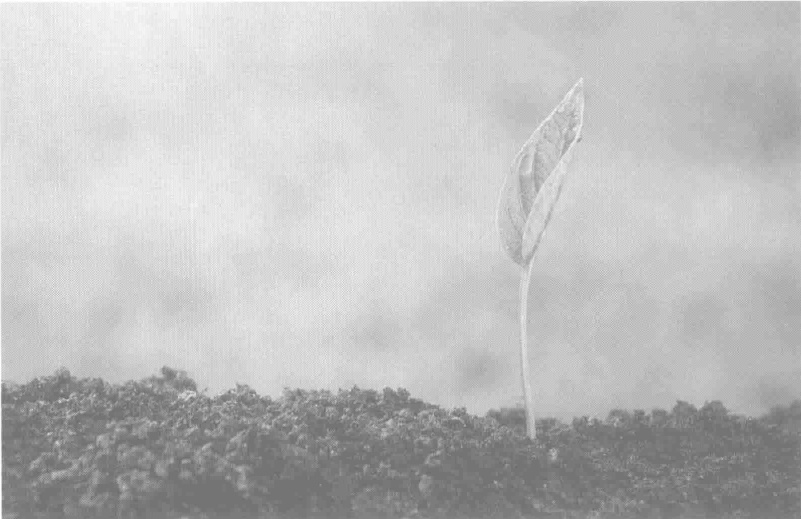
2 And yet, in the cracks between the pavement of the expanding cities, seedlings
of long-gone forest giants continue to emerge. Earth keeps on trying to renew itself, after radioactive leak, after nuclear explosion, after earthquake and eruption, after flood and tsunami. The planet's power of restoration is almost unbelievable. Give it an inch, and it will give you a mile.
3 Field flowers no longer grow amid the crops in England's fields, but once the backhoes are withdrawn from roadwork sites, poppies spring from the disturbed ground. The seed they have grown from blew off the fields maybe a generation ago and has lain in the soil ever since, waiting for someone or something to break the sod. Year after year, the poppies keep turning up, every time bringing their promise of rebirth.
The dead hedgehog on the road cannot be brought back to life, but creating habitats for hedgehogs will give other hedgehogs a better chance of breeding successfully so that numbers can build up again. In suburban gardens across England, people are making tunnels under their fences so that hedgehogs can travel without having to cross roads so often. It doesn't take much and costs nothing, but it puts the householder on the side of Earth, which is the hedgehogs' home as much as it is ours.
5 The swallows that have nested at my place in Essex ever since I have didn't turn up one year. Or the next. Ten springs passed, and I thought they couldn't possibly remember the barn where they had built their mud nests so many years before. I stopped scanning the sky for them. I was working in the greenhouse one day when I heard their call and ran out to see. They were flying in and out of the little entrance I had cut out of the barn door for them, for all the world as if they had never been away. And they have come back every year since. They, too, tell me that everything is not lost.
6 The lower orders, as we unjustly call them, have enormous potential for restoring themselves because they reproduce in huge numbers. A butterfly that this year seems extinct may turn up in clouds next year, given a different weather pattern. This is a massive reversal of fortunes, but the butterfly is born to it.
7 Insects are the geniuses of reversal because transformation is their specialty. They begin as earthbound larvae that do nothing but eat and are as likely to end up as winged creatures that seldom eat. Even the humble cockroach can have several transformational stages; rain forest cockroach nymphs can be spectacular. Even our exhausted honeybees might be capable of coming back from the brink if we improved their genetic diversity.
8 The further down we go, the more transformational the powers of the creatures we meet, until we arrive at the viruses that can change themselves faster than we can find ways of dealing with them. We imagine ourselves to be at war with such creatures, when they are our cousins and we need them on our side. If we colonize Mars, we will need to take some of them with us.
9 In 2001, I went back to my birthplace, Australia, to find a piece of land that I could fix. In the past hundred years, a patch of subtropical rain forest in southeast Queensland had been logged, burned, cleared, plowed, grazed, and sprayed with Agent Orange. Yet when I saw it, I knew that it could rebuild itself. All I had to do was to remove the obstacles that prevented its coming back into its own: the cattle and the invasive weeds, most of them garden escapees, and deliberately introduced pasture grasses.
10 There was enough seed in the crown of trees to revegetate much more than a mere 150 acres; most of it carried larval infestation, which meant that the pollinators
the trees required would gain rebirth along with them. No sooner did the numbers of fruiting trees build up than the bats turned up, a dozen species of them. The bird species multiplied, including some thought to be on the verge of extinction. And the population of these species exploded.
11 The reversal of the forest's devastation may seem slow; it has taken 14 years so far, but for at least five of those, my wonderful workforce and I were learning what to do (and what not to do). It has now gathered speed, and soon there will be nothing but maintenance left to do. The whole process has taken less than an instant of evolutionary time.
(827 words)
New Words and Expressions
undo /ˌʌnˈduː/ v. cancel the effect of (sth.) 消除;取消;使无效
exuberant /ɪgˈzjuːbərənt/ a. strong and healthy; growing quickly and well 繁茂的;茂盛的;茁壮的
bare /beə(r)/ v. remove the covering from (sth., esp. from part of the body) 使赤裸;使露出
fertile /'fɜːtail/ a. able to support the growth of many plants 肥沃的;富饶的
treasure-house n. a place that contains many valuable or interesting things 宝库;宝地
biodiversity /ˌbaɪəʊdərˈvɜːsəti/ n. the existence of a large number of different kinds of animals and plants which make a balanced environment 生物多样性
crack /kræk/ n. a very narrow space between two things or two parts of sth. 裂缝
seedling /'siːdlɪŋ/ n. a young plant that has grown from a seed 秧苗;籽苗;幼苗
radioactive $ ^{*} $ /,reidɪəʊˈæktɪv/ a. sending out harmful radiation caused when the nuclei (= central parts) of atoms are broken up 放射性的;有辐射的
eruption $ ^{*} $ /ɪˈrʌpʃən/ n. the act of throwing out rocks, ash, lava, etc., from the volcano (火山)喷发
tsunami /tsuˈnaːmi/ n. an extremely large wave in the sea caused, for example, by an earthquake 海啸
restoration $ ^{\star A} $/resta'reifən/ n. the act of returning sth. to its correct place or condition 复原;复位
backhoe /ˈbækhəʊ/ n. a large vehicle with machinery for digging, used in building roads, etc. 反铲;反铲挖土机
roadwork /ˈrəʊdwɜːk/ n. construction or repair work being carried out on a section of public road 道路施工
poppy /'popi/ n. a wild or garden plant, with a large delicate flower that is usually red and with small black seeds 罂粟
sod /sɒd/ n. a layer of earth with grass growing
on it 长草的土层
turn up reappear or be rediscovered after being lost or in an unknown place 出现;重现
rebirth /ˌriːˈbɜːθ/ n. a period of new life, growth or activity 新生;复活;复兴
hedgehog /'hed3hɒg/ n. 刺猬
habitat $ ^{\triangle} $ /ˈhæbɪtət/ n. the natural home of plant or animal (植物的)产地;(动物的)栖息地
suburban /səˈbɜːbən/ a. of, for, or in the suburbs 郊区的;市郊的
tunnel /'tʌnl/ n. a usu. man-made underground passage 隧道;地道
householder /'haus,heuldə(r)/ n. a person who owns or rents the house that he / she lives in 房主;住户
swallow /'swɒləʊ/ n. 燕子
barn /bɑːn/ n. a large farm building for storing grain or keeping animals in 谷仓;畜棚;仓房 lower orders 低等生物
unjustly /ʌnˈdʒʌstli/ ad. unfairly 不公平地;不公正地
enormous $ ^{a} $ /ɪˈnɔːməs/ a. extremely large; huge 巨大的;极大的
restore $ ^{(1)} $/ri'sto:(r)/v. bring (sb. / sth.) back to a former condition, place or position 使复原;使复位
reproduce /ˌriːprəˈdjuːs/ v. produce young 繁
殖;生育
extinct*/ik'stijnkt/ a. (of a kind of animal) no longer existing (动物)绝种的
reversal $ ^{®} $ /rɪˈvɜːrsəl/ n. a change to an opposite state, condition, decision, etc. 颠倒;彻底转变
genius /'dʒiːnjəs/ n. a person who is unusually intelligent, or who has a very high level of skill, esp. in one area 天才人物;(某领域的)天才
specialty $ ^{*} $ /'speʃəltɪ/ n. an area of study or business that a person specializes in or has special knowledge of 专业;专长
earthbound /'ɜːθbaʊnd/ a. unable to leave the surface of the earth (只在)陆地的;地面上的
larva /ˈlɑːvə/ n.(复数lavae /ˈlɑːviː/或lavas)an insect at the stage when it has just come out of an egg and looks like a short fat worm 幼虫;幼体
cockroach /ˈkɒkrəʊtʃ/ n. 蟑螂
transformational /ˌtrænsfəˈmeɪʃnəl/ a. 变形的;改变的
nymph/nimf/ n. a young insect that has a body form which compares with that of the adult 若虫(与成虫相似的昆虫幼体)
spectacular /spekˈtækjʊlə(r)/ a. unusually interesting or grand; very impressive 壮观的;引人入胜的
honeybee /'hʌnibiː/ n. a bee that makes honey
蜜蜂
brink $ ^{*} $ /brɪŋk/ n. a point that is very close to the occurrence of sth. very bad or (less commonly) very good 边缘;关头
at war with fighting against; competing with 同……不和;同……进行竞争
colonize $ ^{*} $ /'kɒlənaɪz/ v. create a colony in or on (a place) ; take control of (an area) and send people to live there 在……开拓殖民地;移(民)于殖民地
Mars/ma:z/n. 火星
patch /pætʃ/ n. a small piece of land — 小块土地
subtropical /ˌsʌbˈtrɒpɪkəl/ a. in or connected
with regions that are near tropical parts of the world 亚热带的;副热带的
$ \log /\log/v $. cut down trees in a forest for their wood 采伐(森林的)树木;伐木
plow /plau/ v. dig into or break up (dirt, soil, land, etc.) with a plow 犁;耕
graze $ ^{*} $ /greɪz/ v. put cows, sheep, etc. in a field so that they can eat the grass there 放牧;放牛;放羊
Agent Orange a poisonous chemical substance to destroy areas of tropical forest 橙剂;橙色落叶剂
invasive /ɪnˈveɪsɪv/ a. spreading very quickly and difficult to stop 侵入的;侵袭的
escapee /ɪˌskeɪˈpiː/ n. a person or an animal that has escaped from somewhere 逃亡者;脱逃的动物
pasture $ ^{*} $ /ˈpɑːstʃə(r)/ n. land covered with grass that is suitable for feeding animals on 牧场;牧草地
crown /kraʊn/ n. the upper part of a tree or bush, consisting of the leaves and branches 树冠
revegetate /riːˈvedʒɪteɪt/ v. provide barren land with new plant life (植物)再生长
larval /ˈlɑːvəl/ a. 幼虫的;幼体的
infestation /ˌɪnfesˈteɪʃən/ n. 寄生虫
pollinator /ˈpɒlnertə(r)/ n. 传粉昆虫;传粉媒介
multiply /'mʌltiplai/ v. greatly increase in number or amount (使)大大增加
on the verge of at the point when (sth.) is about to happen or is very likely to happen 濒于;接近于;行将
extinction $ ^{*} $ /ik'stɪŋkʃən/ n. a situation in which a plant, an animal, a way of life, etc. stops existing (植物、动物、生活方式等的)灭绝;绝种;消亡
devastation $ ^{\triangle} $ /devə'steɪʃən/ n. the action or state of being destroyed completely 蹂躏;破坏
Global Reading
- Skim Paras. 1–2 and choose the best answer to the following question.
Which of the following can be the thesis statement of the text?
a) The Earth can restore itself.
b) The Earth has been terribly wounded and has become ugly.
c) Nothing can be done to reverse what has been done to the Earth.
2. Scan Paras. 3–8 and answer the following question
What examples are provided to support the thesis?
- What has the author been trying to do in Australia?
- Skim Paras. 9–11 and answer the following questions.
- Does her effort show positive results?
- Why does the author include this personal experience in the text?
Close Reading
Reading Skill — Recognizing exemplification / illustration
Study the reading skill in the box and complete the notes below the box with more details of the examples given in the text.
Exemplification / illustration is a common technique used in academic texts. Exemplification means “giving examples” and illustration means “making ideas clearer by giving examples or by using diagrams or pictures”. Examples, diagrams or pictures are details to make general or abstract statements specific or concrete. In this way, the author's views or some abstract concepts can become clearer, and the text is kept from being overly vague.
Sometimes the text is a single extended example that gives a complete view of the subject. More often the author offers multiple examples for the same purpose.
Examples of the Earth restoring itself:
Field flowers such as 1) burst from the ground.
More hedgehogs will live if 2) _____ are created for them. Hedgehogs can cross roads safely if 3) _____ are provided.
• Swallows returned to the barn after an interval of 4) _____ years.
Butterflies may reappear when a different 5) ___ occurs.
• Cockroaches are great examples of reversal thanks to their ability of 6) ___.
Honeybees may return if their 7) is improved.
Viruses should not be taken as enemies but allies (盟友) to stand on our side.
My personal experience in restoring a piece of land:
Length of time: from 2001 to now
Nature of the land: a piece of subtropical rain forest
• Problems: the land had been 8) ___.
My work: preventing obstacles such as 9 ___.
● Improvements so far: Seed with larval infestation results in rebirth of 10) _____ in a large space, which attract 11) _____ and birds.
Critical Thinking
Read the following opinions and discuss to what extent you agree or disagree with them.
- The natural resources and services that the Earth provides are infinite.
- It is expensive to pay for the cost of the degradation of the Earth's wildlife and resources.
Language Enhancement
- The boldfaced words are either active words or academic words marked in Academic Word List (AWL).
A. Match the words in the left column with their synonyms in the right. Use the context of the word in the text to help you decide.
___ 1) rarely possible to undo them (Para. 1) a) r
___ 2) bared hills (Para. 1)
___ 3) in the cracks between the pavement (Para. 2)
___ 4) The planet's power of restoration (Para. 2)
___ 5) enormous potential (Para. 6)
___ 6) restoring themselves (Para. 6) f)
___ 7) reproduce in huge numbers (Para. 6) g) hug
___ 8) a massive reversal of fortunes (Para. 6) h) increase greatly
$ \underline{9} $ coming back from the brink (Para. 7) i) breed
___10) The bird species multiplied (Para. 10) j) a complete change
B. Complete the sentences with the boldfaced words from Step A. Change the form where necessary
- The _____ oil spill in Gulf of Mexico in 2010 was a disaster for the local people and sea animals.
- Many of the historic buildings in the old town have all been carefully _____ and are open to the public again.
- He said that combining the two teams would _____ their strength not just by two but several times over.
- You may use the "_____" command to reverse the last command or to delete the last entry that you typed.
- The investments in the Western banks mark a stunning _____ of fortunes that few would have predicted a year ago.
- Like most wildlife, deer _____, grow and store fat in the summer and fall when there is plenty of nutritious food available.
2. A preposition or adverb can be very useful in forming a collocation
A. Scan Reading 1 and fill in the blanks with the prepositions or adverbs used in the collocations
- … poppies spring _____ the disturbed ground. (Para. 3)
- The seed they have grown from blew _____ the fields ... (Para. 3)
- Year after year, the poppies keep turning ___, ... (Para. 3)
- The dead hedgehog ... cannot be brought _____ to life, ... (Para. 4)
- ... numbers can build _____ again. (Para. 4)
- … but it puts the householder _____ the side of Earth, … (Para. 4)
- We imagine ourselves to be at war _____ such creatures, ... (Para. 8)
- … some thought to be on the verge _____ extinction. (Para. 10)
B. Complete the sentences with the collocations from Step A. Change the form where necessary
- Talk to someone or a professional about your problems. Don't let your depression _____.
- He attempted to save the enterprise which was _____ collapse but failed.
- Even when they were _____ each other, they stopped the hostility, put anger aside and united to carry out this program.
- During the course of developing ecotourism (生态旅游), many non-ecological phenomena also _____.
3. Study the word building skill in the box and work on the tasks below
Word Building Skill — Hyponymy(下义关系)and hypernymy(上义关系)
Hyponymy is the relationship between specific and general lexical items. A hyponym (下义词) is a word or phrase whose semantic field (语义场) (see the following word building skill in this unit) is included in that of another word — its hypernym (上义词).
For example, "cat", "dog" and "horse" are all hyponyms of "animal". Here, the word "animal" is a general term, linguistically called a superordinate term (上义词); the words "cat", "dog" and "horse" are specific terms, called subordinate terms (下义词). Generally, hyponymy sees a hierarchical structure of semantic field, and can be usefully employed to make one's speech and writing more vivid and precise.
A. The hyponyms in the box are from Reading 1. Put each of them into the blank after the corresponding hypernym
| nuclear explosion | seedling | nymph | cockroach | radioactive leak |
| poppy | tsunami | earthquake | honeybee | grass |
| butterfly | flood | larva | weed |
- Insect: ___
- Plant: ___
- Disaster: ___
####### B. Hyponyms are not necessarily nouns. Other parts of speech can be hyponyms, too. The verb "destroy" has several hyponyms as shown in the box. Complete the sentences with these hyponyms. Change the form where necessary
extinguish eliminate take apart tear down destruct
- The city will _____ the building and construct a new theme park there.
- This diet claims to _____ toxins (毒素) from the body.
- The military spokesman announced over 1,500 missiles had been _____ this year.
- He _____ the clock _____, found what was wrong, and put the whole thing together again.
- News of the sudden bombing attack has _____ all hope of peace.
4. Study the translating skill in the box and work on the task below
Translating Skill — Translating figures of speech (I): literal translation
A figure of speech is figurative language in the form of a single word or phrase. It can be a special repetition, arrangement or omission of words with literal meaning, or a phrase with a specialized meaning not based on the literal meaning of the words. Figures of speech often provide emphasis, freshness of expression, or clarity.
In C-E translation, it is desirable to retain the figure of speech in a Chinese sentence, sometimes together with the addition of a translator's note.
Source text: 湖泊都由激流的瀑布连接,这一块块用银链和白绢串连起来的翡翠,各具特色,变幻无穷。
Translation: All lakes are connected by waterfalls. These pieces of jade strung on a silver cord are distinctive and constantly changing.
The implied comparisons (metaphor) of “lakes” to “pieces of jade” and “waterfalls” to a “silver cord” are reproduced in the translation.
Source text: 平遥素有龟城之称。
Translation: Pingyao has long been called "tortoise city", symbolizing its longevity.
A translator's note ("symbolizing its longevity") serves to help readers get a better understanding of the symbolic meaning of "tortoise".
Translate into English the following paragraph, paying attention to the translation of figures of speech.
我们生活的星球充满了无数不可思议的自然奇观。水,一种拥有无限力量的神奇物质,塑造和滋养着我们的星球。它不断变换着自己的形态,从一个地方到另一个地方。地球上淡水的循环都是从海洋开始,在大气中停留一段时间,直到以雨雪的形式降落大地。水聚成河,创造着辉煌的生命,是万物赖以生存的根基,与温度一起决定了地球上物种的分布。
Translation:
一
Reading 2
Does Salvaging Scorched Trees Hurt the Environment?
Before Reading
Discuss the following questions.
- What are the causes of forest fires / wildfires?
- What do people usually do with the burned land?
Does Salvaging Scorched Trees Hurt the Environment? Veronique Greenwood
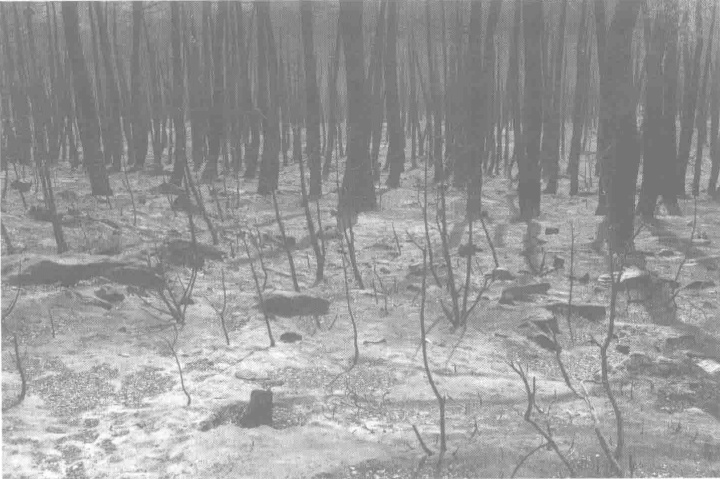
1 When a forest burns, the aftermath is a post-apocalyptic landscape of smoldering black trunks. The forest's managers, whether they work for the U.S. Forest Service or for private companies, sometimes send in heavy machinery to harvest the dead trees in a process called salvage logging, to turn them into boards or other products. The idea is that since the trees are already toast, the responsible thing is to get a little more value out of them before they start to rot, as well as to remove fuel for a future fire from the area.
2 But salvage logging can be controversial. It churns up the fire-damaged soil. It may introduce seeds from invasive species, carried by the machinery. And dead trees are habitats for woodpeckers and other wildlife. Does removing them hamper the long-term recovery of the forest? More than 10 years ago, researchers from the Forest Service's Pacific Southwest Research Station decided to take advantage of a fire in
the national forest near Mount Lassen, in Northern California, to study this question, and recently published their surprising results: At least on plant life, salvage logging did not have as much of an effect as one might expect.
3 At the beginning of the study, the researchers laid out 15 plots in the area burned by the Cone Fire, an accidental blaze that swept through the park's dry pines in 2002. They directed salvage logging efforts of varying intensity in some plots and left others untouched. Then, every two years, they returned to the plots to count the number of plants and plant species that had sprouted, keeping track of which were natives, which were invasive, and whether they were weedy plants or shrubs, among other factors. Interestingly, the weedy plants that grew over the years were the same whether the plot had been logged or left to its own devices. The disturbance of the machinery did not appear to affect what grew, and didn't seem to tip the scales to favor invasive species. Even cheat grass, an invasive legendary plant in the West for its aggressive spread and alarming flammability, showed up in similar amounts regardless of the plots' treatment.
4 They did find that native shrubs were a bit scarcer in the plots that had been heavily salvaged. That may be because the machinery came in a year after the fire, when buried seeds of these species, whose sprouting is triggered by fires, were putting up vulnerable young trees, says ecologist Eric Knapp, one of the study's two authors. But even that difference was not large.
5 It seems that the effects caused by the fire itself, which burned very intensely and destroyed all the trees and other vegetation in the plots, had more weight in how the ecosystem responded than the treatment that came after, Knapp says. This suggests that focusing attention on avoiding such a high-intensity fire altogether, perhaps through the use of smaller, controlled fires that keep the amount of fuel from building up, would have more of an impact than whether salvage happened or not. “If we would have been able to, say, do a prescribed burn, or thin and burn before, we could have prevented this wholesale conversion of the forest,” Knapp adds.
6 The study was an ideal version of salvage logging, with relatively flat land, rocky, harder-to-erode soil, and other characteristics that might have limited the damage, and the researchers caution against assuming that these results would apply everywhere. But over the last few years, other studies have started to show similar effects in very different forest environments, Knapp says. So decisions about whether to salvage log or not perhaps can be made on the basis of factors other than the recovery of the grasses and shrubs. (New trees, he notes, were very, very few. Unless they are planted, it will take a very long time for forest to return.)
7 Going forward, the timing of salvage logging – doing it as soon after the fire as possible – could help avoid damaging native shrubs that grow later, the researchers say. And in situations where less shrub cover is what forest managers want – if, for instance, they are planting seeds for new trees and don't want them to be overwhelmed – then salvage logging a year after the fact might even be helpful, a replacement for herbicide.
8 In general, Knapp says, apart from the practical implications, the study has given him a real appreciation for the resilience of native species. “Even after being burned at high severity and run over with heavy machinery, the plants still came back!” he says. “Years after the scars of salvage were no longer evident, it was actually quite beautiful out there with flowers of all different colors, bees buzzing, and birds singing. … Even if it doesn’t look great right after a fire or after logging, sometimes one might just need to wait a few years.”
(812 words)
New Words and Expressions
salvage $ ^{\Delta} $/sælvid3/ v. save (goods or property) from a damaged ship or from a fire, etc.(船舶失事、火灾等时)抢救 n. the act of saving sth. that is in danger of being completely destroyed 财产抢救
scorched /skɔːtʃt/ a. 烧焦的;烤焦的
aftermath $ ^{\triangle} $ /'ɑːftəmæθ/ n. the result or period following a bad event such as an accident, storm, war, etc.(不幸事件造成的)后果;余波
post-apocalyptic /pəʊstəˌpɒkəˈlɪptɪk/ a. 浩劫后的
landscape /ˈlændskeɪp/ n. an area of land that has a particular quality or appearance 地貌;景色
smolder $ ^{\triangle} $ / smøldø(r) / v. burn slowly without a flame(无火苗地)阴燃;闷燃
logging /'lɒɡɪŋ/ n. the work of cutting down trees for their wood 伐木作业
churn /tʃɜːn/ up stir or mix (sth.) with force 剧烈
搅动
woodpecker /'wud,pekə(r)/ n. 啄木鸟
hamper $ ^{\star} $ /ˈhæmpə(r)/ v. slow the movement, progress, or action of (sb. or sth.) 妨碍;阻碍
lay out arrange (sth.) in a particular pattern 规划;安排
plot /plot/ n. a small piece of land that is used or intended for a special purpose (专用的)小块土地
accidental /æksi'dentəl/ a. happening by chance;
not planned 意外的
blaze $ ^{*} $ /bleɪz/ n. a very large fire, esp. a dangerous one 烈火;火灾
varying $ ^{①} $/'veərɪŋ/ a. different; not all the same
不同的
intensity $ ^{\wedge} $ /ɪnˈtensəti/ n. the degree or amount of strength or force that sth. has 强度
weedy /'wiːdi/ a. full of unwanted wild plants 杂草丛生的
shrub $ ^{*} $ /ʃrʌb/ n. a large plant that is smaller than a tree and that has several stems of wood coming from the ground 灌木
disturbance $ ^{*} $/di'st3:bəns/ n. sth. that stops one from working, sleeping, etc.; the act of disturbing sb. or sth. 干扰;妨碍
tip the scales change a situation so that one person, group, etc., is more able or likely to succeed; give an advantage to sb. or sth. 使天平倾斜;扭转局面
cheat grass 旱雀麦;雀麦草
legendary $ ^{*} $ /'ledʒəndəri/ a. very famous or well known for a long time 闻名遐迩的;广为传闻的
alarming /əˈlɑːmɪŋ/ a. causing worry and fear; disturbing 使人惊恐的;使人不安的
flammability /ˌflæməˈbɪləti/ n. the state of being able to burn easily 易燃性
scarce /skeəs/ a. not enough and only available in small quantities 缺乏的;稀少的
vulnerable $ ^* $ /ˈvʌlnərəbl/ a. exposed to an attack or possible damage 易损的;易受伤害的
ecologist $ ^{*} $ /iːkɒlədʒɪst/ n. a scientist who studies ecology 生态学家
intensely $ ^{①} $ /ɪnˈtensli/ ad. in a way that is very great in degree or very strong 强烈地
vegetation $ ^{*} $ /vedʒɪˈteɪʃən/ n. plants in general, esp. the plants that are found in a particular area or environment(统称)植物;(尤指某地或环境的)植物群落;草木
weight n. the influence or power sb. or sth. has over other people or things 重要性;影响力
ecosystem $ ^{*} $ /'i:kəʊ,sɪstəm/ n. all the plants and living creatures in a particular area considered in relation to their physical environment 生态系统
prescribed /priːskraɪbd/ burn (为了管理森林而人为纵燃的)规划内预防火
thin v. make (sth.) or become less thick or fewer
(使)变稀疏;(使)变少
wholesale $ ^{*} $ /ˈhəʊlseɪl/ a. happening or done to a very large number of people or things 大规模的
conversion $ ^{\star} $ /kən'v3:ʃən/ n. the act or process of changing sth. from one form, use or system
to another 转变;转换;转化
ideal /aɪˈdɪəl/ a. perfect; most suitable 完美的;理想的
rocky /rɒkɪ/ a. made of rock; full of rocks 岩石的;多岩石的
erode $ ^{\triangle\textcircled{A}} $/iroud/ v. gradually destroy the surface of sth. through the action of wind, rain, etc. 侵蚀;腐蚀;风化
caution $ ^* $ /'kɔːʃən/ v. warn or tell (sb.) about a possible danger, problem, etc. 告诫;提醒
overwhelm /ˌəʊvəˈwelm/ v. cover over (sth.) completely 覆盖
replacement /rɪˈpleɪsmənt/ n. a thing that replaces sth., esp. because the first thing is old, broken, etc.
替代品:替换物
herbicide /ˈhɜːbisaɪd/ n. a chemical that is poisonous to plants, used to kill plants that are growing where they are not wanted 除莠剂;除草剂
apart from in addition to; as well as 除了……外(还);此外
implication $ ^{A} $ /ˌɪmplɪˈkeɪʃən/ n. sth. that is suggested without being said directly; sth. that is implied 含意;暗指
Proper Names
Veronique Greenwood /,verəˈniːkˈɡriːnwʊd/ 维罗妮卡·格林伍德
U.S. Forest Service 美国林务局
Forest Service's Pacific Southwest Research Station 美国林务局太平洋西南研究站
Mount Lassen /ˈlæsən/ 拉森峰(美国加利福尼亚州北部)
California /ˌkæliˈfɔːnjə/ 加利福尼亚州(美国)
the Cone /kəʊn/ Fire 火山火
Eric Knapp /ˈerɪk næp/ 埃里克·纳普
Global Reading
- Scan Paras. 1–2 and answer the following questions.
- What is "salvage logging"?
- Is salvage logging done for the good of the forest?
- What did the study by the Forest Service's Pacific Southwest Research Station find?
- Skim Paras. 6–8 and find information to support the following statements.
- The study of the Forest Service's Pacific Southwest Research Station is also supported by other evidence.
- When to do salvage logging is determined by specific purposes.
- Natural species are able to restore themselves if they are allowed enough time.
Close Reading
- Read the text to get the key information about the study.
Does removing dead trees hamper the long-term recovery of the forest?
Length of study: More than 10 years
Site being studied: 1) _____ plots of land in a national forest burned by 2) _____ in 2002
What was done in the study:
- having salvage logging of 3) _____ on some plots and leaving several others untouched
• counting every 2 years how many 4) _____ grow
recording them as natives or invasive, and as 5) ___
Findings:
- Logged or untouched, species of 6) _____ are the same.
• Invasive species don't increase in larger number.
Heavily salvaged plots find fewer 7) ___.
Suggestions:
● It should be understood that a big fire could be avoided by using 8) ___.
• When salvage logging is needed, it should not be done for 9) ___.
- 10) _____ of salvage logging is decided by specific situations.
- Decide whether the following statements are true (T) or false (F).
- Salvage logging is meant to make the best use of the burned trees and to avoid future fires.
- Doing salvage logging one year after the fire is the reason why some plots have fewer native shrubs.
- After a forest fire, human's treatment on the land is more significant than the effects of the fire on the land.
☐ 4) The researchers are confident that the findings they get from the study can apply to other areas.
Critical Thinking
Read the following advice given by Eric Knapp in the text and discuss whether you think the advice is effective or not.
“If we would have been able to, say, do a prescribed burn, or thin and burn before, we could have prevented this wholesale conversion of the forest.” (Para. 5)
Language Enhancement
- The words in the box below are either active words or academic words marked in the Academic Word List (AWL). Choose the most suitable one to complete each sentence. Change the form where necessary.
| caution | erode | ideal | implication |
| intensely | intensity | scarce | varying |
- If the river is not controlled, it will _____ its banks as well as the surrounding farmland.
- The explosion was of such _____ that it triggered massive blaze and cost 10 workers' lives.
- Fresh vegetables are becoming _____ due to the long-term drought we are having.
- Human resources experts _____ against being too hasty in changing jobs because it can leave a bad impression of being "unreliable".
- The setting of this hotel makes it _____ for spending pleasant days with friends or family at any time of a year.
- It would reduce conflicts and promote communication to understand the _____ of the body language of different cultures.
- He said that the European market remained _____ competitive as the local governments continued to support domestic car makers.
- She was involved in a number of car accidents of _____ degrees of seriousness.
- A preposition or adverb can be very useful in forming a collocation.
A. Scan Reading 2 and fill in the blanks with the prepositions or adverbs used in the collocations.
- ... sometimes $ \underline{\text{send}} $ _____ heavy machinery ... (Para. 1)
- It churns ___ the fire-damaged soil. (Pa,
- ... the researchers laid _____ 15 plots ... (Para. 3)
- … an accidental blaze that swept _____ the park's dry pines … (Para. 3)
- ... in similar amounts regardless _____ the plots' treatment. (Para. 3)
- … were putting _____ vulnerable young trees, … (Para. 4)
- … the researchers caution _____ assuming … (Para. 6)
- … be made on the basis _____ factors … (Para. 6)
- … apart _____ the practical implications, … (Para. 8)
- … being burned at high severity and run ___ with heavy machinery, … (Para. 8)
B. Complete the sentences with the collocations from Step A. Change the form where necessary.
- The quake _____ a devastating tsunami that swept over cities and farmland in the northern part of the country.
- You may find that you can't complete the project without starting to _____ the overall project plan.
- The rate of contribution to the pension plan is the same for all employees, _____ age.
- _____ good communicative skills, she types fast enough, and is familiar with all the modern office devices.
- The detective reached this logical conclusion _____ the postmarks on the letters the suspect had received.
- Study the word building skill in the box and work on the tasks below.
Word Building Skill — Semantic field (语义场)
In linguistics, a semantic field is a group of words with related meanings. The vocabulary of a language is not simply a list of independent items, but is organized into areas, or fields, within which words interrelate and define each other in various ways. Thus, the words in a semantic field share a common semantic property (语义特性), and are usually part of a category. For example, the words "father", "mother", "son", "daughter", "brother", "sister", etc. make up the semantic field of "kinship".
Semantic field obviously overlaps with hyponymy; both are involved with forming relationships between words in the same general area of meaning. For practical purposes, in the case of hyponymy, you should pay attention to the question of which specific word to use; while in the case of semantic fields, you should pay attention to the probable collocations that the words of each semantic field have in common.
A. The words in the box are either original words or derived words from Readings 1 and 2. Can you tell to which semantic field they all belong? Choose the correct answer from the given choices.
vulnerability vegetation biodiversity restoration habitat
extinction subtropics pasture devastation
a) AI technology b) globalization c) ecosystem
Try to list the possible members of the semantic field of "personality traits". Consult the dictionary where necessary. It is advisable to write adjectives only.
Personality traits:
friendly, kind, ___
- Study the translating skill in the box and work on the task below.
Translating Skill — Translating figures of speech (II): compensation
When it is impossible to directly render a figure of speech in a Chinese sentence, we can translate the meaning without paying attention to the form, or provide some sort of compensation by using a different image or figure of speech in the English sentence.
Source text: 生活起了个小波浪,如今似乎又平静下去,一切跟平常一样,一切似乎都是外甥打灯笼——照舅(旧)。
Translation: The peace of their life had been disturbed, but things seemed to be settling down again. The villagers felt themselves back in the old rut. (pun translated as an English idiom)
Source text: 前方悬崖陡壁,后面万丈深渊,人们每每站到这里总有“骑虎难下”的感觉。
Translation: Standing between a sheer cliff and a bottomless abyss, people often feel as if they are holding a wolf by the ears. (the image of “虎” (a tiger) replaced by the image of “a wolf”)
Translate into English the following paragraph, paying attention to the translation of figures of speech.
很多人认为,为了防止沙尘暴,应该在沙漠地区多种树。中国科学院植物所的一名研究员认为,种树在干旱(arid)、半干旱地区不合理。在年均降水量(precipitation)不足300毫米的地区,雨量和有效积温(effective accumulated temperature)不能满足树木生长,因此树木很难成活,即使活了,也只能长成“小老头树”。年年植树,树木年年死去,造成了大量人力物力的浪费,且延缓了大自然恢复的宝贵时间。
Translation:
二
Part II LISTENING AND VIEWING
Listening:
Loss of Biodiversity Affects Human Society
Before Listening
Discuss the following questions.
- What do you know about biodiversity?
- Why is biodiversity very important?
- What can we do to protect biodiversity?
New Words and Expressions
interfere /,intə'fɪə(r)/ v. 干预;扰乱
pollination /ˌpɒlɪˈneɪʃən/ n. 传粉;授粉
framework $ ^{\text{®}} $ /'freimwɜːk/ n. 基准体系;准则;观点
planetary $ ^{*} $ /ˈplænɪtəri/ a. 地球的;全球的 markedly /ˈmɑːkɪdli/ ad. to a significant extent or degree 明显地;显著地
recession /rɪˈseʃən/ n. a period of reduced trade and business activity(经济的)衰退;衰退期 roulette /ruːˈlet/ n. 轮盘赌
Listening Comprehension
Study the listening skill in the box and work on the tasks below.
Listening Skill — Recognizing reasons and explanations
In a lecture, a speaker offers reasons and explanations for an event or a problem which is usually mentioned in the first place. A reason is a cause or justification for an event; an explanation is a statement or account that clarifies something, and offers ground for further exploration and understanding.
Some explicit words or phrases of reasons and explanations are: since, as, because, it could mean that ..., etc. (also see Unit 3, Book 1). In other cases, reasons and explanations are presented implicitly, so you should listen carefully to the relationships between the events, the reasons and the explanations.
- Listen to the speech about biodiversity, paying attention to the problem, the reason and the further explanations in it. Fill in the blanks with the exact words you have heard.
- Problem: Biodiversity is dropping below levels considered 1) _____ of human societies.
- Reason: Everything is 2) ___ and ecosystems support our societies with food, fibers and 3) ___.
• Further explanations:
◆ Losing more than 4) _____ of the biodiversity in an area places the local ecosystem 5) _____
A study suggests that 58% of the world's 6)_____ already falls below this level.
An 7)___ could have even worse consequences than economic recessions.
2. Listen again and choose the correct answer to each of the following questions
- What do “planetary boundaries” mean?
a) They are the perfect ecosystems humans are pursuing.
b) They are the environmental protections humans have to provide.
c) They are the environmental limits within which humans can operate safely.
- According to Professor Purvis, which is the possible consequence if we are on the wrong side of the boundary?
a) Everything will go wrong immediately.
b) Things will go very wrong and are likely to cause harm.
c) Biodiversity will keep dropping below levels.
- What does Purvis imply by saying "we're playing ecological roulette"?
a) We cannot avoid biodiversity damage and it's too late for us to make a change.
b) Decision-makers should worry a lot about the ecological recession and give a wake-up call to those who harm the environment.
c) What we are doing to ecology is like playing a dangerous gambling game, so we must protect and restore biodiversity before it is too late.
Viewing: The U.S.'s Quietest Places
Before Viewing
Discuss the following questions.
- Do you sometimes feel annoyed by too much noise in your life?
- What is the harm of noise pollution?
New Words and Expressions
wilderness /'wildənɪs/ n. 荒无人烟的地区;荒野
Alaska /əˈlæskə/ 阿拉斯加州(美国州名)
the Great Basin /'beɪsən/ 大盆地地区(美国西部的沙漠平原地带)
hurly-burley /'hɜːlɪbɜːlɪ/ n. 骚动;喧哗;吵闹
megalopolis /ˌmegəˈlɒpəlɪs/ n. 特大城市
Maine /mem/ 缅因州(美国州名)
the Adirondacks /ˌædɪˈrɒndæks/ 阿迪朗达克山脉(美国纽约州东北部)
upstate /'ʌpˈsteɪt/ a. 州的北部地区(或边远地区)的
decibel /'desɪbel/ n. 分贝(表示功率比和声音强度的单位)
swath /swɔːθ/ n. a long thin area of sth., esp. land 长长的一条;长长的地带
the Rockies /'rɒkɪz/ 落基山脉(北美洲西部)
echo /'ekəʊ/ v. 回响;回荡
dweller $ ^{*} $ /'dwelə(r)/ n. 居民;居住者;栖身者
Viewing Comprehension
Study the listening skill in the box and work on the tasks below.
Listening Skill — Recognizing evaluations
When you listen to a lecture, you need to be able to recognize when the lecturer moves from a problem to a solution, and sometimes to an evaluation. Evaluation is the making of a judgment about the amount, number, or value of something, and is usually carried out using scientific research methods and practices. It is important for you to grasp the evaluations of the problem, which are mostly the central points in a lecture.
- Watch a report on the U.S.'s quietest places, and pay special attention to the evaluation (or the finding to the problem) in it. Fill in the blanks with the exact words you have heard.
Problem: It's harder and harder to find peace and, especially, quiet.
• Research methods: Scientists set off across the U.S. to study our 1) _____ ecology. They recorded more than 2) _____ sound from the depths of the Great Basin's deserts to the hurly-burley of the megalopolis.
Evaluations:
◆ They found that if you're craving quiet on the east coast, head to 3) _____ of Maine or the Adirondacks in upstate New York.
◆ But for real quiet, 4) _____. The great swath of territory west of the Rockies but east of the western coast includes 5) _____, wilderness areas and even 6) _____ that are probably as quiet as they were centuries ago.
- Watch again and decide whether the following statements are true (T) or false (F).
- It is impossible to hear a lot of noise in Alaska.
- Scientists in all the fields studied our audio ecology.
- The measurement for "real quiet" is defined as less than 20 decibels.
- Noise pollution also interferes with the lives of many ocean dwellers, including whales.
Critical Thinking
Discuss the following questions.
- Do you know any ways to avoid noise pollution?
- Can you name some quiet places on the campus of your university?
Part III SPEAKING
After applying one or more research methods, you would get a large amount of raw data in various forms, including numbers, survey responses, and observations. The process of data analysis is aimed to organize the raw data to show important information. In accordance with the form of data, you can use different ways to analyze it. In this unit, we will focus on how to sort and visualize the data by using tables, charts, and graphs.
Research-based group presentations (III): data analysis
Data analysis is a practice in which raw data is inspected, sorted, transformed and modeled for the purpose of extracting useful information. In the course of analyzing the data, trends often emerge, and these trends can be highlighted in the forms of tables, charts, and graphs. These methods are designed to refine and distill (提炼) the data and illustrate it in a clear and understandable manner.
Tables
A table contains a list of numbers or facts arranged in rows and columns. It is relatively easy to design a table. For example, you may need to present the background information of respondents who have filled in the questionnaires for your research. A table is effective to show such information. As in the table below, the second column gives the number of male and female respondents, and the third column shows the percentage.
| Gender of respondents | Number | Percentage |
| Male | 50 | 47.6% |
| Female | 55 | 52.4% |
| Total | 105 | 100% |
• Charts
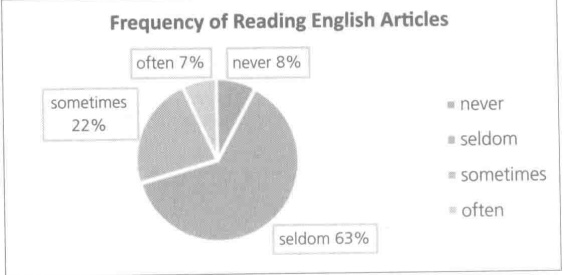
Charts are another type of visual display of the data. There are pie charts and bar charts. A pie chart shows the different parts of a total amount, while a bar chart is useful for comparing things and showing amounts at specific times. For example, the following pie chart shows the data of how often the respondents read English articles. The proportion of different frequencies is illustrated by the different sections in a pie.
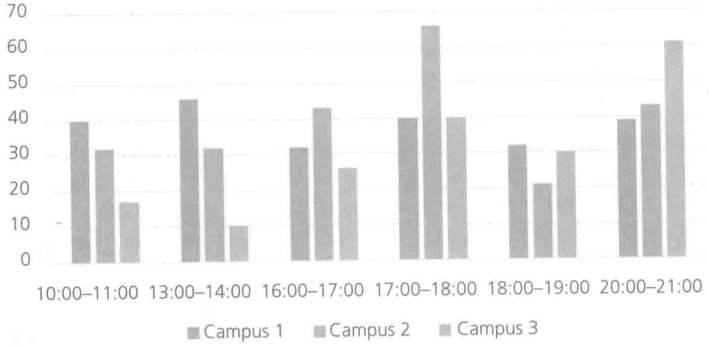
In the bar chart below, the number of shared bikes being rented at different periods of a day is compared among three campuses. The data has been collected by students in a study using the method of observation.
• Graphs
A graph is effective in showing how things change over time, and how two or more sets of measurements relate to each other. For example, the following line graph illustrates the trend of changes in the number of rented shared bikes at three different locations on campus.
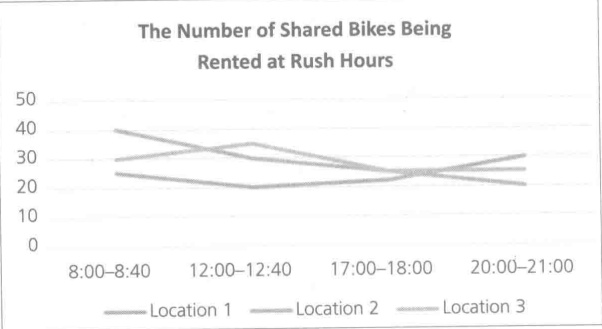
Before doing the presentation, you need to analyze and display your data in the forms of tables, charts, and graphs. During the presentation, it is important to describe the data shown on your PPT slides in a clear way. The appropriate use of signposting language, comparison and contrast language, as well as the accurate expression of numbers and trends are all helpful. Look at the following examples.
• Signposting language
Take a look at this table. It shows the basic information of respondents in our research.
I want you to focus your attention on this pie chart, which describes...
Comparison and contrast language
In this graph we can see that canteens and teaching buildings are the locations where more shared bikes are parked compared with other locations.
Similarly, North America is a popular destination: Approximately 22% choose that area compared with 12% the previous year.
• Numbers
Nearly one third of the female respondents regard personality as the most important factor to success.
It has been reported that U.S. produced 15% of world's carbon dioxide emissions in 2016.
☐ Trends
The ice extent curve between 1979 and 2015 shows a decline of about 1.208 million square kilometer.
There was dramatic increase in cargo traffic at Dubai Airport and Beijing Airport. At both airports, there was a rise in volume of over 30%.
1. In your presentation, you can vary the ways of expressing numbers or statistics. Match the following percentages with fractions (分数)
___ 1) 24%
___ 2) 75%
___ 3) 53%
___ 4) 79%
___ 5) 32%
___ 6) 74.3%
a) (exactly) three quarters
b) more than three quarters
c) approximately three quarters
d) just under a quarter
f) slightly less than a third
g) just over half
- The following text is a transcript of students' presentation on their data analysis. Fill in the blanks by choosing the suitable expressions in the box. Change the form where necessary.
Now I'll analyze the data we have collected. In response to the question "How often do you watch online live videos each week?", about 40% of 1) $ \underline{\text{choose "1-2 times", while 30% choose "3-4 times".}} $ 2) $ \underline{\text{is that about 10% of students watch online videos over 6 times a week. That 3)}} $ means that those students watch online videos almost every day. 4) $ \underline{\text{It shows how long students spend watching live videos each time.}} $ 5) $ \underline{\text{half of our respondents will spend less than an hour viewing live videos each time. About 6)}} $ $ \underline{\text{of students spend 1-2 hours each time. Combining the 7)}} $ $ \underline{\text{of the last question, we can conclude that live video streaming is still in its primary stage, but it is developing very quickly and some students spend lots of time watching these videos.}} $
| approximately | high frequency | look at this chart | one third |
| respondents | results | what catches our attention |
- Plan a group research project by following the requirements below.
| TASK: | Find the annoying environmental issues in your local area. |
| RESEARCH METHOD: | questionnaire or interview |
| OUTCOME: | an oral group presentation |
| CONTENTS: | What are the annoying environmental issues?\nWhat are the causes and effects of these environmental issues?\nHow to solve these problems? |
- Conduct the research according to the requirements of Task 3. Then give the group presentation based on your research. Follow the guidelines below.
Have good teamwork.
- Link each part of your presentation cohesively and coherently.
• Design tables, charts, or graphs to present your data; describe them clearly.
Part IV WRITING
Cause and effect is another organizational pattern that is commonly used in academic writing. A cause-effect essay may focus on discussing causes, or effects, of a particular natural or social phenomenon; or it may balance both causes and effects. The use of cause and effect language is always important for making the relationships clear between various factors. This unit will inform you of two main structures of cause-effect essays as well as the useful language.
Writing cause-effect essays
Before writing the cause-effect essays, you need to decide how to present causes and effects, and in which order. There are usually two major types of structures that can be used to organize your essay, i.e. the block structure and the chain structure.
The block structure discusses all the causes together and / or all the effects together. You may put causes first, effects later, or vice versa. You can emphasize causes / effects, or balance the number of them. Therefore, the block structure of cause-effect essays has many possible varieties, some of which are shown below.
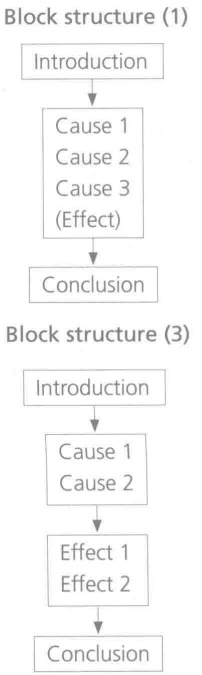
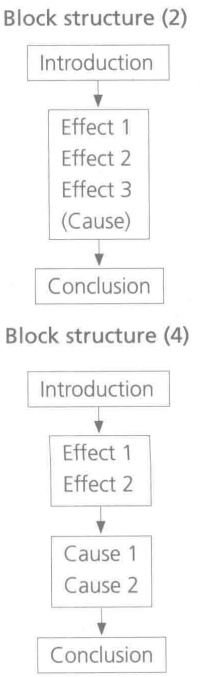
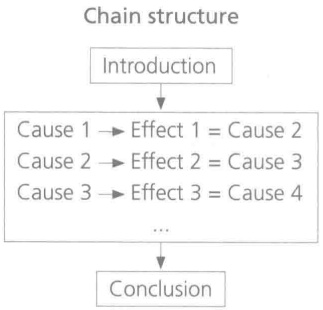
The chain structure is another organizational pattern that you can use when the causes and effects are too closely linked to be separated. In a chain of events, the first one causes the second, while the second event itself becomes the cause of the third event, and so on. For example, to investigate how fertile land becomes desert, we may find a chain of causes and effects: People move into new areas and find suitable land for agriculture by cutting down trees, then the tree roots can no longer hold the soil in place, which in turn causes the topsoil to be washed away during heavy rains, which in turn results in the lack of good soil to grow crops in, then people are forced to move into new areas, and this cause-effect chain goes on. The following diagram illustrates the chain structure.
The writing of a cause-effect essay also follows the procedure of pre-writing, while writing, and post-writing. After doing relevant research you can work out an outline by applying either the block structure or the chain structure. The different structures may be suitable for different topics. In order to make the cause-effect relationships clear in an essay, it is important to use a variety of cause-effect language. They can be nouns, verbs, adverbials, subordinators, and other expressions, as shown in the following box.
Nouns
indicating the cause: e.g. "cause", "reason", "explanation", "trigger", "root"
indicating the effect: e.g. "effect", "result", "consequence", "outcome", "impact"
Verbs / Phrasal verbs
indicating cause $ \rightarrow $ effect: e.g. "cause", "affect", "lead to", "contribute to", "result in", "bring about", "account for", "give rise to"
indicating effect $ \rightarrow $ cause: e.g. "result from", "originate from", "derive from"
Adverbials
indicating cause $ \rightarrow $ effect: e.g. "therefore", "thus", "hence", "consequently", "as a result", "accordingly"
Subordinators
indicating cause $ \rightarrow $ effect: e.g. "so", "so that"
indicating effect $ \rightarrow $ cause: e.g. "because", "as", "since"
Other expressions
indicating effect $ \rightarrow $ cause: e.g. "because of", "due to", "owing to", "as a result of"
- Distinguish the cause and the effect in the following sentences / parts of sentences. Then use various cause-effect language to connect two parts into a new sentence. You can make changes where necessary. The first one has been done as an example.
- People want to earn more money. $ \underline{\text{cause}} $
People go to the forest and illegally cut down trees. $ \underline{effect} $
New sentence: $ \underline{\text{People go to the forest and illegally cut down trees because / as they want to earn more money.}} $
- Many coastal cities and regions have recently been experiencing flooding. ___
the melting of polar icecaps ___
New sentence: ___
- the depletion of the ozone (臭氧减少) _____
Many crops cannot survive. _____
New sentence: _____
- The number of animals per species has been decreasing annually. ___
The environment becomes harsh. ___
New sentence: ___
- The Atlantic Ocean has warmed up. ___
The amount of sea ice around Scandinavia and Siberia in winter has decreased. ___ New sentence: ___
- You are going to write an essay on the following topic. Choose one of the structures you have learnt to complete an outline for your essay.
TOPIC: What are the main causes and effects of the decline in species of wild animals?
OUTLINE
Introduction / Thesis statement: ___
Body
___
___
Conclusion: ___
- Based on the outline that you have worked out in Task 2, write a complete cause-effect essay. Follow the guidelines below.
Follow the procedure of writing an essay from pre-writing, while-writing, to post-writing steps.
Use a variety of cause and effect language.
The text should be cohesive and coherent.
Use appropriate citing and referencing.