Unit 3 Medical Care
3
Medical Care
Lead-in
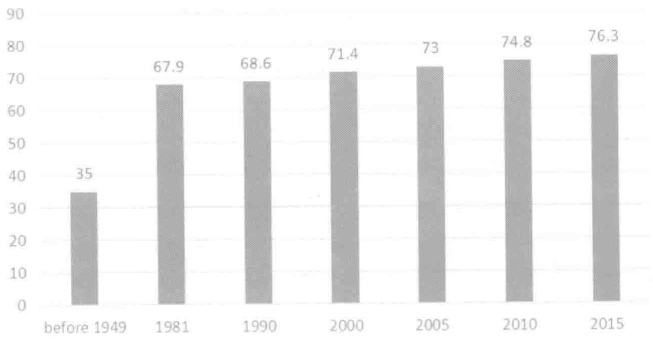
The bar chart below shows the changes of average life expectancy in China. The table lists some facts about China's medical and health services. Study the graphs and answer the following questions.
- What does the bar chart mainly tell you?
- What is the main information you get from the table?
| 2002 (per thousand) | 2011 (per thousand) | 2016 (per thousand) | |
| Licensed doctors (assistants) | 1.5 | 1.8 | 2.3 |
| Registered nurses | 1.0 | 1.7 | 2.5 |
| Number of hospital beds | 2.5 | 3.8 | 5.3 |
Reading 1
My Laughter Rx for Your Heart

Before Reading
Discuss the following questions.
- Some young people are reported to die suddenly at work or when doing sports. What do you think might be the cause?
- Do you believe your heart is healthy? How should we take care of our hearts?
My Laughter Rx for Your Heart Michael Miller & Catherine Knepper
One of my favorite moments as a physician occurs when, with a very somber look, I inform patients that there's one thing they absolutely must do in order to make a successful recovery after a cardiac event: Go home and laugh until they cry.
2 You see, we now know that there's far more to maintaining heart health and reversing heart disease than diet, exercise, and cholesterol levels. The latest research indicates that stress, and an inability to deal with it, is a direct contributor to heart disease. For example, a study involving nearly 250,000 people found that anxiety
was associated with a 26 percent increase in coronary heart disease over an 11-year period.
3 Anger and hostility rank at the top of the list of heart-harmful emotions. Harvard Medical School researchers recently found that 40 percent of patients who suffered a heart attack reported significant anger within the previous year, and roughly 8 percent of that group reported that they felt rage within two hours of heart attack symptoms.
4 But while studies reveal a great deal about the harm that negative emotions deliver to the heart, they also clearly demonstrate the amazing healing power of positive emotions. In my 25 years as a cardiologist performing clinical trials and treating patients, I've seen firsthand how we can harness optimism, confidence, laughter, social connections, and relaxation to help our hearts get and stay healthy.
5 Laugh Hysterically
Deep belly laughter triggers the release of endorphins, which activate receptors in our blood vessels' linings that signal the production of nitric oxide. This powerful chemical causes blood vessel dilation, increases blood flow, reduces vascular inflammation and buildup of cholesterol plaque, and decreases platelet stickiness, which lowers the risk of blood clots.
6 In an early study, my team saw that people with heart disease were 40 percent less likely to use humor in an uncomfortable situation, such as having a waiter spill a drink on them, than people with healthy hearts. In another study, when we asked people to watch a clip from Saving Private Ryan $ ^{1} $ or There's Something About Mary $ ^{2} $, we found that participants' blood vessels were narrowing by up to 50 percent during the stress-inducing clip, while vessel dilation in people who watched a funny clip increased 22 percent. After just 15 minutes of laughing, volunteers got the same vascular benefit as they would from spending 15 to 30 minutes at the gym or taking a daily statin.
7 Listen to the Music
Medical science is now proving what people have known for hundreds of years: that music is deeply healing. In one study, researchers found that listening to music 25 minutes daily for four weeks resulted in a 12 mm Hg reduction in systolic blood pressure (the top number) and a 5 mm Hg decrease in diastolic blood pressure (the bottom number). Results like these are equivalent to the benefit of taking a strong blood pressure medication. The calming effect of music is so powerful that listening to relaxing music before cardiac surgery was more effective at reducing stress than a
sedative medication.
8 And a group who listened to music after surgery fared better than patients who received the sedative. One theory is that music acts directly on the body's autonomic nervous system, which is responsible for heart rate and blood pressure.
9 Cuddle Up
During childhood visits to the doctor, I remember feeling that everything would be fine when my pediatrician would place his hand on my upper shoulder as he listened to my lungs. Early in my training, I did the same thing to my patients. Several studies support the idea that interpersonal touch has important heart-health benefits. In one study, women who received frequent hugs from their partner showed reduced heart rates and blood pressure as well as higher levels of the powerful neurotransmitter oxytocin, which leads to blood vessel dilation.
(637 words)
New Words and Expressions
somber $ ^{\triangle} $ /'sɒmbə(r)/ a. very sad and serious; grave 忧郁的;严峻的
cardiac /ˈkɑːdɪæk/ a. connected with the heart or heart disease 心脏的;心脏病的
reverse $ ^{A} $ /rɪˈvɜːrs/ v. change (sth.) to an opposite state or condition 颠倒;彻底转变;使完全相反
inability /ˌɪnəˈbɪləti/ n. lack of power, skill, or ability 无能;无力;没办法
contributor $ ^{\textregistered} $ /kənˈtrɪbjʊtə(r)/ n. sb. or sth. that helps to cause sth. to happen 起促进作用者
coronary /ˈkɒrənəri/ a. of the heart 心脏的
hostility $ ^{\triangle} $ /hɒ'stɪləti/ n. a state of extreme unfriendliness or opposition 敌意;敌对状态
rage /reɪdʒ/ n. (a sudden feeling of) wild uncontrollable anger (一阵) 盛怒;狂怒
demonstrate $ ^{①} $ /'demənstreit/ v. prove or make clear (a fact), esp. by reasoning or providing examples; show or describe clearly(以推理或举例等)论证;证明;证实
healing /'hiːlɪŋ/ a. having the effect of curing or improving sth. 治愈的
cardiologist /ˌkɑːdɪˈɒlədʒɪst/ n. a doctor who
studies and treats heart diseases 心脏病医生;
心脏病学家
harness /'hænis/ v. use the force or strength of sth. to produce power or to achieve sth. 利用……以产生动力;利用
optimism $ ^{*} $ /'optimizəm/ n. a tendency to give more attention to the good side of a situation or to expect the best possible result 乐观;乐观主义
hysterically $ ^{*} $ /hɪˈsterɪkəli/ ad. (of feelings, words, etc.) expressed wildly, in an uncontrolled manner 情绪狂暴不能控制地;歇斯底里般地
release $ ^{①} $ /ri'liːs/ n. the act of allowing a substance to enter the air, water, soil, etc. 释放;排放
endorphin /enˈdɔːfɪn/ n. a hormone produced in the brain that reduces the feeling of pain 内啡肽(内分泌激素,有镇痛作用)
receptor $ ^{*} $ /r1'septə(r)/ n. a sense organ or nerve ending in the body that reacts to changes such as heat or cold and makes the body react in a particular way 感受器;受体
vessel /'vesəl/ n. a tube that carries blood through
the body of a person or an animal(人或动物的)血管:脉管
lining /'laɪnɪŋ/ n. the covering of the inner surface of a part of the body(身体器官内壁的)膜
nitric oxide /'naɪtrɪk ˈɒksərd/ n. a colorless poisonous gas 氧化氮
dilation /daɪˈleɪʃən/ n. the stretching or enlargement of a hollow organ or body cavity 扩张
vascular /'væskjʊlə(r)/ a. of or containing veins (= the tubes that carry liquids around the bodies of animals and plants) 血管的;脉管的
buildup /ˈbɪldʌp/ n. a gradual increase in the amount or level of sth. 增长;增强
plaque /plaːk/ n. a small flattened patch or deposit, e.g. on the inner wall of an artery 斑;斑块
platelet /'pleɪtlɪt/ n. a very small part of a cell in the blood shaped like a disc, which helps to clot the blood from a cut or wound 血小板
stickiness /'stɪkɪnɪs/ n. the condition of being covered with sth. gluey 黏度
clot /klɒt/ n. a mass of thickened liquid, esp.
blood (血的) 凝块
induce $ ^{®} $ /ɪnˈdjuːs/ v. cause (sth.) to happen or exist 引起;导致
statin /ˈstætɪn/ n. a drug that people take to lower the level of cholesterol in their blood 胆固醇合
成酶抑制剂:他汀类降脂药
mm Hg 毫米汞柱(压力单位)
systolic/sis'tolik/a. 心脏收缩的
diastolic /ˌdæɪəsˈtɒlɪk/ a. 心脏舒张的
equivalent $ ^{①} $ /i'kwivələnt/ a. equal in value, amount, meaning, importance, etc. 相等的;相同的
medication /,medi'keɪʃən/ n. a drug or another form of medicine used to prevent or to treat an illness 药;药物
sedative /'sɛdətɪv/ n. a drug that lessens nervousness, excitement, or pain and often causes sleep镇静剂
act on have an effect on 对……起作用
autonomic /ɔːtəʊˈnɒmɪk/ a. 自主的;自主神经系统的
cuddle /ˈkʌdl/ v. hold (sb. or sth.) close in one's arms to show love or affection 拥抱:搂抱
pediatrician /ˌpiːdiːəˈtrɪʃən/ n. a doctor who treats babies or children 儿科医生
neurotransmitter /ˌnjuːrəʊˈtrænzɪˈmɪtə(r)/ n. a chemical that carries messages from nerve cells to other nerve cells or muscles 神经递质(在神经细胞间或向肌肉传递信息)
oxytocin/pks $ \tau $t $ \alpha $sin/n. 催产素(荷尔蒙的一种)
Proper Names
Global Reading
- Skim the first four paragraphs to find answers to the following questions.
- What is the profession of the two authors?
- What advice do they give to their patients?
- Four factors related to the heart health are stated in the text. What are they?
- What positive emotions help the heart stay healthy?
2. Study the reading skill in the box and answer the questions below
Reading Skill — Understanding subheadings
An academic text is generally organized into three sections: introduction, main body and conclusion. When there are more than two subsections within a section, subheadings are sometimes used.
Subheadings signal important points in the section, leading the reader through the part and keeping them focused at the same time. All subheadings relate to the title of the text or the author's position / argument. They usually follow the same wording pattern (措辞形式) as exemplified below.
Example 1: subheadings in questions
What's the problem?
Which foods contain acrylamide?
Is acrylamide dangerous?
What should we do?
How else can we reduce the risk? (Reading 1, Unit 1, Book 1)
Example 2: subheadings in statements
Sprouted foods are nutritious.
Fermented foods contain probiotics.
Frozen foods retain more vitamins. (Reading 2, Unit 1, Book 1)
Example 3: subheadings in imperatives (祈使句)
Stay Curious.
Eat Way More Plants than You Think You Need to.
Rethink What It Means to Be Old. (Reading 1, Unit 4, Book 1)
Example 4: subheadings in noun phrases
Pets and Stress Relief
Pets and Companionship (Reading 1, Unit 6, Book 1)
- In which section are the subheadings used in this text: introduction, main body or conclusion?
- What is the wording pattern the subheadings follow?
- What is the author's position that these subheadings support?
Close Reading
- Answer the following questions.
- How harmful are negative emotions to the heart?
- How does laughter benefit the heart?
- In what way can music help to keep the heart healthy?
- Why do the authors cite the childhood experience of visiting the doctor?
- Are the following statements true (T) or false (F)? Give reasons for your judgment.
☐ 1) Many people experienced intense anger some time before they had a heart attack.
- Compared with healthy people, more people suffering from heart problems take an easy attitude when something bad happens.
☐ 3) Watching a funny movie could not achieve the same beneficial effects on hearts as doing sports or taking drugs.
☐ 4) Listening to music could have the same healing power as taking medicines.
☐ 5) A study found that women who were often hugged had better heart conditions.
Critical Thinking
Discuss the following questions.
- Do you agree with the authors that to "laugh loudly", to "listen to the music" and to "have more interpersonal touch" can help people maintain heart health? Are the suggestions also good for people to promote overall health?
Language Enhancement
- Many cultures advocate laughter for the sake of health. How good is laughter?
- The boldfaced words in the following sentences are collocations of various types, for example, preposition + noun; verb + noun; noun + preposition, adjective + preposition.
A. Complete each collocation with the exact word from Reading 1.
- ... _____ a very somber look, I inform patients that ... (Para. 1)
- … one thing they absolutely must do in order to _____ a successful recovery after a cardiac event … (Para. 1)
- ... stress, and an inability to deal with it, is a direct contributor _____ heart disease. (Para. 2)
- ... a study ... found that anxiety was associated _____ a 26 percent increase ... (Para. 2)
- Anger and hostility _____ at the top of the list of heart-harmful emotions. (Para. 3)
- ... patients who _____ a heart attack reported significant anger within the previous year, ... (Para. 3)
- ... they also clearly _____ the amazing healing power of positive emotions. (Para. 4)
- In my 25 years as a cardiologist _____ clinical trials and treating patients, ... (Para. 4)
- Deep belly laughter ___ the release of endorphins, ... (Para. 5)
- … which ___ the risk of blood clots. (Para. 5)
- ... listening to music ... resulted _____ a 12 mm Hg reduction in systolic blood pressure ... (Para. 7)
- Results like these are equivalent _____ the benefit of taking a strong blood pressure medication. (Para. 7)
- ... listening to relaxing music ... was more effective at _____ stress than a sedative medication. (Para. 7)
- … music acts directly _____ the body's autonomic nervous system, … (Para. 8)
B. Complete the sentences with the collocations from Step A. Change the form where necessary
- Scientists have proved that moderate exercise _____ chemicals in the brain that make you feel better.
- Edward _____ from injuries and was expected to return to the competition next week.
- The country has been _____ of the safest countries in the world for three consecutive (连续不断的) years.
- Previous research has proven that being optimistic boosts overall physical health and _____ death from all causes.
- _____, he asked the employees, "who is responsible for this inferior product?"
- The anti-depression medication can _____ the brain to change aspects of mental activity.
- Nuclear explosions are measured in kilotons. Their energy release $ \_\_\_\_\_\_ $ that of thousands of tons of TNT (炸药).
- The great increase in tourism in recent years has _____ a corresponding boom in hotel construction.
- Numerous cases have ___ of this very simple yoga pose.
- Drinking very hot tea (at least 70°C) _____ an eightfold increased risk of esophagus cancer (食道癌) compared with warm tea.
- Study the word building skill in the box and work on the tasks below.
Word Building Skill — Analogy (类比法)
Analogy is a word formation process by which words or phrases are created according to the existing patterns in the language. In other words, a new word or a new phrase is coined by an analogy between a newly created one and an existing one. For example, "talkathon" (马拉松式的冗长演说), a new word in modern English, is derived from "marathon".
There are two types of analogical coinages(新造的词语):
Single words: "moonrise" (from "sunrise"); "househusband" (from "housewife")
- Phrases: "air pollution" and "sound pollution" (from "environmental pollution", which appeared first in the English vocabulary).
A. There are some analogical words with their origins in the following table. Translate them into Chinese. The first one has been done as an example. Consult the dictionary where necessary.
| Origin | Analogical word | Chinese meaning |
| white-collar / blue-collar | 1) gold-collar | 金领的(高级管理者的) |
| 2) gray-collar | ||
| 3) pink-collar | ||
| landscape | 4) seascape | |
| 5) moonscape | ||
| baby-sit | 6) house-sit | |
| high-rise | 7) low-rise | |
| overproduce | 8) underproduce | |
| broadcast | 9) narrowcast |
B. The boldfaced words in the following sentences are analogical words. Translate them into Chinese and figure out their origins. Consult the dictionary where necessary.
- A well-designed customer service manual for a product should be reader-friendly with lots of open space on the page, useful illustrations, and normal, everyday language.
- He said that labor laws also need to be changed so that Japanese men will cut down on their workaholic hours.
- Do you think the netizens' opinions on the news represent the situation of the realistic society?
- In this paper, some problems about the underpopulation, industrial structure, and land use are put forward.
- Animal rights advocates argue that zoos are really animal prisons and very often cruel.
| Analogical words | Chinese meaning | Origin |
| 1) reader-friendly | ||
| 2) workaholic | ||
| 3) netizen | ||
| 4) underpopulation | ||
| 5) animal rights |
3. Study the translating skill in the box and work on the task below
Translating Skill — Changing word order (I): attributives
A Chinese noun always comes after its attributives (a single word or several long phrases), while an English noun may come before or after a word modifying it, but always before an attributive clause. Therefore, in many cases, we need to rearrange the position of attributives in C-E translation.
Source Text: 我有重要的事情要告诉你。
Translation: I have something important to tell you.
Source Text: 在太空中有各种各样肉眼看不见的波。
Translation: There are various kinds of waves invisible to the naked eye in the aerospace.
In Chinese, the multiple attributives before a noun are usually so arranged that the most essential one comes first in order while the adjective order in English can be summarized as: opinion, size, age, shape, color, origin, material.
Source Text: 他是一位 $ \underline{\text{中国现代优秀}} $作家。
1 2 3
Translation: He is an $ \underline{\text{outstanding}} $ $ \underline{\text{contemporary}} $ $ \underline{\text{Chinese}} $ writer.
Translate into English the following paragraph, changing the position of attributives when necessary.
中医(Traditional Chinese Medicine)有五千多年的历史,是中国古代劳动人民几千年来对抗疾病的经验总结。中医将人体看成是气、形、神的统一体,以“望、闻(auscultation and olfaction)、问、切”为其独特的诊断过程。中医使用中药、针灸(acupuncture)以及许多其他治疗手段,使人体达到阴阳调和。阴阳和五行是中医的理论基础。五行是自然界中的五种基本物质,即金、木、水、火、土。
Translation:
一
Reading 2 When Less Medicine Means More Health
Before Reading
The following are two contradictory suggestions when a person catches a cold. Which one do you support? Give reasons for your ideas.
A. Take medicines immediately so that the cold will not develop into a severe one.
B. Don't take medicines because your body will cure itself.
When Less Medicine Means More Health John Henning Schumann
Six months ago, an octogenarian patient told me he'd been having lightheadedness. For decades, he'd taken a combination pill (two medicines in one) to keep his blood pressure below 140/90, numbers proved important in preventing heart attacks, strokes, and kidney failure. Light-headedness is common among older people on blood pressure drugs. "It's as though I'm just going to pass out," he told me. "My vision fades, and I get wobbly legs." Fortunately, my patient's episodes had passed without him actually falling.
2 He and I agreed that it would make sense to stop his medicine for a month and see what happened – something called a drug holiday. My patient agreed to buy a home blood pressure cuff, use it two or three times a week, and share the results with me. A month went by. His blood pressure, over multiple readings, was fine. And no more light-headedness.
3 I wrote him back: “Stay off the medication – it’s clear from your readings that you no longer need it.” He was thrilled. The decision saved him money and meant he
could forget about one of his many daily pills.
4 Now new research has thrown that decision into question. A federally funded study was recently stopped early because of evidence that aggressively lowering blood pressure saves lives. The new findings indicate that getting the top (systolic) number to 120 or lower is even better at saving lives than the current standard of 140.
5 Still, I'm satisfied my decision was a good one. I helped my patient avoid a drug-related problem like a fall and maybe a hip fracture – one of the banes of our aging population. What's more, he and I pushed back against medical inertia, the tendency to keep things the way they are because it's easier than making a change.
6 My patient's experience and stories like his have led me to believe that there comes a point in aging when our physiology changes. No doubt there are many factors, such as our senior brains, stiffening blood vessels, and changes in the ratios of our hormones. Sometimes age brings more illness, but in other cases, problems seem to diminish.
7 Too often, we overlook the option of de-prescribing, or discontinuing medications in older people who take a lot of them. A recent review of more than two dozen studies in which patients discontinued medications (including sedatives like Valium as well as blood pressure drugs) found that people did surprisingly well when they stopped taking them. Adverse symptoms abated, and their health generally improved.
8 As a doctor looking first to do no harm, I draw the following conclusion: Though I'm ready to believe the better low blood pressure outcomes promised by the latest research, I'm also going to look for opportunities to minimize the overuse of drugs in older patients. For many of us, less medicine means more health.
(473 words)
New Words and Expressions
octogenarian /ˌɒktəʊdʒɪˈneəriən/ n. a person between 80 and 89 years old 八旬老人;80至89岁的人
light-headedness /laɪtˈhedɪnɪs/ n. the state of being not completely in control of one's thoughts or movements; slight faintness 头晕;眩晕
pass out suddenly become unconscious 昏倒;昏过去
vision $ ^{®} $ /'vɪʒən/ n. the ability to see 视力
fade /feɪd/ v. disappear or die gradually 逐渐消失
wobbly /'wɒbli/ a. moving in an unsteady way
from side to side 摇摆的;摇摇晃晃的
episode /ˈepɪsəʊd/ n. an event, a situation, or a period of time in sb.'s life that is important or interesting in some way (人生的)一段经历
cuff $ ^{\triangle} $/k $ \wedge $f/n.(血压计的)橡皮囊袖带
reading n. a figure shown by a measuring instrument 读数
federally /ˈfedərəli/ ad. in a way that is connected with the national government rather than the local government of an individual state 联邦地;联邦政府地
aggressively /ə'gresɪvli/ ad. very severely or intensely 严重地;高强度地
hip /hɪp/ n. the area at either side of the body between the top of the leg and the waist; the joint at the top of the leg 臀部;髋关节
fracture $ ^* $ /'fræktʃə(r)/ n. a break in a bone or other hard material 骨折;断裂
bane /beɪn/ n. sth. that causes trouble and makes people unhappy 造成困扰(或不快)的事物
inertia $ ^{*} $ /ɪˈnɜːrʃjə/ n. a feeling of not wanting to move or do anything 惰性
physiology /ˌfɪzɪˈplɒdʒɪ/ n. a science concerned with the study of how the bodies of living things, and their various parts, work 生理学
no doubt almost certainly; very probably 多半;
很可能;必定
stiffen /'stɪfən/ v. make or become firm and unable to bend(使)变硬;(使)不易弯曲
ratio $ ^{\textcircled{A}} $ /reiʃəu/ n. the relationship between two groups of people or things that is represented by two numbers showing how much larger one group is than the other 比率;比例
de-prescribe /dɪprɪˈskraɪb/ v. stop telling sb. to take a particular medicine or have a particular treatment 停药;停开处方
abate /ə'beɪt/ v. become less strong; make sth.
less strong(使)减弱;减少
Proper Name
John Henning Schumann /dʒɒnˈhenɪŋˈʃuːmən/ 约翰·亨宁·舒曼
Global Reading
- Study the reading skill in the box and work on the task below.
Reading Skill — Recognizing different ways to begin an academic text
The introduction of an academic text always includes an explanation of the situation as well as the aim of the essay or the author's position. There are various ways to introduce the situation. The following are three common ways, each of which has its own merits, to begin an introduction:
Directly stating the situation (Reading 2, Unit 1; Readings 1 & 2, Unit 2): It is straightforward and efficient.
• Addressing the reader (Reading 1, Unit 1): The reader feels more engaged.
Narrating a personal experience (Readings 1 & 2, Unit 3): A personal story always attracts attention.
Reading 2 starts with a personal experience. Skim the introduction part (Paras. 1–3) and answer the following questions.
- What medicine had the patient taken for many years?
- What problem did the patient report six months ago?
- What advice did the doctor give him?
- Did the patient feel well one month later?
- What is the point the author wants to make by telling this personal experience?
- Do you think this beginning part of the text succeeds in introducing the situation and conveying the author's position?
- Skim the first sentence, which is also the topic sentence, in Paras. 4–7. Are the following statements true (T) or false (F)?
☐ 1) Everyone agrees that the author's advice to the patient is correct.
☐ 2) The author does not regret that he gave the patient the advice.
☐ 3) With the growing age, people's physical conditions may change.
☐ 4) Older people are always given the choice to stop their medication.
Close Reading
Choose words from the text to complete the summary.
A patient in his eighties had been taking drugs for blood pressure. Sometimes he felt he was going to 1) _____. After talking with his doctor, the patient took a 2) _____. During the period, he agreed to use a 3) _____ and reported to the doctor regularly. The experiment ended up fine, so the doctor suggested that the patient not need 4) _____ any more.
Though some research supports a blood pressure number below 5)____, the doctor still feels good for his patient. Because of his decision, the patient would not have a 6)____ or a 7)____. More significant is that by doing so, he and his patient forced back the 8)____.
One good point with old age is that some old problems may 9) _____. More than 24 studies provide evidence that patients' conditions 10) _____ when they stopped medications. Thus, the doctor will continue giving similar advice to his aged patients.
Critical Thinking
Read the news report below and answer the three questions.
China further curbs (限制) overuse of antibiotics
BEIJING – China's health authority on Tuesday announced plans to further curb the overuse of antibiotics, including setting caps (上限) for the variety and use ratio of antibiotics, and punishing doctors found to misuse antibiotics.
The Ministry of Health limited the varieties of antibiotics a hospital could have according to its grade and function. For instance, a top-level general hospital can have a maximum of 50 varieties of antibiotics; children's hospitals, 50; psychiatric (精神病的) hospitals, 10; and stomatology (口腔学) hospitals, 35.
The use ratio, the share of antibiotics among all prescription drugs, has also been capped. The cap for general hospitals is 60 percent, for example.
Moreover, if doctors are found to use antibiotics inappropriately, they will be subjected to penalties ranging from warnings, suspensions (暂停) or cancellations of their prescription-writing rights, to having their licenses withdrawn.
Doctors' clinical prescription performances will be factored (包括) into their overall performance evaluations which affect their income and promotion prospects, according to plans.
- What type of medicines are restricted?
- How does the Ministry of Health set the restriction?
- Do you think the restriction is necessary?
Language Enhancement
- Formal words are often preferable in academic texts compared with common words or informal words. Complete each sentence with the formal word that occurs in Reading 2, with the help of its equivalent used in general texts shown in brackets.
- Read the potential side effects when you take a new ___, and always check with your doctor to see if you might be at risk. (medicine)
- The ___, who is a vegetarian and has never smoked cigarettes or drunk alcohol, is ready to share his knowledge with others. (someone in his eighties)
- The robotic systems put a surgeon's hands at the controls of a robot with ___ arms and unparalleled (无与伦比的) precision. (many)
- In this paper, a population-based study regarding bone ___ in childhood and adolescence was reported. (breaks)
- Surgery is often the best treatment ___ for severe heart problems. (choice)
- Patients should not _____ the use of these medications without first consulting their health care provider. (stop)
- It is wise to discuss with your health consultant and doctor on the best multi-vitamin that could help _____ stress. (reduce to the lowest level)
- _____ of antibiotics can lead to drug-resistant bacteria that have to be treated with more powerful and often more expensive drugs. (very frequent use)
2. Study the word building skill in the box and work on the tasks below
Word Building Skill — Onomatopoeia (拟声法)
Onomatopoeia is the formation of a word which imitates the sound that it describes, thus making the description more expressive and interesting. In other words, onomatopoeic words are echoic words whose sound suggests sense.
Onomatopoeic words can imitate the sound made by animals, e.g. "cuckoo" (布谷鸟) (a bird with a call that sounds like its name), "bark" (to make a short loud sound as a dog); the sound made by humans, e.g. "murmur" (to make a soft low sound), "giggle" (to laugh quickly and in a high voice); and the sound made by things, e.g. "bang" (to strike sharply), "gush" (to flow out in a rapid and plentiful stream).
A. The boldfaced words in the following sentences are onomatopoeic words which imitate human's voices. Choose a, b, or c that has the closest meaning to the boldfaced words. Consult the dictionary where necessary
- His fury was so great that he could hardly speak, so he growled some meaningless words at Jim.
a) made a low sound in the throat as a sign of anger
b) shouted at sb. in a very loud voice
c) ground one's teeth
- When I told her what had happened she just grunted and turned back to her book.
a) made a long deep sound to express unhappiness
b) laughed in a silly way out of embarrassment
c) made a short low sound in the throat to show that sb. is annoyed or not interested
- Jane's constant chatter was beginning to annoy him.
a) a series of short sounds made by things knocking together
b) a continuous rapid talk about things that are not important
c) an informal talk about other people's private lives
- A short and powerful speech that you can blurt out from memory is always better than a long and difficult speech that you read from a paper.
a) shout loudly when in need of help
b) say sth. loudly because of a strong emotion
c) say sth. suddenly and without thinking carefully
- The roar of the crowd combined with the speaker's own low-decibel (分贝) delivery
ensured that few could hear anything he said.
a) a shocking noise like thunder
b) a very loud and forceful voice
c) a sudden loud noise by sth. breaking
- After the secretary whispered to him, the prime minister had a broad grin on his face.
a) spoke very quietly to sb. so that other people cannot hear
b) made a loud sharp sound
c) made a quiet continuous sound
B. There are ten onomatopoeic words in the box. Put them into the respective groups and translate them into Chinese. Consult the dictionary where necessary
| buzz | click | splash | mumble | drizzle |
| meow | swish | clang | whizz | belch |
| Group | Onomatopoeic word | Chinese meaning |
| words related to water | ||
| words related to air | ||
| words related to collisions | ||
| words related to the voice | ||
| words related to animal sounds | ||
- Study the translating skill in the box and work on the task below.
Translating Skill — Changing word order (II): adverbials
Adverbials in Chinese are usually placed between the subject and the predicate, sometimes placed before the subject for the sake of emphasis.
The positions of adverbials in English are more varied. A single word used as adverbial can be placed at the beginning of the sentence, before the verb, between the auxiliary verb and the verb, or at the end of the sentence, while longer adverbials are usually placed at the beginning or end, seldom in the middle, of the sentence.
Source Text: 他们刚刚做了一项物理实验。
Translation: They have just done a physics experiment.
The order of multiple adverbials indicating time or place in Chinese differs from that in English.
Source Text: 福尔摩斯博物馆位于 $ \underline{\text{英国伦敦贝克街221b号}} $。
1234
Translation: The Sherlock Holmes Museum is located at $ \underline{\text{221b, Baker Street, London, England}} $.
4 3 2 1
Translate into English the following paragraph, changing the position of adverbials when necessary.
药膳(medicated diet)在中国有着悠久的历史,种类十分丰富,每一种都有特殊的功用、严格的制作方法和独特的风味。配料一般因人而异。根据每个人生理条件的不同,应使用不同的药材,以达到保健和治病的功效。中药(Chinese medicine)与食物彼此调和可以改善药物的口味,提高食物的功效。药膳用材范围广,可以自制,因此易于普及,深受人们喜爱。
Translation:
一
Part II LISTENING AND VIEWING
Listening:
The Next Outbreak? We're Not Ready (Part I)
Before Listening
Discuss the following questions.
- What do you know about the Ebola virus disease (埃博拉病毒性疾病)?
- How can we avoid catching an infectious disease (传染病) in our daily lives?
New Words and Expressions
outbreak $ ^{*} $ /'autbreɪk/ n. the sudden start of sth. unpleasant, esp. violence or a disease 爆发;突然发生
infectious $ ^{*} $/in'fekʃəs/ a. 传染性的;感染的
microbe /'maɪkrəʊb/ n. 微生物;(尤指引起疾病的)细菌
epidemic $ ^{*} $/epi'demik/n. 流行病
Ebola/i'baula/n. 埃博拉病毒
devastating $ ^{\Delta} $/devøsteritn/ a. causing a lot of damage and destruction 破坏性极大的;毁灭性的
progression /prəʊˈɡresən/ n. the process of developing gradually from one stage to another 发展;进程
heroic /hɪˈrəʊɪk/ a. showing extreme courage and admired by many people 英勇的;英雄的 infection /ɪnˈfekʃən/ n. the act or process of causing or getting a disease 传染;感染 contagious $ ^{\Delta} $/kənˈteɪdʒəs/ a. 患接触性传染病的 bedridden /ˈbedɪdən/ a. 卧床不起的 bioterrorism /ˌbaɪəʊˈtɜːrərɪzəm/ n. 生物恐怖主义
Listening Comprehension
Study the listening skill in the box and work on the tasks below.
Listening Skill — Distinguishing facts and opinions
An important part of listening comprehension is determining what a fact is and what an opinion is. It is a basic listening and analytic skill necessary for understanding and mentally processing information. In a lecture, the speaker expresses some ideas which can be facts or opinions. You need to pay great attention to distinguishing them.
A fact is a statement that is true and can be verified or proven objectively. For example, The last day of school in this semester is June 22nd.
An opinion is a statement that holds an element of belief and view. For example, June 22nd is the best day of the year. The typical words and expressions of opinions are as follows: "think", "probably", "look like", or modal verbs (情态动词), e.g. "may", "could", "would", etc.
- Listen to the speech about epidemics and fill in the blanks with the exact words you have heard. Then decide whether the statements are facts (F) or opinions (O).
☐ 1) Today ___ of global catastrophe doesn't look like this.
☐ 2) The failure to prepare could allow the next epidemic to be dramatically more $ \underline{\text{than Ebola.}} $
☐ 3) Ebola does not spread ___.
☐ 4) So there are things that would literally make things ___.
- Listen again and choose the correct answer to each of the following questions.
- According to the speaker, what would probably kill over 10 million people in the next few decades?
a) A nuclear war.
b) A global catastrophe.
c) A highly infectious virus.
- What are the problems of the case reports about epidemics?
a) We didn't have a system of reports at all.
b) The reports were delayed and inaccurate.
c) The reports had been spread too far.
- Which is NOT the reason why Ebola didn't spread more?
a) Ebola doesn't spread through the air.
b) Ebola didn't get into many urban areas in some West African countries.
c) Ebola is not as devastating as the bioterrorism.
Viewing: The Next Outbreak? We're Not Ready (Part II)
Before Viewing
Discuss the following questions.
- Is influenza (or flu) a common and minor illness?
- What should you do when you catch a cold?
New Words and Expressions
turnaround /'tɜːnəraʊnd/ time 周转时间
pathogen /'pæθədʒɪn/ n. 病原体
vaccine $ ^{*} $ /'væksiːn/ n. 疫苗
reserve corps /kɔːz/ 后备队
logistics /ləʊ'dʒɪstɪks/ n. 后勤;组织工作
germ /dʒɜːm/ n. a very small living thing that can cause infection and disease 微生物;细菌;病菌
R&D Research & Development 研发
diagnostics /ˌdaɪəɡˈnɒstɪks/ n. 诊断学
priority $ ^{①} $ /praɪˈɒrəti/ n. sth. that is ranked highly in terms of importance or urgency 优先事项;最重要的事
hoard $ ^{▲} $ /hɔːd/ v. store (sth.) often in secret 贮存;囤积
Viewing Comprehension
Study the listening skill in the box and work on the tasks below.
Listening Skill — Distinguishing perspectives (观点) and stances (立场)
In an academic context, both perspectives and stances are used to express opinions, and in most cases they carry the similar meaning. However, slight differences exist.
A perspective is the angle or viewpoint associated with objectivity, and always carries a theoretical position. To express a perspective, the speaker can use phrases like "from an economic perspective", "what the economics tells us is", etc.
A stance refers to where the speaker stands, i.e. the personal position or argument. It is essentially subjective, like "in my view", "as far as I'm concerned", etc.
- While watching, pay attention to the second half of the video clip, where the speaker expresses some opinions about epidemics. Fill in the blanks with the exact words you have heard. Then decide whether the statements are perspectives (P) or stances (S).
☐ 1) Now I don't have an exact budget for what this would cost, but I'm quite sure it's very _____ compared to the potential harm.
☐ 2) The World Bank estimates that if we have a worldwide flu epidemic, _____ will go down by over three trillion dollars.
☐ 3) So I think this should absolutely be a ___.
☐ 4) But we need to get going, because time is ___.
- Watch again and choose the correct answer to each of the following questions.
- Which is NOT mentioned by the speaker when he talks about benefits of science and technology?
a) We have cell phones to get information.
b) We have advances in biology that could make proper drugs and vaccines.
c) We have improvements in making war games.
- Why should we combine the medical people with the military?
a) Because the military is able to move fast, do logistics and secure areas.
b) Because the military has the training and is ready to go.
c) Because the military is good at simulations in germ games.
- What does the speaker imply by mentioning "spaghetti" and "basement"?
a) We shouldn't be scared of the shortage of foods.
b) We need the preparedness for the potential outbreak of the next epidemic.
c) We shouldn't prepare for epidemics by storing foods and hiding.
Critical Thinking
Discuss the following questions.
- Is there any new technology which can be used for detecting or fighting against epidemics?
Do some research online and share the findings with your classmates.
- What is a war game? And what is a germ game?
Part III SPEAKING
Besides summarizing what you have read or what other students have said, you may also need to put forward your own argument on the topic in a seminar discussion. Here the argument refers to the "academic argument", which basically includes an opinion and the support (e.g. evidence, examples, or reasons). Therefore, rather than merely giving your thought or belief, you are supposed to support it with strong evidence or justification; then it becomes a valid argument which will be persuasive in the discussion. In this unit, you will learn how to present such an academic argument effectively.
Seminar discussions (III): presenting academic arguments
Since seminar discussions always aim to intensify what you have learnt from lectures or your readings, your argument may often derive from them. For instance, you might develop your opinion based on a text that you have read or use an example given by the lecturer. So, before participating in a seminar discussion, you should finish reading all the required materials and develop your own arguments on a given topic / issue step by step, starting with your own knowledge and experience, and then building on that with the information from sources.
During the discussion you can present your arguments to other participants in a sequence that your opinion comes first, then the support, such as evidence, examples or reasons. When giving the opinion, you'd better clearly and concisely present your main point in one or two sentences, using such signposting language as "In my opinion" or "As for me, I think", etc. When supporting your opinion, you can provide evidence or reasons from the sources (reading materials or lectures), or give general, personal or even hypothetical examples, as shown in the following language patterns:
Giving evidence:
In Reading 2, as indicated by a study, keeping the top blood pressure to 120 or lower may be "better at saving lives than the current standard of 140".
Here in Reading 1, it says 40% of patients with a heart disease have undergone extreme anger in the past year.
Giving reasons:
According to the article, the reason why less medicine means more health is that ... Reading 1 shows that laughing out loud may do good for our heart because / as / since
The rationale for such initiatives is...
Giving examples:
As we saw with examples / illustrations in Prof. Liu's lecture on medical care ...
China, for instance / example, has many traditional ways to treat diseases.
From my own experience, drinking more water plus having enough rest is more effective than taking medicines for a cold.
Say if people can control all types of flu viruses, then ...
Generally speaking, the evidence or examples from sources like your reading materials or lectures would sound more convincing than your personal experience. Therefore, in a seminar discussion, you are encouraged to use more information from the sources to support your claim, making it more valid and persuasive.
Suppose you are going to participate in a seminar discussion on the question: What helps people to get rid of diseases? Argue for the most important factor.
- Work in pairs. Tell each other what your first response is to the question.
- Reread Readings 1 & 2. Then read the following text. Decide:
- Do these texts contain the factors you mentioned in Task 1?
- Do you adapt your ideas after reading the texts? And how?
Luisa Dillner
Almost everyone gets back pain. It's as inevitable as paying taxes and death. But at least you can take painkillers, right? Except that the American College of Physicians (ACP) has announced that drugs should no longer be the first line of treatment. Instead of reaching for paracetamol (扑热息痛) or ibuprofen (布洛芬), you should try treatment such as heat (superficial), massage or acupuncture (针灸). Codeine (可待因) and the occasional diazepam (安定) are particularly frowned upon because they carry the risk of addiction.
Acute back pain usually lasts less than four weeks — if it persists for more than 12, then it becomes chronic. Up to 30% of us will have low back pain a year after having an initial attack. What the ACP stresses is that most people with back pain get better, regardless of treatment. Doctors should therefore avoid any tests and treatments that could cause harm.
The ACP's recommendations are based on a thorough review of the evidence — but the research is often poor. Massage and acupuncture are recommended based on "low-quality evidence" and the health watchdog NICE (a guideline developed by National Institute for Health and Care Excellence, UK, that aims to help people manage their low back pain) takes the opposite view, stating: "Do not offer acupuncture for managing low back pain." Both NICE and the ACP suggest trying spinal manipulation (脊柱推拿术), although NICE only recommends it as part of a treatment package that includes exercise and psychological therapy. The research is weak on whether heat helps, but anyone with back pain can probably testify to the benefit of a hot water bottle.
If nothing else works — and the passing of time has the most evidence going for it — the ACP suggests non-steroidal anti-inflammatory (非甾体抗炎药) such as ibuprofen. But earlier this month, research showed ibuprofen was not much better than a placebo (安慰剂) for relieving back pain. Ibuprofen is also, unfortunately, good at causing gastric (胃部的) problems such as inflammation of the stomach and ulcers (溃疡).
NICE says it is reasonable to try weak opioids (类罂粟碱) for acute pain if ibuprofen does not work or is too risky. For chronic pain, the ACP recommends exercise, acupuncture (again) and mindfulness, as well as tai chi and yoga. For sciatica (坐骨神经痛), where a nerve root is compressed in the spine, there is little evidence that any interventions help a lot.
NICE stresses the importance of exercise, psychological therapies and for people to continue with normal activities. Anyone with chronic back pain will know there is no magic bullet. These latest recommendations focus on not making things worse.
- Work in groups. Discuss the question, present your opinion about the most important factor and support it with evidence, reasons or examples from sources or your own experience, etc. Select a member to fill in the following table. The first one has been done as an example.
| Participant | Opinion | Support |
| A | Maintaining a positive mind might be a key factor. | Reading 1 shows that positive emotional factors such as optimism, confidence, laughter, and relaxation help make our heart healthy. |
| B | ||
| C | ||
| D |
Part IV WRITING
When you are writing an essay, it is important for your ideas to flow smoothly within and between paragraphs. Then how to write smoothly? By achieving cohesion (衔接) and coherence (连贯) in your essay. To put it simply, a text is cohesive if its elements are linked together; a text is coherent if it makes sense. In this unit, you will learn about a number of linguistic techniques and skills that can help you connect your sentences and paragraphs. Unit 4 will focus on how to make your writing meaningful by logically relating each part.
Writing smoothly (I): cohesion
In essay writing, cohesion mainly refers to the grammatical and lexical (词汇的) links that connect one part (e.g. a sentence or a paragraph) to another, which can help readers follow your text easily. There are many devices to achieve cohesion, including reference (照应), ellipsis (省略), substitution (替代), lexical cohesion (词汇衔接) and conjunction (连接) (Halliday & Hasan, 1976).
Reference
You may use referencing words or expressions to: 1) refer back to certain previously-mentioned information; 2) refer forward to something / someone that will follow. For instance, pronouns (代词) are often used to refer back to the person or thing that has been mentioned in the former sentence, such as "it", "he", "she", "they", "this / that", or "something", etc. Expressions like "as stated in the introduction", "as described below" can effectively connect the information that has appeared in a different part of an essay.
Ellipsis
Ellipsis is the strategy to omit a word or phrase in a clause when it has been mentioned earlier. This is an efficient method of language use, which can avoid repetition in academic writing, as in the following example from Reading 1:
After just 15 minutes of laughing, volunteers got the same vascular benefit as they would from spending 15 to 30 minutes at the gym or taking a daily statin.
The writer omits the word "get" after "as they would" because it has been used in the main clause. In order to avoid repetition, the second "get" can be left out. We can infer that ellipsis is often used when making comparisons or contrasts.
Substitution
Substitution is slightly different from ellipsis — it is not omitting, but replacing a word / phrase with another one, usually a more general one. For example, "I'm satisfied my decision was a good one." In this sentence, by using the more general word "one", the writer avoids repeating
the same noun "decision" when he wants to mention it again. Similarly, the verb "do" can be used to substitute any specific verb that has been formerly mentioned.
Lexical cohesion
There are two major types of lexical cohesion: repetition of key terms / concepts and using synonyms. By repeating key terms / concepts in your writing, you tell readers that you are constantly focusing on the given topic; then the organization of your essay shows continuity. Look at the following two paragraphs of a text:
It is not completely understood how visceral fat (内脏脂肪) makes the body resistant to insulin (胰岛素) (and hence allows blood glucose (血糖) levels to rise). One theory is that ...
The good news is visceral fat is so dynamic that you can shift it. You just have to eat less and exercise more — about half an hour a day of quite vigorous exercise should do it ...
The writer repeats the key term "visceral fat" at the beginning of these two paragraphs, showing that they are dealing with the same topic, different aspects — the first paragraph indicates that visceral fat is a threat to people's health (the problem), and the second paragraph demonstrates the ways to get rid of visceral fat (the solution).
Using synonyms is similar to repeating key terms, except with more diversity in word choice. You use different words or expressions with similar meaning, not only helping hold the essay together, but also adding variety to your writing. For example, "medicine" and "drug", "protect" and "defend", etc.
Conjunction
Conjunction refers to the use of conjunctive expressions to join clauses, sentences and paragraphs. You can use a variety of linking words / phrases or transitional words / phrases to add cohesion to a text, such as "and / but", "first / second / third", "however / though", "hence / consequently", "in fact / for instance", etc. These expressions signal the relationship (e.g. cause and effect, addition, contrast) between two clauses or sentences, making them more closely connected and related.
- You have learnt five types of cohesive devices, i.e. reference, ellipsis, substitution, lexical cohesion and conjunction. Read the following paragraph and try to recognize all the cohesive devices being used. Note that the text may not include all types of devices.
But what if instead of drilling holes into teeth and patching them up with synthetic fillers (合成填料), dentists could coax our pearly whites to regrow themselves? Recently, Paul Sharpe, a bioengineer at King's College London, and his colleagues discovered a new way to do exactly this in mice. Last year they published a study describing their innovative techniques in Scientific Reports. Since then they have made even more progress that edges this experimental procedure closer to human clinical trials. If the treatment eventually becomes part of the dentist's standard tool kit, scientists say it would easily be one of the field's most important advances in 50 years.
Reference: ___
Ellipsis: ___
Substitution: ___
Lexical cohesion: ___
Conjunction: ___
- Choose the suitable conjunctive expressions from the box to complete the following text. Note: 1) you may need to capitalize the first letter of some words; 2) there is one expression that needs to be used twice.
but for instance however nevertheless similarly
Scientists found, about two-thirds of the difference in cancer rates (发病率) from one kind of tissue to another is due to differences in the rates of cell division (细胞分裂的速度) in those tissues.
- That doesn't mean that two-thirds of cancers are caused by unforced errors in DNA copying, 1) _____. The high or low rate of cell divisions account for the differences. 2) _____, the "cause" of the Himalayas (喜马拉雅山脉) is the Indian Plate (板块) smashing into the Eurasian Plate. That has produced more than a dozen peaks reaching above 26,000 feet. 3) _____, the difference between K2's (乔戈里峰) 28,251 feet and Annapurna's (安纳布尔纳峰) 26,545 feet is 4) _____, partly due to random factors, from wind erosion to the angle of the rock strata (岩层) underlying each mountain.
- _____, the cause of many cancers might be environmental factors.
- _____ the difference in cancer rates in different tissues can still be the result of different underlying rates of cell division.
- Rewrite the following sentences by using various cohesive devices to make them more closely connected.
- In a typical season most flu-related deaths occur among children and the elderly. The immune systems of children and old people are relatively vulnerable.
___
- Dentists may continue to spend most of their time practicing in an office. Dentists will increasingly rely on new technologies, cameras, an Internet connection and greater collaboration.
- In the first paper those scientists upset a number of people who are advocates for cancer prevention. They leave the impression that most cancers are beyond the reach of prevention. A reasonable person can read the second paper and think, prevention is not useless.
___
- Like skin, teeth can usually repair minor problems themselves. Our teeth remain uncleaned for too long. Acid can eat through the enamel (珐琅质) and begin dissolving (溶解) the underlying layers.
___
- Experts say it is possible to catch the flu twice in one season. There are multiple strains (类型) of flu viruses circulating at any one time. Getting sick with one strain of flu won't necessarily protect you from a different strain.