Unit 5 Exploring your career
5 Exploring your career
Learning objectives
• talk about jobs and work experiences
understand cause and effect in listening
• express likes and dislikes
• present a business idea



Opening up
Look at the pictures. Then work in pairs and discuss which of the jobs shown you would like to have after graduation. You may also mention any other jobs. Give reasons for your choices.

Software engineer


Project manager


Sales representative
Taking in
Listening to China
Before you listen
1 List the factors that you would consider when hunting for a job and rank them in order of importance. Then work in pairs and compare your lists. Explain the reasons for your rankings.
Listening skills
Understanding cause and effect
Understanding cause and effect involves comprehending why something happens (cause) and what happens as a result (effect). This comprehension skill will help you understand better what a speaker is saying.
To figure out cause-and-effect relationships, identifying signal words is the most commonly used strategy. For causes, some of the signal words and expressions are because, since, now (that), as, as a result of, due to, because of, owing to, thanks to, on account of, be attributed to, one reason for this is, and the root cause is. For example, in the sentence The success of the product could be attributed to the brilliant advertising campaign, the expression "be attributed to" indicates that the brilliant advertising campaign is the cause of the success of the product.
To indicate effects, various signal words and expressions can be used, such as consequently, as a result, as a consequence, thus, therefore, hence, so that, accordingly, gain, obtain, create, generate, produce, prompt, trigger, yield, give rise to, lead to, bring about, result in, contribute to, one consequence / outcome / result of this may be, and this may result in. For example, in the sentence The lack of exercise and poor diet can give rise to various health problems, such as obesity and heart disease, the expression "give rise to" makes it clear that various health problems are the effects of the lack of exercise and poor diet.
Sometimes the speaker may use qualifiers, such as partly, largely, possibly, certainly, perhaps, definitely, probably, and undoubtedly, to qualify cause-
and-effect statements, as in the example The accident was probably caused by his careless driving. These qualifiers are often used to show the degree of the speaker's certainty over what they say.
Now, you are going to listen to a passage in which the speaker talks about the
rising trend of flexible (灵活的) employment in China and its advantages. Try to
identify the cause-and-effect relationships in this passage by paying attention to
the signal words and expressions mentioned above.

Scan the code and learn more about the skill on Ucampus.
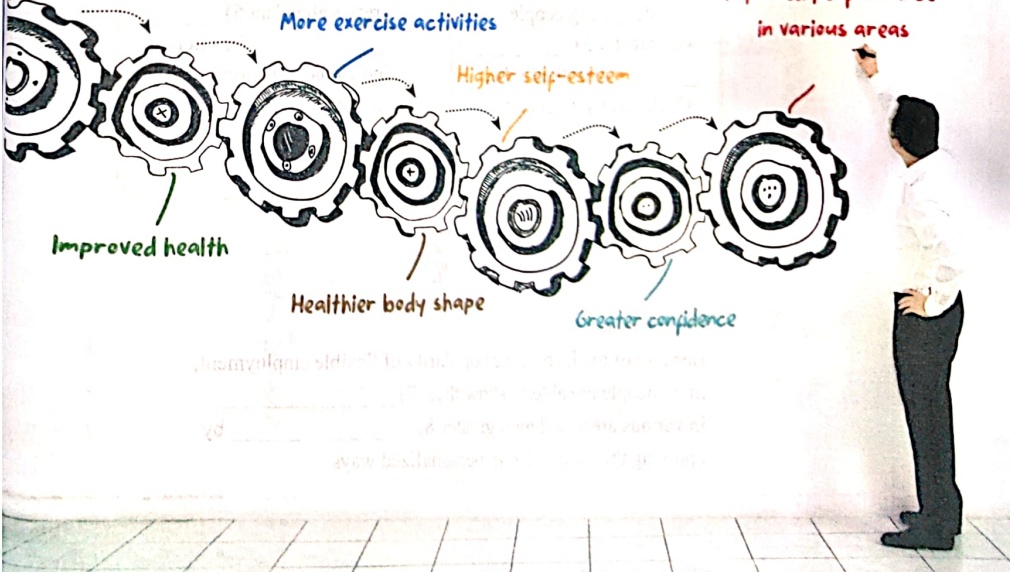
Engaging in light exercises
Improved performance
in various areas
New words
coordinate /kaʊˈɔːdənərt/
vt. 协调(多人参加的活动)
geological
/dʒiːəˈlɒdʒɪkəl/ a.
地质学的
considerable
/kənˈsɪdərəbəl/ a.
相当多的
expertise /,ekspɜː'tiːz/ n. 专门技能(知识)
While you listen

Scan the code. Listen to the passage and complete the following exercises. You may listen to it more than once.
2 Read the chart and fill in the blanks according to what you hear
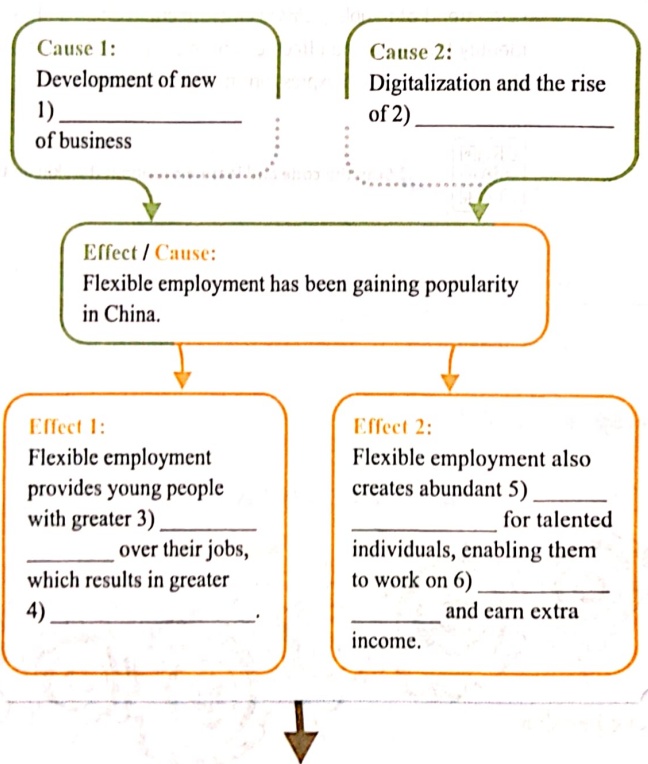
Effect / Cause:
Flexible employment has been gaining popularity in China.
Conclusion:
Because of the increasing popularity of flexible employment, more people are able to show their 7) _____ in various areas and gain greater 8) _____ by applying their expertise in personalized ways.
3 Read the statements and check (✓) the true ones according to what you hear
□ 1 Young people, especially university graduates, are seeking innovative and diverse ways of working.
2 Liu Zhen is a 26-year-old foreign language graduate fluent in multiple languages.
☐ 3 Liu Zhen can choose her clients and projects because she is her own boss.
4 Li Dongqi shares video clips about geology online to popularize geology.
□ 5 Li Dongqi did not expect that he could gain a loyal following and extra income when he started filming his field investigations.
After you listen
4 Work in pairs and discuss the questions.
1 What are the pros and cons of flexible employment?
2 Which one do you prefer, a traditional job or flexible employment? Why?

Viewing world cultures
Before you view
1 Read the program information and answer the questions.
1 What is the “quiet revolution” that is taking place?
2 What reasons can you think of for this change? List at least three ideas.
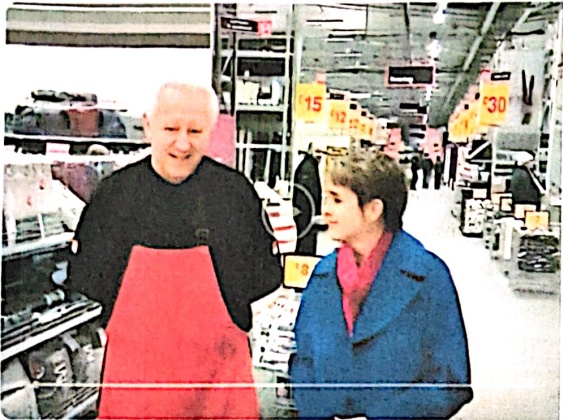
Traditionally, it has usually been women who do part-time jobs when a family needs one parent at home, while men's careers have always come first. But more recently, it's men who are scaling down their work time. With over a million British men now working part-time, a quiet revolution is taking place. In this program, the presenter meets three of these men to find out more about this trend.
New words
Rob Sinclair /rɒb sm'kleə/
罗布·辛克莱(人名)
disrupt /dɪsˈrʌpt/ vt. 扰乱;使混乱
corporate /ˈkɔːpərət/ a.
公司的
on an even keel 平稳的;
稳定的
Richard Steele /,rɪtʃəd
'stiːl/ 理查德·斯蒂尔
(人名)
tablet/taeblit/n. 平板电脑
treble /trebel/ vi. 成三倍
Bernard Brody / b3:n3d
'brəudi/伯纳德·布罗迪
(人名)
boredom /ˈbɔːdəm/ n. 无聊
break the mold /məʊld/
彻底改变格局;打破模式
While you view


Scan the code. Watch the video clip and complete the following exercises. You may watch it more than once.
2 Read the reasons for working part-time. Then match the reasons to the three names according to the video clip.
| Names | Reasons |
| Rob Sinclair ____ Richard Steele ____ Bernard Brody ____ | 1 to make money2 to get his energy back3 to help his wife's career4 to have more time for himself5 to avoid getting bored6 to spend more time with his family |
3 Read the questions and answer choices. Then choose the best answer to each question according to the video clip.
1 What was a big challenge for Rob Sinclair and his wife?
A Achieving a good work-life balance.
B Taking good care of two young boys.
C Making further progress in their careers.
D Earning more money to improve their lives.
2 What did Rob Sinclair do to deal with their problem?
A He spent more time on his writing so as to earn money.
B He cut his working hours to give more time to the boys.
C He cut down on daily expenses to help make ends meet.
D He concentrated on his corporate career instead of writing
3 What did Richard Steele think of his life before he went part-time?
A It was boring.
B It was stressful.
C It was confusing.
D It was frustrating.
4 What does Richard Steele think of his change in pace of life?
A It is a means to regain energy.
B It is a transition to retirement.
C It is a method to escape from reality.
D It is a way to remove barriers in work.
Among the growing number of men choosing to work less than a full week, who make up the majority?
A Men who feel tired from their non-stop work.
B Older men who prefer to stay busy rather than retire.
C Men who enjoy spending more time with their family.
D Older men who want to have more time for themselves.
After you view
$ H_{2}O $
4 Work in pairs and discuss your views on the benefits and challenges of working part-time.

New words
administrator
/ədˈmɪnəstreɪtə/ n.(公司或机构的)管理人员,行政人员
mechanical/mɪˈkænɪkəl/
engineer n. 机械工
程师
agency/eɪdʒənsi/ n.
代理机构
University College
London 伦敦大学
学院(英国的一所公立大学)
Brisbane /ˈbrɪzbən/ 布里斯班(澳大利亚昆士兰州首府)
Watching street interviews

Scan the code. Watch the video podcast and complete the following exercises.
1 Watch the full version of the podcast and summarize its general idea.
2 Read the paragraph. Then watch Part 1 of the podcast and fill in the blanks.

Hi, I'm Hina. I work in London as 1)____. I've learned a lot of skills in my job, and I've made some 2)____
____ at work. Sometimes my job 3) ____ , and I don't get enough time to 4) ____ or even to tidy my flat. What do you do?
3 What do they do? Where do they work? Look at the people and read the statements. Then watch Part 2 of the podcast and check (✓) the true statements.

□ 1 He works as an accountant and he works in London.


3 She is a singing teacher. She works from home and also works in schools.
5 He is retired now. He used to work for a publishing company. He travels down to London maybe two or three times a month.


2 He's a mechanical engineer for an energy company. He works about six hours' drive from where he lives.

☐ 4 He is a charity worker,
so he travels to different
places in the world.

□ 6 He's an expedition leader.
He spends about one-third
of his time outside the
United Kingdom.
4 What are the best things about their jobs? Look at the people and read the statements. Then watch Part 3 of the podcast and match the people A-F to the statements 1-6.
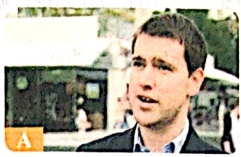





1 The best thing is that no day is ever really the same.
2 I've made some really good friends over the years, from the locals and natives, and the, the local crews I work with.
3 The best things about my job are the different people, er, that I meet, er, from all around the world.
4 I get to be hands-on with everything.
5 I get to travel and, um, a lot of different people every day, and every day is different.
6 Seeing people's faces when you do something for them and seeing little kids, um ... being very happy and laughing, and ... I really love that.
1 What is your current major? What are the typical jobs for the graduates in your field of study?
2 What skills or expertise do you think the graduates in your major should gain for their future jobs?
5 Work in pairs and discuss the questions
3 How do you think graduates in your field can contribute to society through their chosen professions?
Culture notes
University College
London (UCL): a public research university founded in 1826. It became one of the founding colleges of the University of London in 1836. UCL is a multidisciplinary (含有多种学科的) university with an international reputation for the quality of its teaching and research across the academic spectrum (范围). It is regarded as one of the world's most prestigious (有声望的) universities.
Brisbane: the third largest city in Australia, and the capital of the Australian state of Queensland. It has hosted many large cultural and sporting events, including the 1982 Commonwealth Games, World Expo '88, and the 2001 Goodwill Games. It was also rated the 16th most livable city in the world in 2023 by the Economist Intelligence Unit (经济学人智库).
Speaking out
Role-play

Scan the code. Listen to the talk and complete Exercises 1 and 2 on Ucampus.
marine /məˈriːn/ a. 海洋的;海洋生物的
keen/kiːn/ a. 喜欢某事的
Speaking skills
Expressing likes and dislikes
Likes and dislikes are common topics of conversation, and discussing them can help people get to know each other at a deeper level. There are a number of verbs and expressions to show likes and dislikes in English.
Apart from commonly used verbs such as like and love, there are many other verbs and expressions that can be used to express likes. For example, one can say I am keen on listening to music, I adore sunbathing, and He's crazy about that band. These varied expressions allow more precise communication of one's feelings toward activities, people, or objects, enriching conversations with more vivid and specific language.
When we express our likes, it could be very helpful also to share why we like something, adding details like I love playing the guitar because it helps me relax and have fun after school.
In addition to typical verbs such as dislike and hate, there are alternative verbs and expressions that convey a sense of dislike. For example, one might mention She finds onions unbearable, He is fed up with cooking, and I can't stand it when people interrupt me. These varied expressions help convey a broad range of negative feelings, allowing for more detailed and expressive communication about one's dislikes.
Sharing our dislikes may help others understand us better and lead to interesting conversations and discoveries about how we all see the world differently. Everybody has different tastes, and it is fine to dislike something that someone else enjoys.
You may refer to the following table for more expressions that can be used to express likes and dislikes.
Expressions for showing likes
• I like / love / enjoy / adore / fancy ...
• I’m (really) into ...
• I have a soft spot for ...
Expressions for showing dislikes
• I think / find ... is (really) great / wonderful / brilliant / enjoyable / fantastic.
• I'm quite / very / really interested in ...
• I'm a big / true / huge fan of ...
• ... is my thing.
• I’m sick / tired of ...
• I live for ...
• I don't like / enjoy ... (at all).
• I can't bear / stand ...
• ... drives me mad / crazy.
• I think ... is annoying / boring / awful.
• ... is not my cup of tea.
• ... is getting on my nerves.

Scan the code and learn more about the skill on Ucampus
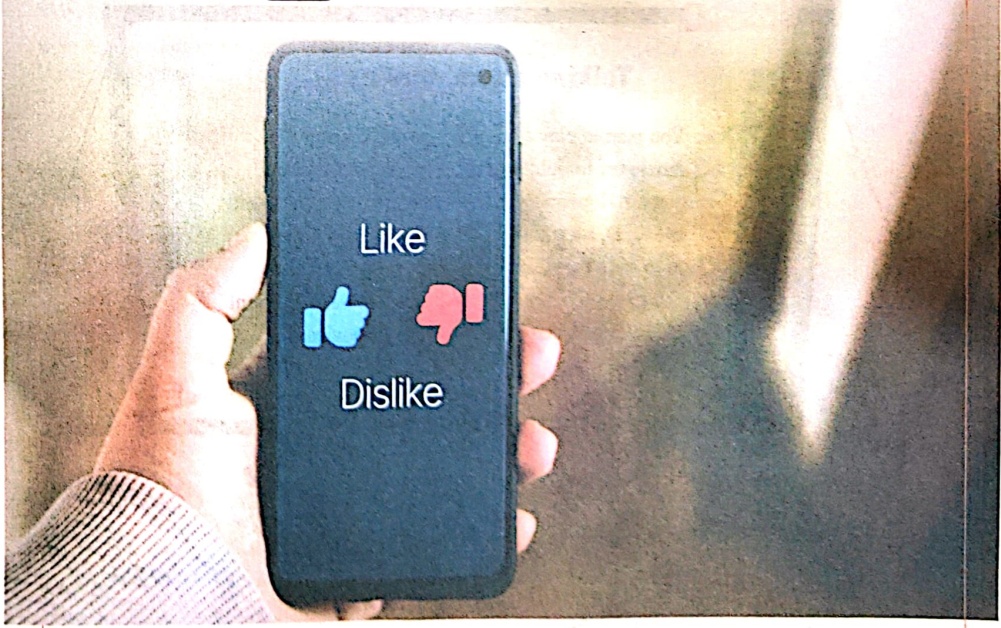
3 Work in pairs and role-play the situations. Use the skills for expressing likes and dislikes.
Situation 1
Talking about flying kites
A: You are going to fly a kite in a park. You meet your classmate, B, in the park. Talk about what you like and dislike about flying kites.

B: You are having a conversation with your classmate, A, about flying kites. Talk about what you like and dislike about flying kites.
Situation 2
Talking about movies
A: You plan to play a movie for tonight's party. Ask your friend, B, what kind of movies they like.
B: You are talking to your friend, A, about tonight's party. Respond to A's questions and show your likes or dislikes toward different types of movies.

Group discussion
Who has the best business idea?
Get ideas


Scan the code. Listen to the talk and complete Exercises 1 and 2 on Ucampus.
Discuss and organize ideas
3 Suppose your university is holding a contest named The Best Business Idea. Work in groups of three, with each member coming up with one business idea. Then discuss the questions and decide on the best idea.
1 What is the name of your business?
2 What is the product / service?
3 How will the business operate?
4 Who will you sell your product / service to?
5 What will you need to start / be successful?
4 Work together to prepare a presentation of your chosen business idea. Use the above questions to organize the supporting details.
Present ideas
5 Present your group's business idea to the class. Before you begin, refer to the checklist to see if you are ready.
| Checklist |
| ☐ Explain our idea with appropriate words and expressions. |
| ☐ Provide convincing supporting details for our idea. |
| ☐ Present our idea in a clear and logical way. |
| ☐ Use appropriate sentence patterns during the presentation. |
| ☐ Use appropriate intonation patterns. |
6 Vote for the best business idea.
Further listening
News reports

Listen to two news reports and complete the exercises on Ucampus.
New words
News report 1
renewable /rɪˈnjuːəbəl/ a.(能源)可 outlook /ˈaʊtlʊk/ n. 前景再生的
deploy/dr/plɔɪ/ vt. 使用;利用
News report 2
recruitment /rɪˈkruːtmənt/ n. 招聘
retention /rɪˈtenʃən/ n. 保留;留住
well-being n. 幸福
spouse /spaʊs/ n. 配偶
front-line a. 一线的
Conversation

Listen to the conversation and complete the exercises on Ucampus.
New words
Monica /'mɒnɪkə/ Green 莫妮卡·格林(人名)
internship /ˈɪntɜːnʃɪp/ n. 实习期的工作
San Francisco /ˌsænfrænˈsɪskəʊ/ 旧金山(美国城市)
Passage

Listen to the passage and complete the exercises on Ucampus.
New words
compensation /ˌkɒmpənˈseɪʃən/
package n. 薪酬包(员工工资及其他福利)
paycheck /'peɪtʃek/ n. 薪金;工资
insult /ɪn'sʌlt/ vt. 侮辱;冒犯
commit /kə'mɪt/ vi. 作出保证
circumstance /'sɜːkəmstəns/ n. 情况;情形
Wrapping up
Use the self-assessment checklist to check what you have learned in this unit.
| OK | Needs work | |
| I can talk about different jobs and work experiences. | ☐ | ☐ |
| I can grasp cause-and-effect relationships in listening. | ☐ | ☐ |
| I can express likes and dislikes by using different expressions. | ☐ | ☐ |
| I can present business ideas clearly and convincingly with supporting details. | ☐ | ☐ |
Unit test


Scan the code and take the unit test on Ucampus.