Unit 6 Miracles of technology

Miracles of technology
Learning objectives
• talk about the technology around us
- use T-charts to take notes while listening
- express opinions
- talk about the benefits and challenges of using AI and provide suggestions



Opening up
Read the following activities and think about how often you do these things. Write O for often, S for sometimes, or N for never. Then work in pairs and discuss your answers.

___ Using ride-hailing apps
___ Making video calls
___ Sending SMS messages
___ Consulting doctors online
___ Using social media apps
___ Using educational apps
___ Shopping online
___ Checking emails
___ Ordering food online
Taking in
Listening to China
Before you listen
1 Work in pairs and discuss the questions.
1 What does “technology gap” mean?
2 What causes the gap?
3 Why is it important to narrow the gap?
Listening skills
Using T-charts to take notes
People often need to take notes while listening. If the listening material involves listing, analyzing, or comparing two aspects of a topic, using a T-chart to take notes is highly recommended. A T-chart, as its name suggests, is a T-shaped graphic organizer in which information is divided into two columns, each with an appropriate heading, thus allowing users to conveniently list or examine two ideas or two facets of a topic.
A T-chart has multiple applications in real-life scenarios. It can be used for comparing two items or ideas, evaluating the pros and cons of a particular option, separating facts from opinions, identifying causes and effects, listing problems and solutions, or showing changes before and after an event. For example, the following pros-and-cons T-chart is often used to categorize information about positive and negative aspects of a topic. In the "Pros" column, you can list the positive aspects of the topic, while in the "Cons" column, you can list the negative aspects of the topic. In this way, it is easy for you to weigh the positive and negative aspects of the topic.
| Pros | Cons |
Now, you are going to listen to a passage about China's efforts to narrow the technology gap in education and medicine. Use the following T-chart to take notes of what China has done in these two fields.

Scan the code and learn more about the skill on Ucampus.
While you listen

Scan the code. Listen to the passage and complete the following exercises. You may listen to it more than once.
2 Read the chart and fill in the blanks according to what you hear.
New words
integrate /ˈɪntɪɡreɪt/ vt. 使结合
telemedicine /ˈteliˌmedsən/ n.
远程医疗
consultation /ˌkɒnsəlˈteɪʃən/ n.
就诊
diagnosis /daɪəɡˈnəʊsɪs/ n.
诊断
China's efforts to narrow the technology gap
Education
• China has been pushing to integrate
- _____ into its education system.
- The government has made significant investments in infrastructure, providing schools with 2) _____ and equipment.
- China has carried out various projects to
- _____.
Medicine
• China has made great efforts to enhance
- _____ innovation in healthcare.
• China's efforts include using digital health technologies to improve access to 5) _____.
• China has adopted advanced technologies to provide earlier and more accurate
- _____.
3 Read the statements and check (✓) the true ones according to what you hear.
☐ 1 The technology gap has been widened with the rapid development of technology.
☐ 2 Today, over 99.5 percent of elementary and junior high schools in China have Internet connectivity.
3 All universities and colleges in China have been equipped with multimedia classrooms.
☐ 4 The Smart Education of China platform provides high-quality educational resources for universities all over the country.
☐ 5 The Internet Plus Healthcare project enables patients to connect with doctors using video consultations.
6 Advanced technologies such as artificial intelligence and big data analytics are used to make improvements in diagnosis and treatment.
After you listen
4 Work in pairs and discuss the questions.
1 What technology tools do you often use in your learning process? In what ways do these tools facilitate your learning?
2 How can technology companies and individuals contribute to narrowing the technology gap?
Viewing world cultures
Before you view
1 Read the program information and answer the questions.
1 How has Shenzhen changed according to the program information?
2 In addition to what has been mentioned in the program information, what else do you know about Shenzhen, for example, its population, education, technology, architecture, and culture?

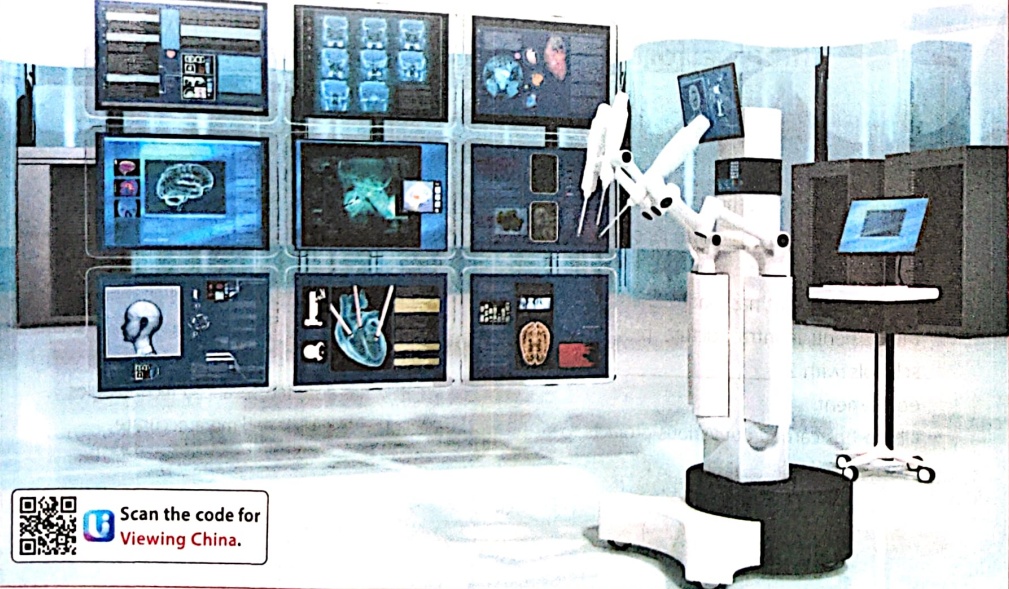
The presenter of this program visits different parts of China and sees how the country is transforming both itself and the world. In this episode, he goes to Shenzhen. Until the late 1970s, Shenzhen was a place of farmland and fishing villages and had just about 30,000 inhabitants. Now, Shenzhen has developed into a major technology and innovation hub in China.
While you view


Scan the code. Watch the video clip and complete the following exercises. You may watch it more than once.
2 Read the questions and answer choices. Then choose the best answer to each question according to the video clip.
1 Why is Shenzhen called China's "miracle city"?
A It has created many economic miracles in China.
B It attracts diverse talent both at home and abroad.
C It has transformed itself drastically in just four decades.
D It plays a significant role in shaping the future of humans.
2 What does Duncan find addictive in China compared with the U.K.?
A The rapid pace of change.
B The innovative atmosphere.
C The incredible opportunities.
D The positive work environment.
New words
teeming /'tiːmɪŋ/ a. 拥挤的;热闹的
epicenter /'epɪsenta/ n. 中心;集中点
expat /eksˈpæt/ n. 居住在国外的人;侨民
entrepreneur /,ontreprəˈnɜː/ n.
企业家
addictive /əˈdɪktɪv/ a. 使人入迷的
blink/blŋk/ vi. 眨眼睛
undeniable /ˌʌndɪˈnɑːrəbəl/ a.
不可否认的;无可争辩的

3 Which of the following inventions does the presenter see during his visit?
A Robots for car parks.
B Robots for cleaning floors.
C Glasses for taking pictures.
D Glasses for health monitoring.
4 For what purpose was the monument erected?
A To honor influential policy-makers.
B To highlight technology development.
C To mark different years of importance.
D To record the speed of economic growth.
5 What does the presenter think about Shenzhen when he compares it with his hometown?
A Its roads are expanding.
B Its city views are pretty.
C Its changes are incomparable.
D Its development is unbelievable.
Read the statements and fill in the blanks according to the video clip.
1 It's become a teeming metropolis of over 12 million people and the epicenter of China's _____.
2 They say if you want to see the future of the _____, you want to come here.
3 Among Shenzhen's population are a growing number of expats — $ \underline{\text{}} $ who could work anywhere in the world, and they're choosing this city.
4 The pace of change here is _____. So much so it even has its own name: "Shenzhen speed".
5 The year 1978 or 1979 is around about the time when things really $ \underline{\text{}} $ here in Shenzhen.
6 When you _____ in the area that I was raised in versus here; it's unbelievable!
After you view
4 Work in pairs and discuss the questions.
1 What do you think has led to the dramatic changes in Shenzhen?
2 Do you know any other cities in China that have also been transformed by technological development? Give specific examples to support your ideas.
Watching street interviews


Scan the code. Watch the video podcast and complete the following exercises.
1 Watch the full version of the podcast and summarize its general idea.
gadget /'gædʒɪt/ n.
小工具
New words
technophobe
/ˈteknəfəʊb/ n. 技术
恐惧者
2 Read the paragraph. Then watch Part 1 of the podcast and fill in the blanks.
devastated /'devəsterɪd/
a. 心神不定的

I love technology. I enjoy reading about
- _____, and I spend a lot of
money on technology. I couldn't live without
my 2) _____ because I 3) _____ with it. How about you? How
do you feel about technology?
3 How do they feel about technology? Look at the people and read the statements. Then watch Part 2 of the podcast and match the people A-F to the statements 1-6.






— I am definitely not a technophobe. Er ... I have learned to love technology very much, though, in my job.
2 For what I do, I'm probably quite a technophobe.
3 I sort of have every latest gadget as it comes out.
4 I love technology – a lot. Um … you know, everything about it, like new gadgets, you know, computers, things like that.
5 I've got lots of gadgets. Er ... I wouldn't be ... I wouldn't, wouldn't know what to do without my laptop.
6 I hate technology. I, I find it frightening and disturbing.
4 Are there any items of technology they couldn't live without? Look at the people and read the statements. Then watch Part 3 of the podcast and fill in the blanks.

I couldn't live without my computer. Um, why not? Because I'm 1)____. It broke down once for three weeks, and I was 2)____.

Um ... I couldn't live without 3) _____. I could probably live without my 4) _____. I quite like leaving it turned off for a while. But, er, the laptop's 5) _____.

My phone. I think, 6) _____, I don't need anything else.

I don't think I could live without my mobile phone. And I couldn't live without the 7)_____ , and I couldn't live without the 8)_____ - because I depend on them.
5 Work in pairs and discuss the topics.
1 What technology items could you live without or couldn't you live without? Why?
2 What are your thoughts on the role of technology in today's society?
3 Moderate use of technology can help us in learning and daily life, but excessive reliance on technology can have adverse consequences. List some detrimental (有害的) effects of overdependence on technology and suggest measures to tackle this problem.
Speaking out
Role-play

Scan the code. Listen to the conversation and complete Exercises 1 and 2 on Ucampus.
New words
genuine /ˈdʒenjuːn/ a. 真正的
minimize /ˈmɪnəmaɪz/ vt. 使减少
到最低限度
perspective /pəˈspektɪv/ n. 看法;观点;视角
Speaking skills
Expressing opinions
In the previous conversation, you may have noticed that native speakers use different expressions to state their opinions. In fact, there are numerous ways to express your opinions in English. What expressions you choose largely depends on how you want to present your opinion.
Firstly, the expressions you choose depend on how strongly you want to express your opinion. This choice may greatly influence how others perceive your message and the degree of emphasis you wish to convey.
If you want to give your opinion moderately, you can use expressions like I think ..., I feel ..., For me (the most important thing is) ..., One thing I'd like to say is that ..., I'm afraid (that) ..., I suppose ..., I mean ..., and In my opinion ...
If you want to give your opinion strongly, you can use expressions like I'm sure that ..., I'd have to say ..., I have no doubt that ..., I'm absolutely convinced that ..., and I strongly believe that ...
Secondly, the expressions you choose depend on how formally you want to express your opinion. Selecting the appropriate level of formality sets the tone for the conversation and ensures that your opinion is received in the intended context.
If you want to give your opinion formally, you can use expressions like My view is that ..., As far as I'm concerned ..., The point I want to make is ..., and I'm convinced that ...
If you want to give your opinion informally, you can use expressions like For me ..., I reckon ..., I guess ..., and If you ask me ...
You may refer to the following table for more expressions that can be used to state opinions.
Expressions for stating opinions
• From my point of view, ...
• From my perspective, ...
• I'm of the opinion / view that ...
• It's my opinion / view / feeling / belief / understanding that ...
• It seems to me that ...
• I hold the view that ...
• As I understand it, ...
• It's quite clear to me that ...
• My personal view is that ...
• As I see it, ...
• Personally, I think ...
• I'd say that ...
• I'd suggest that ...
• I'd like to point out that ...


Scan the code and learn more about the skill on Ucampus.

3 Work in pairs and role-play the situations. Use the skills for expressing opinions.
Situation 1
A conversation at a Chinese language school
An international student has an interest in learning the Chinese language and culture. They want to take a course at a famous Chinese language school. So, they ask a teaching assistant at the language school some questions.
你好
A: You are the international student. Ask the teaching assistant some questions about the content, the duration and the class schedule of the course, and the certificate you can get after completing the course.
B: You are the teaching assistant.
Answer the international student's questions about the course they want to take.
Situation 2
What should we choose for our P.E. class?
A college student is going to choose what they will learn in their P.E. class next semester. They have trouble deciding which one to choose between two options. So, they ask their roommate some questions.
A: You are the college student. Seek advice from your roommate and ask them about their own choice for this course.
B: You are the roommate. Express your opinions about what to choose for the P.E. class and explain the reasons. Then talk about your own choice and the reasons for your choice.

Group discussion
Using AI for the greater good
New words
algorithm /ˈælgərɪðəm/ n. 算法;计算程序
exclusive /ɪkˈskluːsɪv/ a. 独有的 ethical /ˈeθɪkəl/ a. 伦理的;道德的
implication /ˌɪmplɪˈkeɪʃən/ n.
可能的影响(或结果)
prioritize /praɪˈdrɒtəɪz/ vt. 优先考虑(处理)
Scan the code. Listen to the conversation and complete Exercises 1 and 2 on Ucampus.


Get ideas
Discuss and organize ideas
3 Work in groups of three and discuss the benefits and challenges of using AI technology in our lives. Use the T-chart to take notes of your ideas.
| Using AI technology in our lives | |
| Benefits | Challenges |
4 Work together to brainstorm some suggestions to address the challenges of using AI technology. Then prepare a speech to present your group's ideas.
Present ideas
5 Present your group's speech to the class. Before you begin, refer to the checklist to see if you are ready.
| Checklist |
| ☐ Provide a clear analysis of the benefits and challenges of using AI technology in our lives. |
| ☐ Give relevant suggestions to deal with the challenges posed by AI. |
| ☐ Use different words and sentence patterns to add variety to the presentation. |
| ☐ Use appropriate intonation patterns and body language to help convey our ideas. |
News reports

Listen to two news reports and complete the exercises on Ucampus
New words
News report 1
cautiously /'kɔːʃəsli/ ad. 谨慎地;慎重地
overlook /ˌəʊvəˈlʊk/ vt. 忽视;忽略
Sydney /ˈsɪdni/ 悉尼(澳大利亚新南威尔士州首府)
bias /ˈbaɪəs/ n. (研究或实验结果的)偏差
inequity/in'ekwəti/ n. 不公正;不公平
News report 2
University of Illinois /ˌɪlɪˈnɔɪ/ 伊利诺伊大学(美国的一所公立大学)oversized /əʊvəˈsaɪzd/ a. 超大型的 respective /rɪˈspektɪv/ a. 各自的 texture /ˈtekstʃə/ n. 质感;质地
Conversation

6 Listen to the conversation and complete the exercises on Ucampus.
Passage

6 Listen to the passage and complete the exercises on Ucampus.
New words
browse /brauz/ vt.(在计算机或因特网上)浏览信息
equivalent /ɪˈkwɪvələnt/ n. 等同物;对应物
pointlessly /ˈpɔɪntləsli/ ad. 毫无目的地
preserve /prɪˈzɜːv/ n.(某群体的)专属领域
bulk/balk/email n. 大宗邮件
Wrapping up
Use the self-assessment checklist to check what you have learned in this unit
| OK | Needs work | |
| I can talk about technology and its influence on our lives. | ☐ | ☐ |
| I can use T-charts to take notes while listening. | ☐ | ☐ |
| I can use a variety of expressions to express opinions. | ☐ | ☐ |
| I can give a speech on the benefits and challenges of using AI technology in our lives and provide suggestions to address the challenges. | ☐ | ☐ |
$ k\in\mathbb{R}^{m} $
Unit test


Scan the code and take the unit test on Ucampus.
NEUHORIZON 第四版 COLLEGE ENGLISH 新视野大学英语
《新视野大学英语》(第四版)以党的二十大精神为引领,以新时期高等外语教育改革和人才培养方向为指导,参照《大学英语教学指南(2020版)》“基础目标”和“提高目标”的教学要求进行设计。系列教材共设4个级别,包含《读写教程》(配教师用书)、《视听说教程》(配教师用书)、《综合训练》和《长篇阅读》等分册。通过先进的教学理念、科学的教学设计、智能的教学手段,全方位支持大学英语教学,助推中国式教育现代化。
价值引领,深化课程思政
充分发挥教材铸魂育人功能,从主题设定、素材选择和活动设计等方面入手,实现价值塑造、知识传授和能力培养的有机结合,以润物无声的方式帮助学生提升思想水平和道德修养,成为担当民族复兴大任的时代新人。
选材丰富,彰显中国文化
话题选材强调经典性、时代性与趣味性,帮助学生开阔视野、了解世界;多维度彰显中国文化,将其有机融入选材、练习活动与单元任务中,引导学生坚定文化自信,厚植爱国情怀。
因材施教,促进全面发展
练习活动具有丰富性、应用性与思想性,满足不同水平学生需 $ \underset{\cdot}{求} $;通过系统的技能训练、多样的语言活动和真实的产出任务等,提升学生的语言综合运用能力、思辨能力和跨文化能力。
数智创新,赋能智慧教学
充分体现信息技术变革,对教材内容、教学平台和教学资源进行一体化设计,打造纸质教材与数字产品深度融合的新形态;通过完善的服务体系、先进的数字平台、优质的线上资源,驱动外语教学创新模式、提质增效。
项目负责:高阿敏 张萌轩
责任编辑:张萌轩
责任校对:秦学信
封面设计:袁凌
版式设计:付玉梅
《新视野大学英语(第四版)视听说教程2思政智慧版》验证码
数字课程验证码
U卡通课程验证码

高等英语教育出版分社宗旨:
FLTRP Higher English Education Publishing

外研社高等英语资讯


U校AIApp