Chapter 1 Introduction to Academic Writing
Chapter 1 Introduction to
Academic Writing
Objectives
√ Identify different types of academic writing
√ Understand the features of an essay
√ Familiarize yourself with the process of essay writing
1.1 Types of academic writing
As a college student, you may be assigned to write different types of
academic texts, such as essays, term papers, lab reports, book / article
reviews, research papers, posters
[1], etc. What you are asked to write
will depend on your discipline and the course you take. Usually, the format
and requirement of these academic writing tasks may vary , so you
should:
● follow the guidelines given by the teacher;
● ask for examples from previous students;
● do a library or online search for sample writings.
Nevertheless, the different types of academic writing still have
something in common. Academic writing follows a basic structure (e.g.
introduction — body — conclusion); the language being used should be
formal and efficient; there are rules and conventions on citing sources.
Therefore, to fulfill the various writing tasks successfully, you need to know
the basic principles of academic writing and learn the practical skills and
strategies to help you write a well-organized text, which conforms to the
styles and conventions of academic writing.
Exercises
Match the following excerpts (1-3) with different types of academic
writing (a-c).
______a) a lab report ______ b) an essay ______ c) a book review
- One of feminism’s paradoxes — one that challenges many of its
optimistic histories — is how patriarchy remains persistent over time. While
Judith Bennett’s Ale, Beer, and Brewsters in England: Women’s Work in a
Changing World, 1300-1600 recognizes medieval women as historical actors
through their ale brewing, it also shows that female agency had its limits
with the advent of beer. I had assumed that those limits were religious and
political, but Bennett shows how a “patriarchal equilibrium” shut women out
of economic life as well. Her analysis of women’s wages in ale and beer
production proves that a change in women’s work does not equate to a
change in working women’s status. Contemporary feminists and historians
alike should read Bennett’s book and think twice when they crack open their
next brewsky.
- One of the primary methods used to characterize a new compound is
the physical determination of its normal melting and boiling points. The
“normal” melting or boiling point is the temperature at which a substance
melts or boils when the barometric pressure is 760 mmHg or 1 atm. In this
experiment we will first adjust our thermometers using ice and water, whose
normal melting and boiling points are well characterized as 0.0 ℃ and
100.0℃ respectively. Following this, we will measure the normal melting
and boiling points of an unknown compound. We will use the data to
determine the identity of our unknown from a list of possible unknown
samples and physical data from the Chemical Handbook.
- Culture shock is an occupational disease of immigrants who just do
not get accustomed to the foreign country. Similar to most ailments, culture
shock has its own cause, symptoms, and cure.Anxiety over losing all
familiar signs and symbols of social intercourse usually causes culture
shock. In fact, culture shock is ascribed to people’s lack of understanding of
the other nation’s cultural background as well as a lack of communication.
People with culture shock are very likely to reject the foreign environment
making them uncomfortable. What’s worse, they feel regression and miss
their homeland. In order to overcome culture shock, it is helpful and useful
to gain the understanding and means of communication by knowing the
foreign language and becoming a participant observer.
1.2 Introduction to essays
Among the various types of academic writing mentioned in the last
section, the essay is the most popular form of assignment in colleges and
universities.
An academic essay is different from a short piece of composition which
is often completed in an exam and based merely on one’s former experience
and understanding. This type of writing is characterized by the frequent use
of subjective expressions, such as “I think”, “I believe”, and“in my opinion”.
In general, academic essays are more objective in tone and formal in style.
You should come to your own idea after a period of research, which may
involve reading relevant books or articles, doing an experiment or survey,
observing an object or behavior, etc. The arguments you propose need to be
based on the result of your research, rather than your own knowledge and
beliefs.
Most importantly, essays are persuasive and argumentative in nature.
You need to search for relevant information and weigh up the evidence from
different points of view; then develop your arguments. Clear evidence,
relevant examples, and logical reasons must be provided in defending your
claims. In other words, you do not simply transfer information from one
place to another.Instead, you should try to develop your original ideas from
solid argumentation to convince others.As a result, the word count of an
essay can vary from several hundred to several thousand words depending
on the depth of your argument.
Teachers in disciplines such as business, history, education, and
law prefer using essay writing as a form of assessment. One primary reason
is that students are required to demonstrate more than just knowledge —
they also need to read the literature
[2] , exercise critical thinking and
formulate their point of view.
Exercises
Which of the following statements are NOT the features of an academic
essay?
- It is research-based.
- Its tone is objective.
- Its style of language is formal.
- There are many subjective expressions being used.
- Its content is always persuasive and argumentative.
- It is based on the writer’s own knowledge and beliefs.
1.3 Process of essay writing
Since the essay is often assigned as coursework and may constitute an
essential part of course assessment, writing good essays becomes one of the
academic survival skills that each college student should master. However, it
is not easy to write an academic essay successfully due to:
● the extended length of the essay;
● the need of sufficient online / library research;
● the increased level of formality and sophistication of language;
● the conventions
[3] of citing and referencing (see more in Chapter
8).
Considering its complex nature, you should spare enough time for
writing an essay. Do not expect to finish writing a satisfactory essay within
one or two days, since you must follow a set of procedures, each of which is
time-consuming. Usually, the process can be divided into three stages:pre-
writing, while-writing, and post-writing, as shown below.
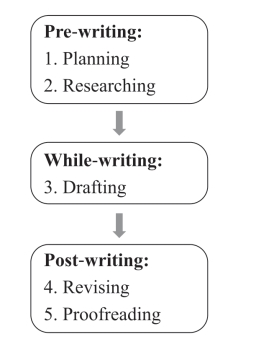
The steps in this diagram are not necessarily rigid or linear. In the actual
writing process, you may move back and forth between these stages, e.g.,
after the first draft you may revise it, and then come to the second draft and
keep revising; or when drafting you may find it lacking of specific evidence,
then you go to do further research on it. All in all, the writing of an extended
essay cannot be accomplished in one go.
1.3.1 Pre-writing
Some of you are likely to neglect the stage of pre-writing, assuming it is
a waste of time to prepare before the “real” writing. However, this first stage
of essay writing sets the basis for your solid argument. It will largely
determine which standard your final essay can reach. The pre-writing stage
mainly includes planning and researching. In fact, planning and researching
are intermingled with each other — the two components can hardly be
discussed separately. For example, your plan about what to write will be
based on the result of your research (i.e., searching for relevant books,
journals or information in the library and on the Internet). Considering the
importance and complexity of researching in the process of essay writing,
we will elaborate about how to do extensive research on a certain topic in
Chapter 2. In this section, we concentrate on several critical steps in
planning, namely, planning the time, content, and structure.
Plan the time
Usually, the teacher will allow you sufficient time to work on your
essay, such as three weeks or two months. You may be tempted to work
slowly or wait to start preparing until the last few days before the deadline,
which will cause you to run out of time. Therefore, at the beginning you
should appropriately allocate the time. An equal allocation of time to each
stage of pre-, while- and postwriting would be suitable for a beginner. For
example, if you have three weeks to work on your essay, the first week
should be devoted to plan and research; in the second week, you may start
your first draft; in the third week, revise the initial draft (if necessary,
produce the second draft and revise), and finally proofread the whole piece
of work.
Plan the content
You should be clear on what to write from the start. There are two
possibilities:
- You are free to choose any topic relevant to the course;
- You are given a specific and set topic / question.
If it is the first case, you must widely search for ideas and sources to
decide on a topic. Merely relying on your assumptions and prior knowledge
is not enough, because you need to find out whether there is enough
evidence available in support of your claims. Try to choose a topic that is:
● interesting (for you and your reader);
● important (e.g., having social or academic value);
● manageable (considering the word limit, your time, etc.);
● adequately sourced with materials.
Then you can narrow down the topic with a specific focus. For
example, you may be interested in the topic of “Artificial Intelligence (AI)”,
but there are many aspects related to it, such as the history of AI, the future
of AI, the impact of AI, etc. Therefore, in the planning stage, you must
establish one focus for your essay in order to explore it in more depth; do not
expect to write everything about the topic — it would make your essay
tedious and pointless.
Finally, formulate a working title for your essay once a specific focus
has been established.This title may be adapted according to the research you
have been doing. Normally, a title reveals information on:
● the general topic;
● the specific focus.
For instance, from the title “An Analysis of the Harm of Indoor Air
Pollution on People’s Health”, we know that the general topic of this essay is
indoor air pollution; the specific focus is the harm on people’s health.
Analysis shows this is an analytical essay. You need to plan the rest of the
essay by adhering to the content of your title.
In the second case, if you are given a specific essay title / question, you
should try to understand the key terms in it and follow the instructions. The
correct understanding of instructional words in each title / question helps
you to identify the essential requirement of the writing task. The following
table lists several commonly used instructional words in essay questions.
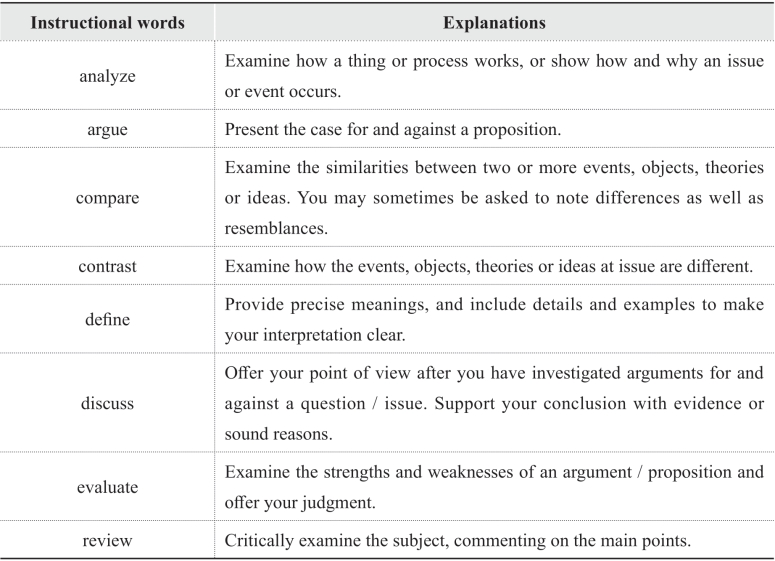
(Adapted from Belmont, W. & Sharkey, M. 2011. The Easy Writer: Formal
Writing for Academic Purposes. Pearson Australia. pp 265-266.)
Plan the structure
Working out an outline is an effective way to help you plan the
structure of your essay (see more in Chapter 3). An outline briefly shows
the major information that you want to cover in the essay,including a thesis
statement
[4], main points of each body paragraph, a conclusion, etc. You
need to organize such information in a clear and logical manner to guide
your following drafting.
In fact, the process of developing an outline is most time-consuming
and significant in the whole pre-writing stage. It requires you to do a lot of
research and reading, develop your thoughts,and finally organize the
information in a sensible order. A well-organized outline with enough
information makes your drafting easy and efficient.
According to the different visual conventions (i.e. symbols) being
used, there are alphanumeric
[5]outlines and decimal
[6] outlines.
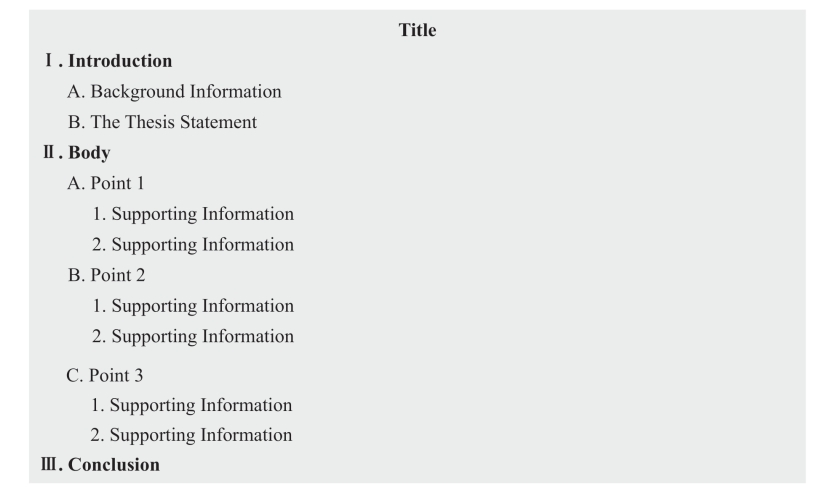
The symbols used in alphanumeric outlines include:
● roman numerals ( Ⅰ, Ⅱ, Ⅲ…): used to mark each major section.
Typically, I is for the introduction, Ⅱ for the body, and Ⅲ for the conclusion.
● capitalized letters (A, B, C...): used to mark the main points within
each major section.
● arabic numerals (1, 2, 3...): used to designate the subdivisions of each
main point.
● lowercase letters (a, b, c...): used if further detail is still required.
The alphanumeric outline is the most common and easily recognized
type of essay outlines. The following is a sample layout (see AppendixⅠfor
examples of different types of outlines):
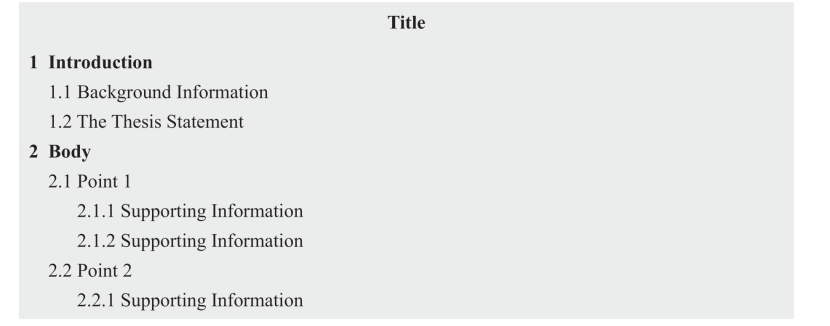
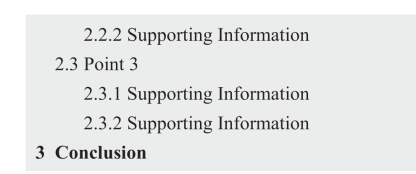
The decimal outline has a similar structure to the alphanumeric outline,
but it uses a series of numbers (the decimal notations) to designate each
subsection, as shown in the sample layout below:
Another way to distinguish outlines is based on different forms of
language being used in each entry
[7] or at each level: if you use phrases, it
is called a topic outline; if you use full / complete sentences, it is called a
sentence outline. You must stick to one format when you are working on
your outline: never mix the use of phrases with sentences (for the topic
outline, use one pattern of phrases throughout, e.g. all noun phrases or all
verbal phrases).
As we combine symbols and language, we get four types of outlines,
i.e. an alphanumeric topic outline, an alphanumeric sentence outline, a
decimal topic outline and a decimal sentence outline. In the process of
planning, you can choose any outline type that suits your need, but bear two
things in mind: (ⅰ) unify the format throughout; (ⅱ) each divided / subdivided
section must have at least two parts (e.g. if you have Point 1, there should
also be Point 2).
1.3.2 While-writing
After all the necessary preparations done in the pre-writing stage, you
can now set about writing your essay. Actually, “drafting” is a more suitable
term to refer to the writing of the initial versions of your essay. This first
draft is often rough and messy, which needs to be revised and polished. Do
not feel reluctant to start your drafting process; the sooner you begin, the
more time you left for revising and polishing.
The first draft is your first attempt to develop your ideas based on the
outline you have worked out and the research you have done. Following the
structure
[8] of the outline, you can start drafting the different parts of your
essay, word by word, sentence by sentence. Many of you would like to
write with a computer, which has obvious benefits, e.g. Microsoft Word
can check the spelling and change the wrong spelling automatically. But you
may not be able to see traces of scribbling and alteration made on a
manuscript (a handwritten document). Such scribbling or messiness is
regarded as a key feature of drafts: you can move back and forth to change
a phrase or add an idea, etc.
Usually you will begin your draft from the introduction part; then the
body part and finally the conclusion. The most important element in your
introduction is the thesis statement. In your outline,you have formulated a
thesis. During the process of developing and organizing your ideas while
writing / drafting, you may feel the need to adapt or even change the thesis.
It is reasonable to do so,because the thesis (the main argument) of the essay
governs the rest of ideas and you need to make the body paragraphs follow
the lead of your thesis, without straying from the point.
While writing, you should also try to fit the notes that you have taken
when doing research in different parts of your draft. During the research
stage, you are supposed to take notes from different sources. The notes are
usually in the form of quotations, paraphrases, summaries and your
comments, accompanied by the source information
[9] (i.e., author’s name,
title, publication information, etc.). You can refer to the information in your
notes to support your main arguments as evidence, examples, or useful sub-
ideas.
After finishing your first draft, you should set it aside for one day. The
next day reread what you have written carefully and with a critical eye; then
make the necessary changes and improvements to produce a second or third
draft.
1.3.3 Post-writing
In the post-writing stage, you revise and proofread your draft to make it
more satisfactory.Revising means correcting or improving a piece of writing
from various aspects, and proofreading is the last step of revising, which
focuses on issues like formatting problems and surface errors such as
misspellings, errors in grammar and punctuation.
Some of you may think that after writing your first draft, everything is
done, and you can hand it in to the instructor — this is a common
misconception. Your draft is bound to irritate your instructor because he /
she can easily find many problems and errors in it, which will lead to a poor
grade for your essay. Don’t falsely think “I have worked hard on my draft
that I cannot afford to throw any of them away or do any change”. As
writers, we often produce lots of material that needs to be discarded or
replaced. You need to learn to trim things down and polish them. To some
extent,revision can be regarded as the most significant procedure in
academic writing, as the American writer William Zinsser put it, “Rewriting
is the essence of writing well — where the game is won or lost.”
Generally speaking, you should revise your drafts from four aspects:
the content, the organization / structure, the language style, and the citations
and references.
Content
The content is the essence of your essay. Since an essay is always
persuasive and argumentative,your positions and the way you defend your
arguments comprise the main content. Check the following list of questions
to decide whether you need to revise your draft:
● Have you done everything the assignment requires?
● Are the arguments you made accurate and complete?
● Have you supported each point with adequate evidence, examples or
reasons?
● Have you developed your arguments in a logical way?
● Is all the information relevant to the overall writing goal?
Organization / Structure
The words “organization” and “structure” can be used interchangeably.
They both refer to the ways in which the different parts of something are
connected and arranged. An essay basically contains three parts, i.e.
introduction, body, and conclusion. The title and the reference list are also
necessary. Check the following list of questions to decide whether you need
to make revisions of the overall organization and the structure within each
paragraph:
● Does the text have all the required sections, including the title, the
introduction, the main body, the conclusion and the reference list?
● Is there a clear thesis statement in the introduction?
● Is each body paragraph related to your thesis?
● Is there a topic sentence
[10] in each body paragraph?
● Are the paragraphs arranged in a logical sequence?
One effective way to check the structure of your writing is to make a
reverse outline after you have written the first draft. See more in Chapter 3
for the essay organzation / structure.
Language style
Academic writing is usually objective in tone and formal in style. Its
language should also be clear and efficient. When checking the language
style of your draft, you should pay attention to the following aspects and
make appropriate revisions to make it adhere to the features of academic
writing.
● Is the language objective, e.g. are there more third-person point of
view than first- and second-person?
● Have you varied the length and structure of your sentences?
● Are there slang phrases, idioms, or colloquial expressions in the text?
● Have you used language that reflects the values and biases of a male-
dominated society (i.e.sexist language such as policeman, salesman)?
● Are there many repetitions?
See more in Chapters 4-7 for the language style of an essay.
Citations and references
Different from the general types of writing, academic writing requires
you to cite from others(i.e. borrow others’ words or ideas) and acknowledge
the sources. So, you need to use appropriate forms of citations and
references in your essay. Check the following questions:
● Have you appropriately used quotations, paraphrases, or summaries
in the text?
● Have you referred to the sources when citing from them?
● Are the sources being cited referenced accurately in the text and in
the reference list?
See more in Chapter 8 for citations and references.
After revising from the above four aspects, you need to do the last thing
before turning in your essay, that is, proofreading. Read your essay slowly,
word by word and sentence by sentence, trying to identify the formatting
problems, spelling errors, punctuation errors, and grammar errors. Those
careless errors will probably distract your reader from what you want to say;
therefore it is worth paying attention to the details that help you to make a
good impression. In this process, you can keep handbooks and dictionaries
close at hand as they could be helpful. You also need to refer to the format
requirements of the assignment if there are any.
There are several tips for you to revise or proofread more effectively.
First, work from a printed copy, since it is easier on the eyes. Problems that
seem invisible on the screen tend to show up better on paper. Another tip is
to read the draft out loud — it may help you to concentrate and to be more
acute to the flow of sentences. Finally, do not try to revise everything at one
time. You can focus on one aspect or one type of errors at a time, for
example, checking the content for the first round of revision, then the
organization.
Exercises
- Read the following titles and decide whether they are appropriate
for writing a 500-word essay. Give your reasons and change those
inappropriate ones.
- The Influence of Artificial Intelligence
- Why Some of Us Get Spider Phobia?
- Effective Ways to Lose Weight
- British Education System
- Chinese Economic Development in the Past Decade
- The Analysis of the Security of Nuclear Power Plants in the US
- Suppose you are required to write a 500-word essay for the course
of “Academic Writing”. Work in a group and share what essay topic you
want to write about. Discuss with each other to narrow down your topic and
work out a working title.
The
general
topic
of
my
essay
is_____________________________________________
The
specific
focus
of
the
topic
is____________________________________________________________
_____________________________________________
A
working
title
for
my
essay
is____________________________________________________________
_____________________________________________
- Complete the following outline with suitable content.
The Impact of Long Screen Time on College Students’ Health
I. Introduction
A. Background information: Most college students spend long hours
on looking at the screen of digital products.
B. Thesis statement: Long screen time has negative effects on
students’ physical and mental health.
II. Body
A. Long screen time has negative effects on students’ 1)
______________.
- College students may spend less time on 2) ______________
because of long hours on smartphones or computers.
- Long screen time will lead to many health complaints.
a. It does harm to 3) ______________.
b. It does harm to 4) ______________.
c. It does harm to 5) ______________.
B. Long screen time has negative effects on students’ 6)
______________.
- Students may become reluctant to have face-to-face communications.
- Long screen time will lead to depression and anxiety.
III. Conclusion
- In Exercise 2, you have decided on the topic and worked out a
working title for your essay assignment. Now, continue to produce an outline
for your essay. You may need to do some relevant research and reading.
Choose a type of outlines that you prefer.
- Read the following statements related to the procedures of writing
an essay. Decide whether they are true (T) or false (F).
[T / F] 1) It is possible to finish writing a good essay in one go.
[T / F] 2) The preparations made before writing are not very important.
[T / F] 3) You need to use a critical perspective to reread your drafts.
[T / F] 4) An outline helps you to plan the structure of your essay.
[T / F] 5) When proofreading, you should check whether the thesis has
been clearly presented.
[T / F] 6) To certain extent, rewriting / revising is more important than
writing / drafting.
- Read the following body paragraph of a student’s first draft of an
essay and focus on the revision of its structure. Check:
- Is there a topic sentence? If yes, underline it. If no, add an
appropriate topic sentence.
- Do the rest of sentences support the topic sentence? If no, delete the
irrelevant sentence(s).
AI Is Not a Bane for Human Beings
It is argued how AI could help people live a better life. There are robots
that are created to keep people healthy with medical technologies like
Baymax in Big Hero 6. They act as family doctors, and make sure their
owners’ body situation whenever and wherever their owners are. AI also
help with our work by finishing dull work efficiently, and more economic
benefits have been created. It is not difficult to understand that people
benefit from AI like these which could prevent them getting sick and are less
likely to go to the hospital and see a doctor. Although AI is not widespread
in common people and its advantages have not seen obviously, AI do help
people improve the quality of life to some extent.
- Proofread the following sentences which are taken from students’
drafts. Correct spelling errors,punctuation errors, and grammar errors.
- As development of the Internet, online shopping becomes more and
more popular and there are enorous deals finished on line.
_____________________________________________
_____________________________________________
- In China, we have sharing bikes while most of countries not.
_____________________________________________
_____________________________________________
- Such huge study pressure can easily make their psychology to
become very fragile, which results in excessive anxiety and lower learning
efficiency as well.
_____________________________________________
_____________________________________________
- Take the Australian government, for instance, it has introduced
several measures.
_____________________________________________
_____________________________________________
- Every individal in labor market, especially the college student, is
required to pay more attention on improving our professional skill,
constantly aiming at the mastering scientific knowledge.
_____________________________________________
_____________________________________________
【注释】
[1]poster n. a visual display outlining the work or project one has been
involved in 海报
[2]literature n. books and articles (that have been published ) on a
particular subject 文献,资料
[3]convention n. the way in which something is done that most people in a
society expect and consider to be the right way to do it; a normative way
惯例,规矩
[4]thesis statement n. the main argument of a piece of writing 中心句
[5]alphanumeric a. containing both letters and numbers 字母数字的
[6]decimal a. based on or counted in tens or tenths 小数的,十进位的
[7]entry n. an item, for example a piece of information, that is written or
printed in a dictionary, an account book, a diary, etc. (词典等的)条
目
[8]structure n. the way in which the parts of something are connected
together, arranged or organized 结构The structure of an outline is a rough
framework for the essay. See Chapter 3 for the detailed explanation of the
structure of an essay.
[9]quotations, paraphrases, summaries & source information: These are
important notions related to the citing and referencing conventions of
academic writing, which will be elaborated in Chapter 8.
[10]topic sentence n. a sentence that states the main idea of the paragraph 主
题句