Chapter 4 Formality
Chapter 4 Formality
Objectives
√ Understand formality
√ Use formal and academic vocabulary
√ Use more complex sentences
√ Minimize the use of first and second person pronouns
√ Avoid the use of rhetorical questions
Formality is the first and foremost requirement of academic writing.
The formal style is usually marked by an objective, complex and precise use
of language, in contrast with the informal and colloquial style. To be formal
in your writing, avoid using the words, phrases, or sentences that are
frequently used in daily conversations, and avoid using techniques that are
often used in speeches.In particular, you can write a formal essay by:
● using advanced, precise and academic vocabulary;
● using complex and compound-complex sentences;
● minimizing the use of first and second person pronouns;
● avoiding the use of rhetorical questions.
4.1 Using advanced, precise and
academic vocabulary
Word choice is vitally important for achieving formality in academic
writing. You should raise the awareness to use formal words instead of their
informal and colloquial equivalents. One simple way to distinguish formal
and informal words is to count the syllables
[1] a word has. Words with one
syllable are commonly used in daily speeches; they are often informal and
are usually adjectives and verbs. For example:
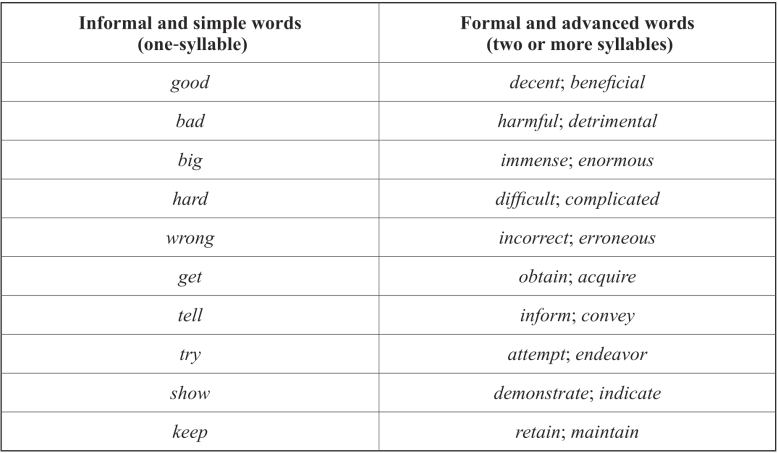
Adjectives: good, bad, big, hard, wrong…
Verbs: get, tell, try, show, keep…
In contrast, words with two or more syllables are more formal and
advanced than their onesyllable counterparts. Compare the words in the table
below. The words in the right column are the equivalents of the words in the
left column, but their meanings are more precise and their levels of formality
are higher. In academic writing, you should increase the proportion of using
such formal and advanced words which always have two or more syllables.
In addition, phrasal verbs (a verb + preposition / adverb), such as put
off, look into, come across,etc. are also considered informal. Typically, their
meaning is not obvious from the meanings of the individual words
themselves. Therefore, they must be understood as a whole. Phrasal verbs
are mainly used in spoken English and informal texts. In academic writing it
is preferable to use a formal alternative (i.e. one word verb), for example,
use postpone rather than put off. More examples are shown below.
look into → investigate
find out → discover
cut down → reduce
set up → establish / found
bring about → cause / produce
You may notice that these phrasal verbs all contain a one-syllable verb,
like look, find, cut or set. They are informal in nature, and thus need to be
avoided in academic writing. However, some phrasal verbs containing a
two-syllable verb, e.g. account for, carry out, consist of, dispense with, or
follow up, may be more formal. From time to time, such phrasal verbs will
be found in an academic essay. Therefore, note that although you should
generally avoid the use of phrasal verbs in academic writing, their usage
cannot be totally ruled out.
In oral English, several nouns like stuff or thing are often used to
express vague and imprecise meanings. Like the following examples:
- I’ve got loads of stuff to do today. (stuff = tasks)
- The chairs were covered in some sort of plastic stuff. (stuff =
material)
- She’s very fond of sweet things. (things = foods)
- He’s just bought one of those exercise things. (things = equipment)
In these examples, stuff and thing are used to refer to any object,
feature, or event, etc. when you cannot, need not, or do not want to refer to it
more precisely. They are acceptable and normal in spoken language. But in
academic writing, you need to use precise and specific words or phrases to
replace such vague expressions. As illustrated in the bracket after each
example: in Example 1, stuffactually refers to tasks or jobs; in Example 2,
stuff refers to a kind of materials; in Example 3, things refer to foods; and in
Example 4, things refer to equipment.
In Examples 1-4, you may notice another informal use of language in
terms of vocabulary — contractions
[2], such as I’ve, She’s, and He’s.
Contractions are commonly used in speech or written dialogue , which
show an informal tone. In academic writing, you should use the complete
forms of words or phrases in order to establish a more serious tone, instead
of using their contractions, for instance:
I’ve → I have
She’s → She is
He’s → He is
won’t → will not
wanna → want to
gonna → going to
kinda → kind of
A high-frequency academic word list has been developed by Averil
Coxhead at the Victoria University of Wellington, New Zealand. It is called
the Academic Word List (AWL), which contains 570-word families and is
divided into 10 sublists (see Appendix Ⅱ for all the word families in the
AWL). You should attempt to learn the various derivations (i.e. the verb,
noun, adjective and adverb forms) of the word families given. For example,
the first word family in Sublist 1 is “analysis” (the noun form). But you need
to know the other forms derived from this word family, including:
● the verb forms: analyse / analyze;
● the adjective forms: analytic / analytical;
● the adverb form: analytically;
● the other noun form: analyst.
The words selected for the AWL are those occur frequently in a range
of academic subjects,including the Arts (including history, psychology,
sociology, etc.), Commerce (including economics,marketing, management,
etc.),
Law
and
the
Sciences
(including
biology,
computer
science,mathematics, etc.). The AWL is useful to all second-language
learners who wish to study in an English-speaking university and college. If
you can make appropriate use of the vocabulary in the AWL when writing
your academic essays, it will largely enhance the formal and academic tone
of your writing.
Exercises
- Underline the informal expressions in the following sentences and
replace them with more formal equivalents. The first example has been done
for you. In some sentences, there may be more than one informal expression.
Example: Investors were storing up a lot of cash in anticipation of
disasters.
a
lot
of
→
a
great
deal
of____________________________________________________________
______
- He worked together with his son Michael on the English translation
of a book on food production.
___________________________________________________
- After six months the dieter is behaving according to the goals and
she has achieved a big reduction in sugar intake.
___________________________________________________
- Recycling this wasted stuff would have a positive effect on
environmental protection.
___________________________________________________
- His mother did well in keeping the peace between these two very
different men.
___________________________________________________
- It’s not polite to cut in when someone is speaking.
___________________________________________________
- He should have looked into how the patient has handled previously.
___________________________________________________
- It wasn’t easy for them to accept or put up with differences in each
other.
___________________________________________________
- Modern houses have many labor-saving things such as washing
machines and dishwashers.
___________________________________________________
- The words listed in the following box are from the word families in
the Academic Word List (AWL).Choose the most suitable one to complete
each sentence. Change the form where necessary.
constitute economical evidence inconsistent
interpret similar specific underestimate
- We need to find a more ____________ way to manufacture our
products because our profit margin is too low.
- The DNA of chimpanzees shows a remarkable ____________ to that
of humans.
- The police freed a suspected murderer because they didn’t have
enough ____________ to charge him.
- Canada’s aboriginal population ____________ a small but important
part of the country.
- Gasoline has no ____________ freezing point; it freezes at any
temperature between -180 and-240 degrees Fahrenheit.
- They need an accountant to ____________ their financial statements.
- The ____________ in the quality of food at that restaurant has
discouraged many customers from continuing to eat there.
- Experts warn that many parents continue to ____________ the risks
their children take when using the Internet.
4.2 Using complex and compound-
complex sentences
Besides word choice, the use of sentence types is also a crucial factor
that will influence the formality of your essay. In English grammar, there are
four types of sentences: simple, compound,complex, and compound-
complex. Good writing always requires a mixture of all four kinds of
sentences. However, writing with complex and compound-complex
sentences is generally considered more mature, advanced and academic. The
use of these two sentence types are effective in achieving the formal style.
An essay with only short, simple sentences is boring and not academic,as is
the writing that uses too many compound sentences. Therefore, compared
with general writing,the proportion of complex and compound-complex
sentences should be more than that of simple and compound sentences in
academic writing.
4.2.1 Simple and compound sentences
Before illustrating how to make complex and compound-complex
sentences, first you need to know a very important concept — clauses, which
are the building blocks of sentences. A clause is a group of words that
contains (at least) a subject and a verb. There are two kinds of
clauses:independent and dependent. An independent clause contains a
subject and a verb and expresses a complete thought. It can stand alone as a
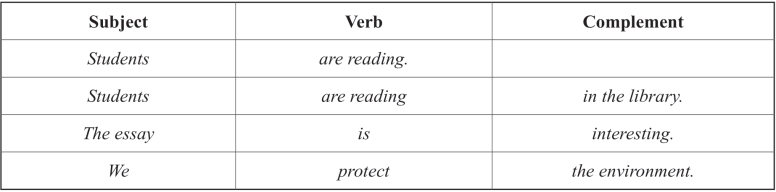
sentence by itself. In other words, an independent clause forms a simple
sentence, which has one subject and one verb, and may (but not must)have a
complement. The subject tells who or what does something; the verb tells
the action; the complement completes the meaning of the verb or adds more
information to the sentence.
See the examples of simple sentences (also the independent clauses)
below.
Then, two or more independent clauses can be joined together to form
a compound sentence.There are three ways to join such clauses: (ⅰ) with
a coordinator
[3] (e.g. and, but, so, yet, for,(neither)…nor…,
(either)…or…); (ⅱ) with a conjunctive adverb, also called an
adverbial conjunction (e.g. however, meanwhile, besides, therefore,
in addition); (ⅲ) with a semicolon
[4].
See the examples of the compound sentence below.
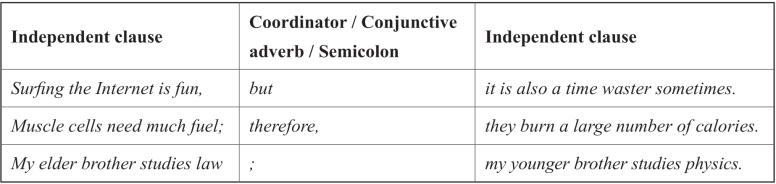
Notice the punctuation when making a compound sentence. In the first
example, there is a comma (,) after the first independent clause, without any
punctuation after the coordinator but. In the second example, a semicolon (;)
follows the first independent clause, and a comma (,) follows the conjunctive
adverb therefore. In the third example, the semicolon (;) is used by itself,
without any connecting word — this method can be used only when the two
independent clauses have a very similar structure or when the relationship
between the two clauses is quite obvious.
4.2.2 Complex sentences
Since simple and compound sentences just involve one type of
clauses, their structure is not sophisticated. As we have mentioned, the
overuse of simple and compound sentences in an essay will undermine its
academic style. Therefore , you should learn to make more complicated
sentences ,i.e. the complex and compound-complex sentences , where
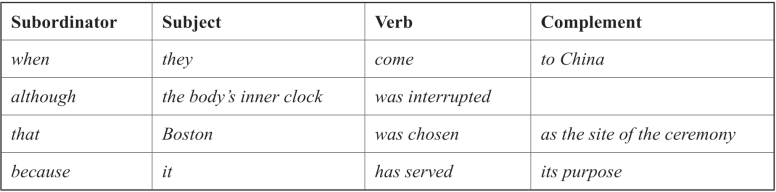
another type of clauses — dependent clauses — is required. A dependent
clause, also called a subordinate clause, begins with a subordinator
[5] such
as when, while, if, that, or who, followed by one subject and one
verb, and sometimes a complement. It does not express a complete thought
and cannot stand alone as a sentence by itself.
The followings are the examples of the dependent clause.
A complex sentence is a sentence that combines one independent clause
with at least one dependent clause. The independent (main) clause contains a
more important idea, while the less important idea is placed in the dependent
/ subordinate clause. In complex sentences, dependent clauses usually
function as adjectives, adverbs, or nouns. According to their functions,
dependent clauses can be further divided into three types: adjective clauses,
adverb clauses and noun clauses.
An adjective clause, also called a relative clause, begins with a relative
pronoun such as who,whom, which, whose, or that, or with a relative adverb
such as where or when. It modifies or describes a noun. An adverb clause
begins with an adverbial subordinator such as when, while,because,
although, if, so that, etc. It adds information that explains when, where, why,
how, how much or under what condition the action in the main clause takes
place. A noun clause begins with a wh-question word, that, whether, or
sometime if, and serves as a noun within the sentence. It can be the subject
or the object. Take a look at the following examples:
● with an adjective (relative) clause:
- The old lady who needs constant attention is cared for by relatives.
- Processed foods are the kind of foods which have been chemically
processed.
● with an adverb clause:
- If an important passage is highlighted by multiple users, that
information will be stored on the cloud.
- She seems to be forever on a diet, since she puts on weight easily.
● with a noun clause:
- Whatever the boss decides to do will significantly influence the fate
of the company.
- Experts believe that the coming drought will be extensive.
Examples 1 and 2 are complex sentences with adjective (relative)
clauses. In Example 1, the dependent clause who needs constant attention
begins with the relative pronoun who and functions as an adjective to modify
the old lady. The main / independent clause is the old lady is cared for by
relatives. In Example 2, the dependent clause which have been chemically
processed begins with the relative pronoun which and functions as an
adjective to modify foods. The independent clause is Processed foods are the
kind of foods.
Each of the two complex sentences contains an adverb clause in
Examples 3 and 4. In fact, the position of adverb clauses is flexible — they
can be at the beginning, in the middle, or at the end of a sentence. In
Example 3, beginning with the subordinator if, the dependent clause If an
important passage is highlighted by multiple users comes at the beginning of
the sentence. It explains under what condition the action of “being stored on
the cloud” takes place. In Example 4, the adverb clause since she puts on
weight easily follows the main clause to clarify the reason why She is
forever on a diet.
Examples 5 and 6 are the complex sentences with noun clauses. In
Example 5, the subordinate clause, whatever the boss decides to do,
functions like a noun and serves as the subject of the sentence. This sentence
is considered a complex sentence because it has both an independent
clause(the entire sentence) and a dependent clause (whatever the boss
decides to do). In Example 6, the noun clause that the coming drought will
be extensive serves as the object of the whole sentence.
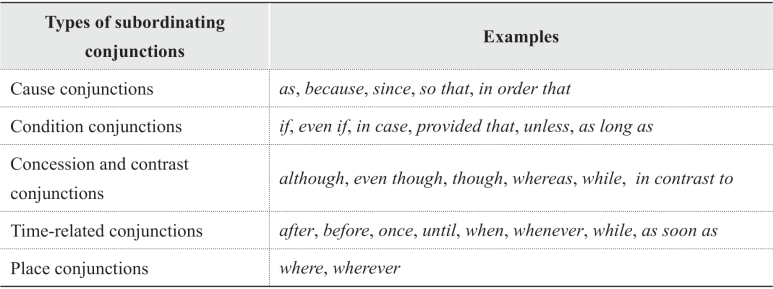
Notice that in the complex sentences with adverb clauses, the use of
different subordinating conjunctions can result in various relationships
between the main (independent) and subordinate(dependent) clause. There
are five main types of subordinating conjunctions as shown below, based on
the type of meaning they convey.
4.2.3 Compound-complex sentences
Compound-complex sentences, are the most complicated sentences, as
their name implies.A compound-complex sentence has at least two
independent clauses and at least one dependent clause. Therefore, many
combinations of clauses are possible, and their punctuation requires careful
attention. There are a few examples below.
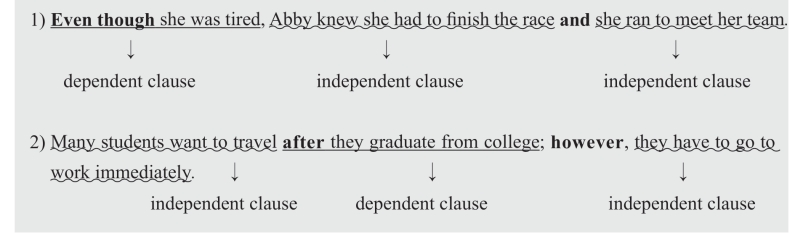
In the first example, there are one dependent clause beginning with the
contrast conjunction even though and two independent clauses connected by
the coordinator and. A comma (,) is used to divide the dependent and
independent clause, while no punctuation is used between two independent
clauses. The second compound-complex sentence also contains two
independent clauses (connected by the conjunctive adverb however) and one
dependent clause (beginning with the time-related conjunction after). There
is no punctuation between the independent and dependent clause, but a
semicolon (;) is used to separate the two independent clauses with a comma
(,) after the conjunctive adverb, however.
Compound-complex sentences help you express longer and more
complicated thoughts by using more parts than other types of sentences.
They are essential and effective in explaining complex relationships and are
frequently used in analytical writing. This complicated sentence structure
adds to the formality of an essay. However, if handled poorly, compound-
complex sentences may cause confusion and grammatical errors. Writing
experts would suggest you minimize their use, restricting them to no more
than 10 percent of your work.
All in all, it is a wise choice to vary the sentence structures in your
essay by mixing the use of the four sentence types. But to some extent, the
complexity of language reflects its formality. Since complex and compound-
complex sentences are considered more academic and formal than simple
and compound sentences, you may use more of the former where possible in
your essay.
Exercises
- Identify the dependent and independent clauses in the following
sentences. Draw a straight line “_____”under the dependent clause and draw
a wave line “ ” under the independent clause.
- Those who scored higher on cellphone dependency often used their
phones to make themselves feel better.
- Since the blueprint presents the details of the engineer’s plans, it
must be interpreted accurately by the contractor.
- Usually I take a walk every day while the sun sets, but it is raining
today.
- About half of the world’s current population lives in urban areas, and
that number is expected to increase.
- The report stated that even when men’s working hours were reduced,
they used the extra time for leisure activities rather than for housework or
childcare.
- Conjunction serves as an important element to make compound,
complex or compound-complex sentences. Choose the best conjunction for
each of the following sentences.
- Brainstorming can be done individually, ________ it seems to work
best with about five to seven participants. (and / but / so)
- Students should declare a major by their junior year ________ they
have not made up their minds.(when / until / unless)
- ________ the bad weather, they decided to have a picnic. (Because /
Despite / Whereas)
- You can drive a car ________ you have a valid license. (provided
that / before / though)
- Physical Education is allotted an entire period of the day, ________
it is essential to students,________it should be. (while / because / even
though, yet / so / or)
- ________ housework and childcare are included, women work more
hours per week than men,________they earn less than men. (If / Since / Till,
but / and / for)
- Some of the studies show positive results, ________ others do not.
(however / whereas / so)
- Men are anxious to improve their circumstances, ________ they are
unwilling to improve themselves; ________ they remain bound (make no
progress). (and / or / but, therefore / unless /moreover)
- Use what you have learned about the four types of sentences to
improve the following paragraph,which contains too many short, simple
sentences. Use different methods of combining the sentences and write a
new paragraph with a higher proportion of complex and compound-complex
sentences.
Understanding body language can lead to closer relationships.
Nonverbal communication constitutes up to 60% of meaning in interpersonal
communication. Notice the signals. People send out with their body
language. Be able to effectively read those cues. It is a very useful skill.With
a little extra attentiveness, one can learn to accurately read body language.
With enough practice it can become second nature.
___________________________________________________
___________________________________________________
___________________________________________________
___________________________________________________
___________________________________________________
___________________________________________________
4.3 Minimizing the use of first and
second person pronouns
A personal pronoun refers to a particular person, group or thing.
Personal pronouns can be classified into three types:
● first person pronouns: I, we, me, us, my, our …
● second person pronouns: you, your
● third person pronouns: he, she, it, they, his, him, her, its, their …
4.3.1 First person pronouns
With first person pronouns, the writer is referring to himself / herself
directly (e.g. I did something, my reason is …). But in essay writing, you
will not be asked to write personal narratives.Instead, you will be asked to
write arguments, often researched arguments, in which personal stories are
subordinate to researched evidence. However, if you decide it would be
effective to include a personal story as well, then first person pronouns are
appropriate in that section only.
Also, in academic writing, it is important to avoid personal bias and
subjectivity. If you constantly use expressions like in my opinion, I strongly
believe, as far as I am concerned, it would leave readers an impression that
the essay is based on your own ideas or opinions rather than facts and
evidence. In addition, since the whole essay is a development of your
opinion, it is unnecessary to clarify that a specific point is your idea. If the
viewpoint in your essay is not your idea, but from the works of others, you
need to cite it by adopting the citing and referencing conventions (See more
in Chapter 8).
On the other hand, the first-person plural we may be more tolerable in
academic essays, because we can refer to the reader and the author, or people
in general. Such usage of we is called the“inclusive we”, which may draw
the readers of the essay closer to the author, and make the essay sound less
subjective. Consider the following example, in which the first person plurals
our and we are used to refer to people in general.
Technology is used to make our life better, but we should not over-rely
on it.
However, sometimes the use of we can be problematic, as in the
following example:
As we all know, raising the retirement age is not an effective
countermeasure to solve the labor shortage.
In this example, the writer uses the expression as we all know to
introduce his / her personal view, rather than a fact that is generally known
or acknowledged by most people. So if the reader does not know or agree
with this statement, it would be quite awkward. We can improve the
sentence by using other impersonal alternatives, such as:
As suggested above, raising the retirement age is not an effective
countermeasure to solve the labor shortage.
It is admitted that raising the retirement age is not an effective
countermeasure to solve the labor shortage.
There are more examples below to show how to avoid the usage of first
person pronouns that would make your essay informal and subjective. The
first and simplest way is not to include the expressions like I think, I believe,
or in my opinion in your essay when you are stating your arguments. You
can directly delete such phrases, and change the following clause where
necessary, as illustrated in Example 1 where the original sentence is quite
informal. In Example 2, there are two improved versions: one is to delete in
my opinion, or I think that; another is to replace these phrases by using the
evidence presented above indicates that. The second version clearly shows
that you are concerned about facts and evidence rather than being influenced
by personal feelings or biases.
Original example 1: I cannot believe how much tuition has increased.
Improved version: Tuition has drastically increased.
Original example 2: In my opinion, / I think that the most effective
way to improve indoor air quality should be to eliminate individual sources
of air pollution or to reduce their emissions.
Improved version 1: The most effective way to improve indoor air
quality should be to eliminate individual sources of air pollution or to reduce
their emissions.
Improved version 2: The evidence presented above indicates that the
most effective way to improve indoor air quality should be to eliminate
individual sources of air pollution or to reduce their emissions.
Secondly, when you are providing evidence to support your arguments,
do not involve your personal experience like I found, as I was reading …, I
noticed that …. Instead, use alternatives that are more objective, such as the
passive voice with a formal subject it (It is / was found that …), or
expressions like according to…, as illustrated in Example 3. In Example 4,
the original sentence using the first person shows the writer’s experience in a
subjective and individual perspective, but the writer’s purpose is to describe
a phenomenon that is in fact objective or independent of that perspective.
Therefore, using the noun this study as the doer of the action of revealing
and avoiding the first person here creates the desired impression of an
observed phenomenon that could be reproduced, and creates a stronger,
clearer statement.
Original example 3: I / We found that with raising the retirement age
per year, the number of the pension reservation will increase 4 billion yuan
while the cost will reduce 16 billion yuan.
Improved version: According to a recent survey, / It was found that
with raising the retirement age per year, the number of the pension
reservation will increase 4 billion yuan while the cost will reduce 16 billion
yuan.
Original example 4: As I was reading this study of medieval village
life, I noticed that social class tended to be clearly defined.
Improved version: This study of medieval village life reveals that
social class tended to be clearly defined.
Another similar example (as shown below) takes place in the
introduction section, where you may need to tell your readers the
organization or the purpose of your writing. Instead of using the first person,
you can use the nouns such as this essay, this article, this thesis, etc., which
stand for the author.
Original example 5: I / We will provide evidence of the harm of
technology to our interpersonal relationship.
Improved version: This essay / article aims to demonstrate the harm
of technology to our interpersonal relationship.
However, there is no strict rule about the total exclusion of first person
pronouns in your essay.Some disciplines or instructors may allow or
encourage you to use the first person. In some style guides, the use of the
first person is also allowed. For example, in the American Psychological
Association (APA
[6]) Publication Manual (6th edition), it is recommended
that authors use the first person to avoid ambiguity when writing research
papers — authors can use the first person while describing actions (e.g.
conducting experiments or surveys) that are actually performed by the
author(s) of the paper.
4.3.2 Second person pronouns
Compared with the first person, second person pronouns (you and your)
are generally unacceptable because they are too casual (informal) for
academic writing. Whereas it is effective and common for speakers to use
you and your to address the audience; if a writer uses them, the writer seems
to be speaking directly to the person reading the essay. It is not appropriate
in the writing assignment scenario at university (while it is fine with
textbooks, like what we are doing right now) — you are not writing an essay
directly to a teacher; rather, you are writing for a broader audience that
includes the teacher, other students, and any other readers who might be
interested in the topic. So an academic writer who uses the second person is
often mistaken about who his / her audience is.
Therefore, when you are writing your draft, avoid using any second
person, reminding yourself that such pronouns are informal for your essay
writing. If you find some carelessly-used second person pronouns when
revising or proofreading your draft, there are several effective ways for
revision.
● Use the impersonal pronoun one. One can be used in formal writing
to refer to people in general. It is gender-neutral. You may replace you / your
with one / one’s.
● Use nouns such as a person (singular form) / people (plural form) and
then use the third person he / she or they for the following reference.
● Change the sentence structure. Do not use the second person as the
subject / actor, but use alternatives like gerunds
[7] or noun phrases which
are impersonal and objective.
Take a look at the following examples which show the possible ways to
avoid using the second person.
Original example 1: If you do not have your breakfast, you will eat
much more food at lunch.
Improved version 1: If people do not have breakfast, they will eat much
more food at lunch.
Improved version 2: Skipping the breakfast will result in (people’s)
over-eating at lunch.
Original example 2: Obesity can be measured by many methods, but
the simplest measurement is Body Mass Index (BMI) which is a useful tool
to determine if your weight is suitable for your sex, age and height.
Improved version: Obesity can be measured by many methods, but
the simplest measurement is Body Mass Index (BMI) which is a useful tool
to determine if one’s weight is suitable for his / her sex, age and
height.Exercises
Rewrite the following sentences by using different ways to avoid the
use of first or second person pronouns.
- My point of view is that smoking after overworking or after
exercising not only cannot relieve fatigue, but also will destroy our health.
___________________________________________________
___________________________________________________
- You may set the air conditioner to a very low temperature in summer.
___________________________________________________
- We found that the rice which is genetically engineered will contain
extra minerals and vitamins.
___________________________________________________
- As long as you pay attention to it, the problem of obesity can be
solved and you can live more happily.
___________________________________________________
- As a basketball lover, I wrote this article to discuss what injuries the
basketball game may bring us and how we can avoid them.
___________________________________________________
4.4 Avoiding the use of rhetorical
questions
A rhetorical question is not a genuine inquiry that is supposed to be
answered. It is often asked for effect, or to lay emphasis on some point being
discussed. For example, How could I be so stupid?Marriage is a wonderful
institution, but who would want to live in an institution? The answer to a
rhetorical question may be obvious or will be immediately provided by the
questioner. In English,rhetorical questions are commonly used in speech and
in informal writing (such as advertisements).They are effective in engaging
the audience, arousing their curiosity, and motivating them to try to answer
the questions that are posed. As a result, people pay closer attention to the
information relevant to the rhetorical questions.
However, rhetorical questions are not appropriate for academic writing,
first because of their informal nature: They are frequently used in oral
English, and you need to avoid using techniques that are often used in
speeches. Second, if you ask a rhetorical question in your essay, you are
asking your audience to think, and your audience is, in most cases, your
teacher. It may not be the student’s role to get the teacher to think about the
content. Third, using a rhetorical question to suggest a point is not as clear
and strong as using a statement. The reader may or may not know the
answer,so you are running the risk of being misunderstood. Finally, if you
ask a rhetorical question and then answer it immediately in order to attract
the reader’s attention, you are actually taking up more space than it would
take to simply state the point.
Consequently, you should avoid using any rhetorical questions in your
essay. Instead, you may change them into statements and still use them
effectively, as the following examples show.
Original example 1: It does not seem to be a significant issue, but just
think it deeper: What does it mean that your information is known by
strangers?
Improved version: It does not seem to be a significant issue, but the
consequences of a person’s information being known by strangers would be
serious.
Original example 2: Do you ever wonder how those people get your
phone numbers and advertise the specific commodity so precisely? The
answer is probably the information leakage.
Improved version: It is the information leakage that probably makes
those people obtain one’s phone numbers and advertise the specific
commodity precisely.
In these two examples, the rhetorical questions are used by a student to
develop his arguments in an essay concerning Internet security. You may
notice that the combining use of rhetorical questions and second person
pronoun you or your renders the essay too informal. It seems that the author
is directly talking to the reader. Such usage could be highly effective in a
speech to engage the audience to think and follow the speaker’s thoughts.
But in academic writing, you must avoid using both rhetorical questions and
the second person pronouns. Therefore, we can revise the original examples
to make them formal and impersonal. In the first example, the meaning of
what does it mean is not clear and different readers may have different
answers. So the improved version expresses the author’s point more clearly
in a declarative statement: the consequences ... would be serious. In the
second example, the author immediately answers the question after posing it.
It is not only an informal usage but also takes up more space than simply
stating the point; thus we can use a statement to integrate the question and
the answer in the improved version.
In fact, many students are inclined to use rhetorical questions in the
introduction section for the purpose of attracting the reader and keeping
them interested. It is out of good intention, but this way is inappropriate for
academic writing. In the example below, the author begins the essay by
asking the reader a rhetorical question. But she seems to have missed the
targeted audience — as we have mentioned, the main reader of your essay is
your teacher; then may be your classmates. How could your teacher be a
college student? When teachers are reading such a beginning, they would be
annoyed by the informal tone and the wrong targeted audience. Instead, the
improved version is more objective and convincing in introducing /
describing a universal phenomenon that will be discussed in the essay. It is
therefore a better substitution for the rhetorical question.
Original example 3: As a college student, have you ever encountered
any psychological problem?
Improved version: In recent years, many college students are reported
to have encountered psychological problems of varying degrees.
Exercises
Change the following rhetorical questions into statements. In several
questions, there may also be some other informal features that need to be
revised.
- Industrial sites cause vast amounts of environmental pollution, so
why do we still use them?
___________________________________________________
- Is having daydreams an awful matter? As a matter of fact,
daydreaming has more benefits than you thought.
___________________________________________________
___________________________________________________
- Whoever has not experienced being so stressed at work that they
don’t feel like doing anything when coming home?
___________________________________________________
___________________________________________________
- Though both the CBA and NBA are top-ranking basketball
associations, why is there such a wide gap between them? The leading
causes might be the differences of players’ physical attributes,schedule of
their spare time, and the number of basketball infrastructures.
___________________________________________________
___________________________________________________
___________________________________________________
【注释】
[1]syllable n. a part of a word that contains a single vowel sound and that
is pronounced as a unit 音节
[2]contraction n. a shortened form of a word or words (词的)缩略形式
[3]coordinator n. (also called coordinating conjunction) a word such as
and, but, or so which joins clauses or sentences of equal importance 并列
连词
[4]semicolon n. the punctuation mark (;) which is used in writing to
separate different parts of a sentence or list,showing a pause that is longer
than a comma but shorter than a full stop / period 分号
[5]subordinator n. (also called subordinating conjunction) a word that
begins an independent clause, e.g. although,because or when 从属连
词;主从连词
[6]APA The APA style provides basic guidelines which are commonly used
to cite sources in psychology, education,and the social sciences (see more in
Chapter 8)
[7]gerund n. a noun in the form of the present participle of a verb (that
is, ending in -ing), for example traveling,reading, writing, etc. 动
名词