Chapter 2 Research and Critical Thinking
Chapter 2 Research and Critical
Thinking
Objectives
√ Develop research skills
√ Identify credible sources
√ Take effective notes
√ Develop critical thinking skills
√ Apply critical thinking to research and writing
2.1 Research skills
Writing essays requires extensive research and planning. Research does
not necessarily mean that you use certain scientific methodology (e.g.
conducting an experiment or a survey) to collect data or discover facts.
Rather, it refers to searching widely for useful and reliable information
related to your essay questions. Essay planning should be combined with
sufficient library and online research. Your research will help expand your
ideas and dispel any pre-conceived notions. Research skills are crucial to
your university career and they usually involve:
● analyzing your topic;
● identifying credible sources;
● evaluating information;
● taking notes.
2.1.1 Analyzing your topic
As we mentioned in Chapter 1, there are usually two types of writing
requirements: one is a free topic; the other is a specific topic or set question.
Here we will illustrate how to analyze the topics or questions.
Before you begin your research, you must first analyze and dissect your
essay topic or question.This will ensure that you have the correct key words
to use in your search engine. Thus, the sources you discover will be
specifically geared to your needs. The best way to analyze your topic is to
read your essay question and consider how you would answer the following
questions:
● What is the focus of the question?
● How do you understand the topic?
● What do you want to search for?
See the following example.
Write an essay on “How has China’s relationship with America
changed since 2015?”.
What is the focus of the question?
You may first underline the key words in this essay question: How has
China’s relationship with America changed since 2015?
The first key word How refers to “in which ways”. The second group of
key words is China’s relationship with America, which is the main topic of
the essay. The key word changed should be the focus of the topic, and the
year 2015 defines the time when you need to pay attention to the change. A
clear understanding of these key words will direct you in your research.
How do you understand the topic?
To answer this essay question successfully may require much
background information. If you are not familiar with the topic concerning
China’s relationship with America , this is when you must consult
background material, such as online encyclopedias, news articles, news
reports , or scholarly journal
[1] articles. After reviewing background
material , your perspective of the topic will be clearer , and your
understanding will help you to plan the content and proceed with the
research.
What do you want to search for?
In particular, you have to figure out what to search for before writing.
For this example, “How has China’s relationship with America changed
since 2015?”, you may first want to know the factors which lead to the
change of relationship between the two countries. You can then search for
and examine the political, economic, cultural, or military factors during the
period 2015-2019, such as:
● political motivations: What specific political events occurred during
this time? Which leaders were involved? What was the outcome?
● economic fluctuations: How was the economy of both countries?
How about imports and exports? What was the situation of employment or
unemployment in each country?
After getting the necessary information, you can start planning the
content and structure of your essay by taking these factors into account.
Sometimes the essay question may be stated in a more complex
manner, including several statements and instructional words. In this case,
you have to add one more step to identify the instructional words. See the
following example.
Discuss your understanding of the key roles and responsibilities of a
teacher with particular reference to meeting individual pupil’s needs.
Evaluate these roles and responsibilities.
First, identify the instructional words (see Section 1.3.1) which tell you
what actions to take in your essay: one is discuss and the other is evaluate.
To discuss means you have to offer your point of view after you have
investigated arguments for and against the topic and support your conclusion
with evidence or sound reasons. To evaluate in this example requires you to
give your judgment about which role and responsibility are most important,
which are less important.
Then underline the key words and figure out the focus: Discuss your
understanding of the key roles and responsibilities of a teacher with
particular reference to meeting individual pupil’s needs. Evaluate these roles
and responsibilities.
The topic of this essay should be the teachers in primary school. The
main focus is teachers’roles and responsibilities. You should understand the
differences between these two concepts:roles and responsibilities. By
definition, a role refers to the function or position that someone has or is
expected to have, while a responsibility refers to a duty to help or take care
of a person because of one’s job or position. Another focus of the essay is to
relate your discussion to each pupil’s needs. Evaluate is a key word requiring
you to determine the importance of each role and responsibility and give
necessary explanation.
Thirdly, form your understanding of the topic by combining your own
experience / knowledge with background research. You may regard a teacher
as a third parent, an instructor or mentor, a role model, etc. Different roles
carry out various responsibilities.
Finally, based on your understanding, decide on what to search for in
order to support your main argument and sub-ideas. For instance, if you
want to argue that being a third parent is the most important role of a teacher
to the pupils, you need to find more evidence or give sound reasons for this
claim.
Notice that you may not want to limit your search options by only using
the key words in the essay question. To deepen your search, you should
think of synonyms or additional phrases as the alternative key words. Use a
thesaurus to find synonyms. You can find an online thesaurus at
www.thesaurus.com.
2.1.2 Identifying credible sources
A host of excellent resources can be utilized for your essay writing.
Your school library will have a list of databases that you can refer to. Try to
evaluate the credibility of different sources which include:
● books and journals;
● newspapers and magazines;
● websites.
Generally speaking, published books, journals, newspapers, and
magazines are reliable sources because the information in these materials has
been checked and proofread before being published.Most printed materials
have an online version, but you need to be watchful, e.g. observing carefully
to see whether a website is the official website of a newspaper. Although the
Internet offers oceans of information at your fingerprint, it causes the
problem concerning the quality of information.Many resources on the
Internet are inaccurate, or even fake. The following 4 W’s checklist may
help you to identify reliable online sources:
● Who wrote it?
● What is written?
● Where is the source from?
● When was it published?
Who wrote it?
Reputable websites will name the author or the organization that is
responsible for the information. If you cannot locate the author’s or the
organization’s name, it is probably not an appropriate source to use. If the
source provides the author’s or the organization’s name, consider the
following questions:
● Is the author an expert?
● Is the material published by a reputable organization?
● Has it been cited in other articles?
What is written?
Information in some sources may be based on facts and studies, while
information in other sources may be based on the author’s opinion. Read the
material to determine the following:
● Is the language used academic and factual?
● Has the author cited evidence?
● Do statistics come from reliable sources?
● Has the author referenced sources?
Where is the source from?
When searching for online sources, it is essential to check the types of
website you are visiting.Personal pages or blogs are not reliable sources.
Similarly, in some online communities users may pose a question to seek for
answers and then receive opinions from different individuals. The opinions
on such websites are not trustworthy since they may not be based on facts.
Usually, you can trust those websites with the address ending in (or say,
with Internet domain suffixes):
● “gov”: stands for government;
● “edu”: stands for an educational institution.
Notice that some domain may end with a code for a country, such as
“uk” for the United Kingdom, “cn” for China, “us” for America, and “jp” for
Japan. In term of the domain suffix “com”which stands for a commercial
website, you have to carefully judge the website’s credibility. For example,
the news websites’ address always end in “com”. They are typically reliable,
since the publishers and authors of these international websites are reputable
and trustworthy. Moreover,many online news websites have their
correspondent printed version. You can be confident that the news /
information presented there is true. Some examples of reputable news
websites are:
● https://www.cnn.com
● http://www.chinadaily.com.cn/
● https://www.livescience.com/
While other commercial websites may not be as credible as the
websites we have mentioned previously. So, if you want to cite sources on
such websites, you have to pay attention to who wrote the information and
what is written.
Wikipedia is a great resource to use when searching for quick facts or
widely known data.However, the contents of this online encyclopedia can be
edited by anyone, which makes it an unreliable source for academic writing.
You can use it as a starting point to gain a general understanding of the topic
and click on the links it provides for more accurate information.
When was it published?
Pay attention to the time the source was published. Topics in fields such
as science and technology require current information, so using a journal
article from 10 years ago may not be the best option. Try to use the most
updated webpages possibly to ensure that you have found current and
updated information, such as the latest statistics and data. Web pages usually
list a“last updated” section at the bottom of the page. For books, check the
copyright date on a book’s copyright page (back of the title page), and for
magazines, journals or newspapers, look at the date of issue.
2.1.3 Evaluating information
The process of identifying credible sources involves the careful
evaluation of information.High quality information is an essential part of any
academic writing. Generally, you must evaluate the relevance, authority and
objectivity of the information. Then you can be confident using the
information found as evidence to support your arguments.
Relevance
When you are reading a book or an article, it is unlikely that the whole
text will be relevant or useful, so you need to first skim titles and headings,
the table of contents, introduction, or abstract to gain a rough idea, and then
determine which sections might be relevant to your topic.
Authority
This is particularly crucial for the website sources. The authority of the
information is closely related to the author or the organization that wrote or
published the information. Just like when you identify credible sources, you
have to evaluate: Is the author clearly identified? What is the author’s level
of expertise on this subject? Is the organization which published the
information authoritative?
Objectivity
You need to watch for bias, as some articles may be written for a
particular reason, or the research has been sponsored by a commercial
organization. Therefore, you have to consider whether the information is
biased or objective. Evaluate from the following aspects:
● Is the purpose of the information to inform or to persuade?
● Is the information containing facts or opinions? If it is full of
opinions, are they backed up with sound evidence?
● Is the language emotional or neutral?
2.1.4 Taking notes
After finding the relevant , authoritative and objective information
from credible sources , it is necessary to note it down on paper or a
computer. Effective note-taking will facilitate your essay writing, mainly
because you are condensing and integrating information from a wide variety
of sources into a more easy-to-read format. It would also help you to avoid
plagiarism
[2] (see more in Chapter 8 ). There are some practical
suggestions and useful strategies to help you take notes more effectively.
Pen-and-paper note-taking vs. electronic note-taking
Both ways of taking notes have their merits and drawbacks. For
example, it may be exhausting to write many words by hand, but pen-and-
paper note-takers tend to be more selective in what they write down and they
will process the information carefully. With a pen, you are flexible to use
different symbols, hand-drawings to encode information and tailor your
notes to your own needs.
Since nowadays most students prefer to search for sources online, it
may be convenient to use electronic equipment (e.g. laptops, tablets,
smartphones) to take notes. However, when you are using a laptop, you
might be easily distracted by the Internet, such as chatting on social
networks or viewing sports news from time to time. In addition, since it
becomes too easy to copy and paste lines of information from a webpage
when using computers, note-takers may fail to paraphrase the original
sentences and have an inclination to commit plagiarism later when writing
the essay.Therefore, you should choose a best way of note-taking that caters
to your preference and needs.
Note down the publication information
The first thing you need to do if you have found the useful and reliable
material is to note down its publication information, including the author’s
name, the title, the publisher, the date of publication, the website
address, the issue of a journal, the page numbers, etc. You will need
such information later to complete your reference
[3] (see more in Chapter
8 ) list. If you are using a computer , list all the sources in a Word
document and save them to your computer.
Use the appropriate format to take notes
There are different notes systems, such as linear notes, charting notes,
Cornell notes, etc. In the process of taking notes, you can follow one
particular format, or you can integrate any set format with your own style.
Basically, you should:
● include information like main arguments and supporting details;
● distinguish your own words (i.e. paraphrases or summaries) from the
direct quotations (see more in Chapter 8);
● use abbreviations, symbols, or visuals (e.g. tables, charts, diagrams),
etc. to present information in a direct and clear way;
● leave blank space for adding extra comments, questions, or thoughts
that you have about the information later.
Here we use the Cornell notes system as an example to show how to
organize your notes. This system is so called because it was developed by an
education professor (Walter Pauk) at Cornell University in the 1950s. Prof.
Pauk introduced this note-taking method in one of his famous books,How to
Study in College.
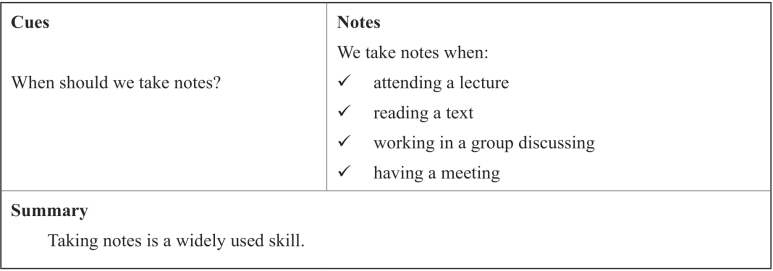
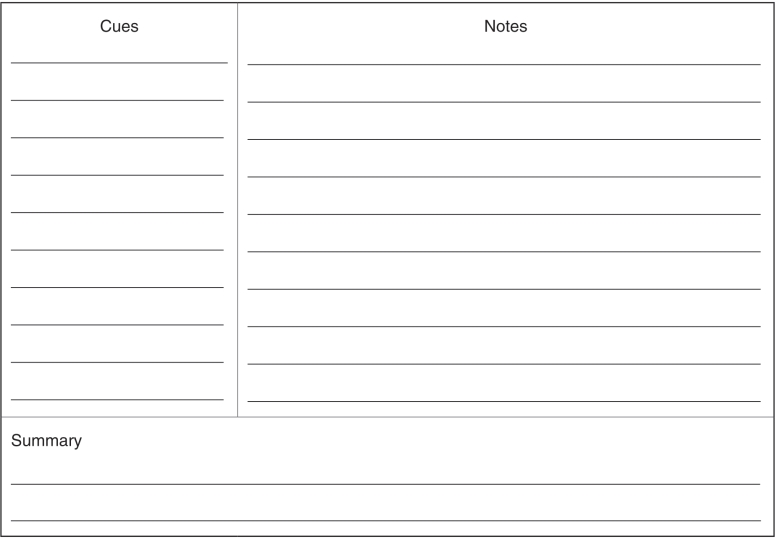
As the following example shows, the Cornell notes divide a single page
into three sections:Cues, Notes, and Summary. The section of Notes is
placed at the right side of the paper and occupies the largest space. It is used
for recording information from sources. You can note down main arguments
and supporting points in this section. The section of Cues is placed at the left
side of the paper, where you can put questions or comments. It helps you to
think deeply and have a better understanding of the information you have
read. These cues are useful for your future review and reference. The section
of Summary is placed at the bottom of the page, where you need to
summarize the main ideas of the notes you have taken. Conveying the gist of
the information in your own words is an effective way to check your
comprehension. You just need to write a few sentences for this part.
An example of Cornell notes
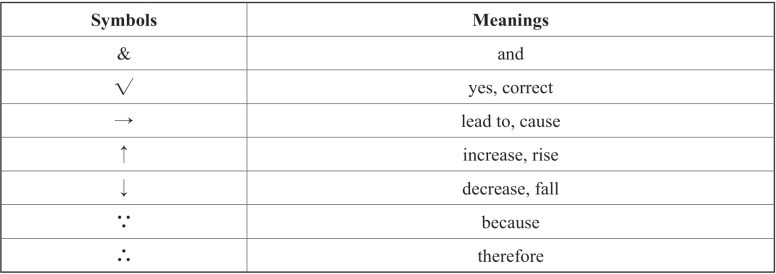
While taking notes, you can use various symbols and abbreviations to
help you save time and space. There are some commonly used symbols as
follows.
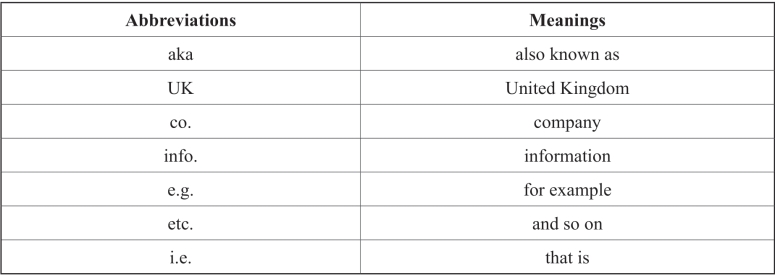
An abbreviation is a short form of a word or phrase, made by leaving
out some of the letters or by using only the first letter of each word. For
example:
Besides, visuals such as tables, charts, diagrams and personal drawings
can be helpful to make your notes easy to understand. Only if you have
analyzed and processed information, can you make these visuals. They will
benefit your following citing of the relevant information. Finally remember
that you are encouraged to develop your own list of personal abbreviations,
symbols, and visuals.As long as you can understand them, it is acceptable to
use them when taking notes.
Integrate your notes
It might be possible that you have taken pages of notes for an essay
topic from multiple sources,e.g. books, journal, websites. Then you should
integrate these notes and put the similar contents together. By combining and
sorting your notes, you can make them more organized, which will help you
easily locate the needed information when you start writing your essay.
Exercises
- Underline the instructional words with “ ” and key words with “
” in the following essay questions.
- Compare the advantages and disadvantages of mobile payments vs.
cash transactions.
- Overpopulation in many major urban centers around the world is a
major problem. What are the causes of this? How can this problem be
solved?
- Some people think an international car-free day is an effective way
to reduce air pollution. Others think there are more effective ways to do this.
Discuss both sides and give your opinion.
- The prevention of health problems and illness is more important than
treatment and medicine.Government funding should reflect this. Use
examples to illustrate how your country is doing in this aspect.
- Read the following text and determine whether it is authoritative
and objective. Give reasons and evidence to support your judgment.
Low Levels of “Bad” Cholesterol May Have a Downside
By Rachael Rettner, Senior Writer | July 3, 2019 04:32 p.m.
When it comes to “bad” cholesterol, lower is usually better for heart
disease risk. But a new study suggests it may be possible for cholesterol
levels to be too low.
The study researchers found that low levels of “bad” cholesterol,
known as LDL cholesterol, were tied to an increased risk of hemorrhagic
stroke, which occurs when a blood vessel bursts in the brain.
The findings suggest that, “as is true with many things in nutrition,
moderation and balance are key when deciding the optimal target level of
LDL cholesterol,” the study’s senior author Dr. Xiang Gao, an associate
professor of nutritional sciences at Penn State, said in a statement. “You
can’t go to either extreme — too high or too low.”
(Adapted
from:
https://www.livescience.com/65865-low-bad-
cholesterol-stroke-risk.html)
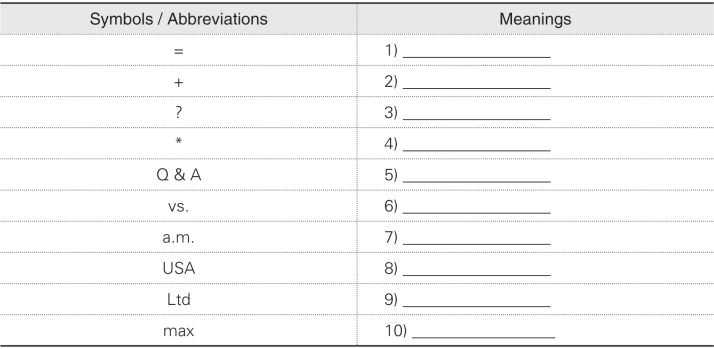
- Complete the following box by writing down the appropriate words
or phrases the following symbols and abbreviations stand for.
- Suppose you are researching for the essay question: How have
students changed since they entered the university? Read the following text
and take relevant notes in the Cornell style. Use appropriate symbols,
abbreviations and visuals where possible.
Men gain twice as much weight as women during freshman year, study finds
By Arman Azad, CNN; Updated 18:02 GMT, July 3, 2019
During their first year of college, men eat more fried chicken and
donuts — and drink more beer and liquor — than women. They also gain
twice as much weight, according to a study published Wednesday that
analyzed the so-called “Freshman 15”.
Men gained about eight pounds after a year in college while women
gained only four, the study found. Men tended to consume more unhealthy
foods, but both sexes ate worse overall. Women, for their part, tended to
drink more wine and eat more French fries.
“We were expecting to see that weight increased. We were expecting to
see that, potentially,males and females would eat different foods,” said
Andrea Josse, an assistant professor in the School of Kinesiology and Health
Science at Canada’s York University. “But I think one of the most surprising
things to me was the magnitude of change between the males and females.”
“We need to make sure that our students come into the university
knowing what they can do to improve their health and combat this really
stressful year,” said Josse. “Creating programs and building strategies in
university that focus on promoting a healthier lifestyle, including healthy
eating,exercise and stress relief, should be a priority.”
(Adapted from: https://edition.cnn.com/2019/07/03/health/freshman-15-
college-study-trnd/index.html)
2.2 Critical thinking skills
Academic writing involves a host of important skills, one of which is
critical thinking. You may be asked to “critically evaluate” a theory or
findings or to develop a “critical analysis” in your written work. In a broad
sense, critical thinking is regarded as a complex of various cognitive
skills,including selection, decision making, analysis, deduction, inference,
and evaluation, etc. In the academic context, critical thinking mainly involve
students’ abilities to distinguish between facts and assumptions, clarify
relationships, make correct inferences, evaluate evidence, and deduce
conclusions.
In other words, to be “critical” does not mean you have to “disagree” or
“disapprove” other people’s point of view or a theory. In fact, the English
word criticism comes from the ancient Greek verb krino which means to
judge. Therefore, to put it simple, critical thinking involves examining and
judging carefully. This skill is essential for your essay writing, because it
allows you to:
● dig into a subject or a store of information, and gain a deep and
unbiased understanding of it;
● form your own opinions and back them up with reliable evidence or
logical reasoning;
● evaluate your own work in the same way you judge others’ work.
Critical thinking plays a vital role in the process of researching. For
instance, when you are identifying sources, you must judge each source in
terms of its credibility. By asking relevant questions and examining
carefully, you can determine whether a source is reliable or not. Besides,the
step of evaluating information when researching fully depends on your skills
of critical thinking — you must select the related information, examine its
authority and objectivity, figure out the author’s arguments and supporting
details, etc.
In the following sections, we will focus on several critical thinking
skills that are useful when reading sources, namely:
● analyzing arguments;
● assessing evidence;
● deducing conclusions.
You can apply these skills in your essay writing, mainly manifested
through the process of argumentation. That is to say, the critical thinking
skills will help you to form your own argument in an organized or logical
way, supporting it with evidence and relating it to others’ claims.
2.2.1 Analyzing arguments
In your initial reading, try to identify the topic and the main claim of
the author first. You can often find such information in the title of the article
or in the introductory paragraph. For instance, if an article is entitled “Loss
of Biodiversity Affects Human Society”, you can easily infer its topic as
biology and society and the author claims that the lack of many different
kinds of animals and plants would negatively influence the human society.
An argument must have both a claim and evidence or reasons that
support the claim. Therefore,the second step in analyzing the argument is to
locate evidence or reasons: looking for the evidence or reasons that the
author uses to back up his or her claim.
Evidence could be facts, statistics, research findings, experimental data,
or any credible information you obtain from books, journals, websites,
newspapers, magazines, and documentary(we will elaborate the skills of
assessing evidence in the next section). The way to locate evidence is
multifold. According to different types of evidence, you can look for
different tips and linguistic patterns, for example:
● numbers, if the evidence is data and statistics;
● words like study, research, survey, experiment, etc., if the evidence is
research or experiment findings;
● quotation marks, if the author is quoting from a book or journal
article;
● another author’s family name and year of publication, e.g. Andrews
(2004), if the author is citing from other sources.
As for reasons, you can easily detect them in a source by looking for:
● conjunctions, e.g. as, because, since, so that, in order that;
● nouns, e.g. reason, cause, ground, justification, explanation;
● verbs, e.g. cause, explain, illuminate, interpret, account (for);
● phrases, e.g. on account of, because of, owing to, due to.
After clarifying the reasons that the author gives, you must figure out
whether they are sufficient and valid to the argument. Ask yourself: Would it
be possible to draw other conclusions from these reasons?
The final step is to analyze the logic of the argument: Does the author
develop the argument in a logical and coherent fashion? In an article, the
author would probably put forward several points before coming to his / her
main point, or say main argument or conclusion. If the argumentation is
logical, it usually follows the sequence: premise→Argument A→Argument
B→conclusion. There could be more arguments, such as Argument C or D.
You need to be able to identify the underlying logical errors, which mainly
include the following questions:
● Is the premise correct?
● Are there any confusing breaks in the logical flow, e.g. the lack of
some necessary point?
● Are there flaws in the reasoning? For instance, does Point A actually
cause Point B? Is the argument generalized from too few examples? Are
there hidden assumptions? (We will explain a commonly used type of
reasoning in detail in Section 2.2.3.)
2.2.2 Assessing evidence
Valid and reasonable arguments must be supported by evidence or
reasons. So, it is vital to assess the evidence critically. If the evidence is
strong enough, it helps build strong arguments. First you should be able to
identify the types of evidence, such as statistics, research or surveys, case
studies, findings from experiment. Then you can evaluate the evidence for
its credibility, quality,and relevance.
Credibility
The credibility of evidence has much to do with the external criteria
such as the source and the author. Evidence from a more reliable source
tends to be more credible. For example, an article from an academic journal
is likely to be more reliable than the one from a newspaper. Hence, the
evidence taken from a journal article is often regarded as reliable. The other
important factor is the author’s credentials and authority. If the author knows
well about the subject under discussion,the opinions he / she offers would be
justified. Similarly, if the author is supporting the claim with a quotation
from another person, the credibility of the evidence depends on the quoted
person’s authority. Therefore, when assessing the credibility of the evidence,
you need to think about these questions:
● Where is the evidence from?
● Is the source credible?
● Who is the author or the quoted person?
● Is he / she an expert or authority on the topic?
● Is the evidence biased?
Quality
The quality of evidence mainly involves the intrinsic features of
studies, surveys and experiments. For instance, if the evidence provided is
the results of a survey, then you have to consider whether the sample of this
survey is large enough or representative. A survey comprising 10 people is
not as convincing as the one that includes 1,000 people. Also, for a survey
that investigates the citizen’s opinions on constructing an airport nearby, if
those being questioned are only female citizens, the sample would be
regarded as not representative because male citizens’opinions should also be
considered. So, when assessing the quality of the evidence, you can ask the
following questions:
● How recent are the studies? Are they up to date?
● How large and representative are the surveys?
● How robust are the experiments?
● Is the research scientific or commercial?
● Is the evidence anecdotal (e.g. stories of one person being cured from
a treatment is less impressive than clinical trials)?
Relevance
For the relevance of evidence, you need to consider whether and to
what extent the evidence connects with the claim. Suppose the author is
arguing for the importance of asking questions in effective communication,
if he / she provides evidence concerning the non-verbal communication(e.g.
eye-contact, facial expressions), such evidence cannot well support his / her
claim. In addition,the more closely and directly the evidence connects with
the claim, the better.
2.2.3 Deducing conclusions
When reading sources, you should have the ability to deduce an
appropriate conclusion from the given information. This skill will help you
form your own opinion by incorporating all the evidence that you have
found.
In Section 2.2.1, we mentioned that you need to critically analyze the
logic of the main argument to see whether the author’s reasoning is logical
or not. Here we will introduce a commonly used line of reasoning that can
reach a logical conclusion, i.e. deductive reasoning.
Deductive reasoning is a kind of reasoning from the general to the
specific, or called top-down thinking. It relies on a general statement or
hypothesis (also called a premise) held to be true to reach a specific, logical
conclusion. For instance, if it is true that all humans have brains, then
Rosie,who is a human, has a brain too. This is a logical way of reasoning. If
an author follows such a line in his / her argumentation, the conclusion
would be valid. In an academic text, you are likely to read the following
example of deductive reasoning.
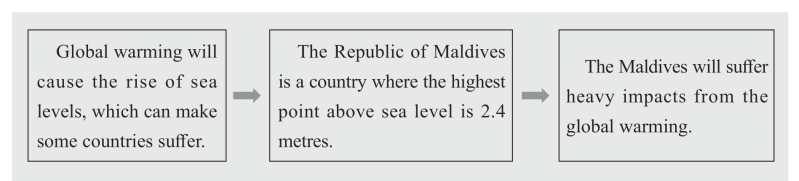
In this example, the author might want to examine the effects of global
warming on the Maldives. He / She can use the logic of deductive reasoning
to draw his / her conclusion:
Premise 1: Global warming causes sea-level rise which in turn would
make some countries underwater.
Premise 2: The Maldives is such a country that sits very close to sea
level.
Conclusion: Global warming would possibly make the Maldives
underwater.
Here Premise 1 is a general statement describing one effect of global
warming, and Premise 2 is a specific statement describing the feature of the
Maldives. So, the key to the deductive reasoning is that the topic starts off
very broadly; then it narrows as it finds connections between the general and
specific statements.
Sometimes making a reasonable argument / conclusion can be tricky.
Even if you put forward two true premises, they may not necessarily come to
a valid conclusion. There are several common errors when forming an
argument or drawing a conclusion, namely, ignoring alternative
arguments,making sweeping generalizations, and thinking in black and
white.
Error 1: Ignoring alternative arguments
Premise 1: I get a headache if I don’t get enough sleep.
Premise 2: I have a headache now.
Conclusion: Therefore, I didn’t get enough sleep last night.
Explanation: Although not getting enough sleep last night may be the
reason you have a headache, there are other possible causes, like illnesses or
allergies. It is best to examine all possible arguments when forming logical
conclusions.
Error 2: Making sweeping generalizations
Premise 1: My friend tried yoga.
Premise 2: Practicing yoga cured her health problems.
Conclusion: Therefore, yoga can cure anything.
Explanation: Again, there are many factors which contribute to
illness. Since we are all different, what worked for one person may not work
for everyone. Making blanket generalizations can hurt your argument and
make it very difficult to draw a valid conclusion.
Error 3: Thinking in black and white
Premise 1: Some movies are entertaining.
Premise 2: Some movies are boring.
Conclusion: Movies are either completely entertaining or completely
boring.
Explanation: Everyone has a different opinion about movies.
Thinking in extremes on either side of the argument leaves out vital
information that might be found in the middle or the “grey area”. These
kinds of assumptions can be offensive to the reader as well,so be cautious
about making absolute statements in your writing.
2.2.4 Forming your own arguments
Critical thinking skills are essential when you are researching for your
topic — you need to carefully analyze others’ arguments, critically evaluate
the evidence, and judge whether the reasoning of the conclusion is valid.
When critical thinking is applied to your essay writing, the above abilities
are expressed through the process of producing your own arguments. The
argument is the primary expression of critical thinking in higher education; it
is also the defining feature of an essay.
After your critical reading of all the sources, you should have filtered
out invalid arguments and unqualified evidence. Then you need to apply the
same rigor to your own writing as you do to analyzing and assessing source
materials. Particularly, you have to:
● work out early on what your conclusion (or say main claim, or thesis
statement) is and write
it down in your outline;
● map out how each paragraph leads your reader towards the
conclusion in the outline;
● keep checking the logic of your main argument by asking “Is the
reasoning of my conclusion logical?”;
● use the appropriate evidence to support each of your claims to form
valid arguments.
Exercises
- Decide which of the following statements are simple claims, and
which are evidence-supported arguments.
- Dogs make better pets than turtles.
- One person out of every hundred people is colour blind.
- Artificial Intelligence will replace human workforce in the future.
- Smoking is detrimental to the lungs, as eighty-five percent of all
cases of lung cancer in the U.S.are caused by smoking.
- People prefer to imitate others’ behavior in order to be liked by
others.
Claims:____________________
Arguments:________________
- Read the following text critically and choose the correct answer to
the questions. The text is a letter sent to the editor of the New York Times.
Harvesting Water
To the Editor:
Rather than allowing rain and snow to evaporate or cause pollution
from runoff (径流)downstream, we can use these wasted resources in a
variety of ways.
Whether runoff is stored inexpensively in the soil or in highly effective
systems of water storage tanks, called cisterns (蓄水罐), there is a
growing movement to use old-fashioned American ingenuity to harvest
precipitation (降水), that is, collect it when it does fall on our roofs
and other impervious (不透水的) surfaces.
Water harvesting is common, from Australia and New Zealand to
Bermuda and beyond.Meanwhile, retrofitting our communities to harvest
precipitation would create jobs in the building and development industries
that crumbled in 2008.
NATE DOWNY
New York, April 8, 2013
- What is the claim in the text?
a) It might be a good idea to harvest precipitation when it falls on roofs
and other impervious surfaces.
b) The building and development industries have crumbled since 2008.
c) There is no claim in the letter.
- What is the evidence offered to support the claim?
a) Storage tanks are called cisterns.
b) Water harvesting is common in other countries and would create
jobs.
c) There is no evidence offered in this letter.
- Critically assess the evidence provided in the following text by
answering questions in terms of credibility, quality, and relevance.
What gets students motivated to work harder? Not money
By Matthew G. Springer
Assistant Professor of Public Policy and Education, Vanderbilt University
Rewarding teachers financially for student achievement is an
increasingly common practice,despite mixed evidence as to whether it
improves results. Some scholars have instead suggested paying students. But
giving kids cash for grades and scores hasn’t proved straightforward either.
So maybe the answer isn’t monetary. Could students be better motivated by
something as simple as a little formal recognition?
……
Our recent study attempted to better understand the response to a
different after-school tutoring services (free but chronically underutilized).
We found that adolescents do not respond to incentives in ways that can be
easily predicted by economic theory. But the right kinds of incentives could
well lead adolescents to engage in behaviors likely to enhance their learning.
Here’s how we did our study. We selected 300 fifth to eighth grade
students in a large southern urban school district who were eligible (具备
条件的) for free after-school tutoring services. Prior research had shown
that these particular tutoring services were relatively high quality and had,
in fact ,increased students’ test score performance. We then randomly
assigned these students to one of three groups:
● a reward of \$100 (distributed via an online platform) for consistent
attendance;
● certificates of recognition , signed by the school’s district
superintendent (负责人), mailed to the student’s home, again for
consistent attendance;
● a control group, which received no experimental incentives.
We found that the students who were offered up to \$100 for regular
attendance were no more likely to attend sessions than if they were offered
nothing at all.
In other words, money made no difference. Alternatively, when
students received a certificate of recognition for attending tutoring sessions
regularly, the differences were dramatic. The students in the certificate group
attended 42.5% more of their allotted tutoring group.
(Adapted
from:
https://theconversation.com/what-gets-students-
motivated-to-work-harder-not-money-47080)
- What is the main claim of the author?
_____________________________________
- What type of evidence is used?
___________________________________________
- Credibility:
●
Where
is
the
evidence
from?
_________________________________________________________
●
Is
the
source
credible?
_____________________________________________________________
__
●
Who
is
the
author?
_____________________________________________________________
______
●
Is
he
an
expert
or
authority
on
the
topic?
________________________________________________
So,
is
the
evidence
credible?
____________________________________________________________
- Quality:
●
Is
the
study
a
recent
one?
____________________________________________________________
● How large and representative is the sample of the study?
________________________________
●
Is
the
research
method
scientific?
_____________________________________________________
●
Is
the
evidence
anecdotal?
___________________________________________________________
So,
is
the
evidence
of
high
quality?
______________________________________________________
- Relevance:
●
How
does
the
evidence
connect
with
the
claim?
________________________________________
__________________________________
So,
is
the
evidence
relevant?
____________________________________________________________
- Evaluate the logic in the following arguments. Determine if the
conclusion is valid or invalid.
- A car will not run without gas.
My car does not run.
Therefore, my car must be out of gas.
- It’s dangerous to drive on icy streets.
This street is icy now.
So it would be dangerous to drive on this street.
- All swans are white.
Jane is white.
Therefore, Jane is a swan.
4) Racism is prevalent (普遍存在的) in the society.
Race would play a role in shaping how university professors respond to
prospective graduate students who express interest in their research.
So racial biases are barriers that prevent equal access to graduate-level
education.
- All cells have DNA.
Elephants have cells in their bodies.
Therefore, elephants have DNA.
Valid
conclusions:
____________________
Invalid
conclusions:____________________
【注释】
[1]journal n. a newspaper or magazine that deals with a particular subject
or profession (某学科或专业的)刊物,杂志
[2]plagiarism: n. the practice of using or copying someone else's idea or
work and pretending that you thought of it or created it 剽窃;抄袭
[3]reference: n. a note usually placed at the end of a book or an article that
tells you where a particular piece of information comes from 参考书目