Chapter 6 Cautiousness
Chapter 6 Cautiousness
Objectives
√ Understand cautiousness (hedging)
√ Express uncertainty
√ Show distance from the argument
√ Qualify the quantity or frequency in an argument
Another important feature of academic writing is the use of cautious
language, often called“hedging” or “vague language”. For instance, instead
of claiming “this is true and everyone agrees”,you can suggest “this seems to
be true and many people would agree”. The first statement is overconfident
and absolute, which should be avoided in your essay. While the second
statement uses the hedging expressions seem to and would to indicate
uncertainty and to demonstrate modesty — it is a better academic style.
Using cautious or hedged language is important for the following reasons:
● to minimize the possibility of opposition: By hedging your claims,
your reader (e.g. your teacher or your classmates) could not easily disprove
or refute them.
● to be more precise when reporting results: Expressing a lack of
certainty does not necessarily show confusion or vagueness; instead, it may
show the true state of the writer’s present understanding and indicate that the
results are open to argument.
● to execute a politeness strategy: Hedging helps you to appear humble
rather than arrogant or all-knowing; it is a rational interpersonal strategy
which helps build good writer-reader relationships.
● to conform to an established style of academic writing: A certain
degree of hedging has become conventionalized in academic writing.
Hedging words and phrases are used to soften our words, to make them
less direct, and to limit or qualify the statements we make. In the following
sections, you will learn three ways of hedging:expressing probability,
showing distance, and qualifying the quantity or frequency.
6.1 Expressing probability
In academic writing, it is better to avoid making statements that imply
full certainty, unless you have strong evidence to make the claim justifiable.
A frequently used way to tone down your statements is to express
probability, i.e. to show different degrees of uncertainty. You can use various
types of words or phrases, including verbs, nouns, adjectives and adverbs, to
express probability, as illustrated in the following table.
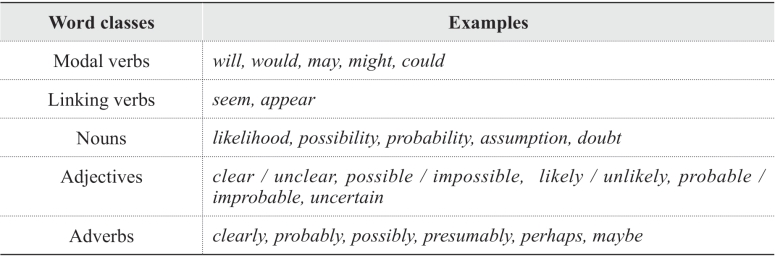
Modal verbs, also called modal auxiliary verbs, or just modals, are
often used to indicate the probability of a claim or interpretation. They are
used to change the meaning of other verbs(commonly known as main verbs)
by showing (or denying) possibility, ability, permission,obligation, or future
intention. For the function of expressing different degrees of probability, you
can use will, would, may, might, and could to modify the main verb, as
illustrated in the following examples:
Original statement: The UK’s ageing population leads to increased
welfare costs.
Modified statements:
The UK’s ageing population will lead to increased welfare costs.
The UK’s ageing population would lead to increased welfare costs.
The UK’s ageing population may lead to increased welfare costs.
The UK’s ageing population might lead to increased welfare costs.
The UK’s ageing population could lead to increased welfare costs.
The original statement about the impact of the UK’s ageing population
is too factual: It sounds like the ageing population definitely causes welfare
costs to increase in the UK. We can use modal verbs to tone down this claim.
In the modified statements, the certainty being conveyed gradually decreases
from the first statement to the last one. Will can be used to express a higher
likelihood,while could is normally used to express a slight or uncertain
possibility. The degrees of certainty expressed by would, may, might are in
between.
Two linking verbs
[1], seem and appear, could also be used to express
probability. When you are describing your own feelings or thoughts, you
use them to make your statement less certain or forceful. These two verbs
can be used in the following structures:
(1) … seem / appear to …
(2) There seems / appears to be …
(3) It seems / appears that…
(4) It would seem /appear that…
For example:
● She notes that this seems to be especially true of girls, who typically
do not like to disagree with each other in “real life”.
● Even though there seems to be a divergent view on the age bracket of
individuals that fall within this group, uniform characteristics of youth have
been identified as radiance,freshness, vigor, spirit, and strength.
● It appears that the unpleasant weather in California will continue.
● The evidence would appear to point to the conclusion that students’
academic performance at university could be improved by exams.
Besides verbs, some nouns can be used as cautious language to show
uncertainty, making your statements tentative, e.g. likelihood, possibility,
probability, assumption, and doubt. The following examples may help you
better understand such usage of these words.
● The likelihood is that these companies will show excellent profits on
a two-year time scale.
● Bankruptcy is a real possibility if sales do not improve.
● It is our assumption that MOOC will be a new orientation for the
development of future education.
In the first example, the phrase the likelihood is that means it is likely
that. The second example expresses an idea that it is highly possible for the
company to go bankruptcy if sales do not improve.In the third example, the
opinion that MOOC will be a new orientation for the development of future
education is toned down by stressing it is just an assumption — it may not
be true.
There are several adjectives and adverbs that could be used to reflect
how certain you are of your opinions, and to indicate that your opinions are
open to argument. If you have sufficient evidence to support your claim, you
may write It is certain / clear that…, but in most cases you need to use
expressions showing various degrees of uncertainty, e.g. the adjectives
possible, likely, probable or the adverbs maybe, perhaps, probably, etc. We
can divide the following adjectives and adverbs into a hierarchy of certainty,
from the most certain to the least certain.
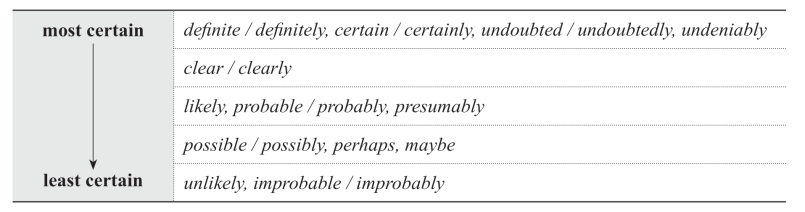
For example:
● Young drivers are more likely to have accidents than older ones.
● Exercise will not only lower blood pressure but possibly protect
against heart attacks.
● It is improbable that this year’s figure will fall much below last year’s
75,000.
Exercises
- Match the hedged word to the corresponding word class below.
- adjectivea. assumption
- adverbb. might
- nounc. likely
- modal verb d. appear
- linking verbe. perhaps
- Identify which sentences are using hedging (tick “√” in the box
before the sequential number) and underline the cautious expressions in
those sentences.
□ 1) Viewing a movie in which alcohol is portrayed appears to lead to
higher total alcohol consumption of young people while watching the movie.
□ 2) This effect might occur regardless of whether it concerns a real-life
interaction.
□ 3) Playing violent video games causes more aggression, bullying, and
fighting.
□ 4) It will probably result in higher taxes and an increased retirement
age for younger people.
□ 5) Everybody agrees that the main cause of the financial crash was
subprime mortgage crisis.
□ 6) There did not seem much likelihood of the infection happening at
that moment.
- Complete the following hedged statements by choosing the
appropriate expression.
- When in real life, anticipation of others’ reactions ________ be
among the causes of imitation.(should / may)
- New visa regulations will more than ________ have an impact on the
amount of international students entering the UK’s universities. (likely /
unlikely)
- It would ________ that class size is a significant factor affecting
student performance. (possible /seem)
- In spite of its limitations, the study ________ to have a number of
important strengths. (assumes /appears)
- It is believed that using social media ________ lead to negative
social comparisons. (might / must)
6.2 Showing distance from an
argument
Another way of hedging is to show distance, i.e. to remove yourself
from a strong claim by attributing it to other people or people in general. The
use of reporting verbs can be effective in showing distance while voicing
your opinion.
Reporting verbs are a group of verbs (e.g. say, believe, suggest, claim,
or argue) used to communicate information from other sources, such as
books and articles. In academic writing, it is often necessary to refer to the
research of others and to report on their findings, or to cite someone else’s
views. You use such information to support what you are saying in your own
writing. For example, Leech (1983) stated that…, A recent study suggests
that…, etc.
When expressing an opinion, if you would not like to attribute it to
yourself, you may use reporting verbs. One way is to use a reporting verb in
an impersonal that-clause: It is / has been +past participle of the reporting
verb + that…, such as the following language patterns:

Using It (sometimes called the “empty” or preparatory subject
[2] )
allows you to avoid phrases such as I believe that or I would argue that,
and thus distances you from the argument or point of view. You may add
some adverbs like commonly, usually, generally, widely ahead of the
reporting verb to indicate that most people hold the same opinion. For
example:
● It is generally believed that climate change is caused by human
activities.
● It has been suggested that the main concerns for the future
generations are global food supplies and population growth.
● It is widely accepted that environment exerts profound influence on
one’s personality.
In the above examples, the impersonal that-clause seems to express the
opinion held by other people (It has been suggested that) or people in
general (It is generally believed that and It is widely accepted that), but
actually the writer is expressing his / her own point of view by showing
some distance from it. This is also a type of hedging (i.e. cautious language)
which helps writers avoid making strong and direct claims.
The other way for you to show distance from an argument is to use a
reporting verb in a thatclause to refer to studies / research, attributing the
argument to be one of the research findings, as in the examples below. Such
statements may have been indicated by certain studies. The reporting verbs
used in this way, such as indicate, suggest, and demonstrate, show the
writer’s tentative or neutral stance.The opinion thus expressed becomes
distant from the writer and is not very strong or definite. Notice that using
the preposition according to has the similar effect, such as according to a
recent study….
● Studies have indicated that good mental health is facilitated by
physical exercise.
● The latest research indicates that eating smaller meals more often can
lower one’s cholesterol.
● The evidence suggests that stress is partly responsible for this disease.
● Statistics demonstrate that the male-female income disparity appears
more prevalent in top managerial position.
Exercises
Rewrite the following sentences by using hedging to show distance
from the argument.
- I would argue that the reunification of the two Koreas would
eventually be of benefit to both.
______________________________________________
- We agree that excessive stress is harmful for our heart health.
______________________________________________
- I believe that a journalist should be objective to a large extent.
______________________________________________
- We assume that the economy will continue to improve.
______________________________________________
- I would claim that immoderate consumption of alcohol leads to
serious health problems.
______________________________________________
6.3 Qualifying
In academic writing, you should be cautious by not presenting your
argument in the largest degree of quantity or frequency. For example, avoid
writing:
● The Queen of England is loved and respected by all her subjects.
● Women are constantly discriminated in their jobs.
But instead, write:
● The Queen of England is loved and respected by many of her
subjects.
● Women are sometimes / often subjected to discrimination in their
jobs.
Those words, especially adjectives and adverbs, which describe another
word in a particular way are called qualifiers. It is effective to use
appropriate qualifiers to reduce the extremity of quantity or frequency in
your argument, thus making your expression less absolute.
6.3.1 Qualifying the quantity
In terms of quantity, you should avoid using all / every / each to
describe a 100% quantity,because such certainty or absoluteness may only
exist in few cases. There will always be exceptions,as in the previous
example, The Queen of England is loved and respected by all her subjects.
This sentence is too factual: It sounds like every single of the queen’s
subjects loves and respects her.Although the queen may be very popular,
there are probably some people who do not love and respect her. Therefore,
in order to make your arguments more cautious, and more convincing, you
can use different words or phrases describing the quantity between 0% and
100%, as shown below:
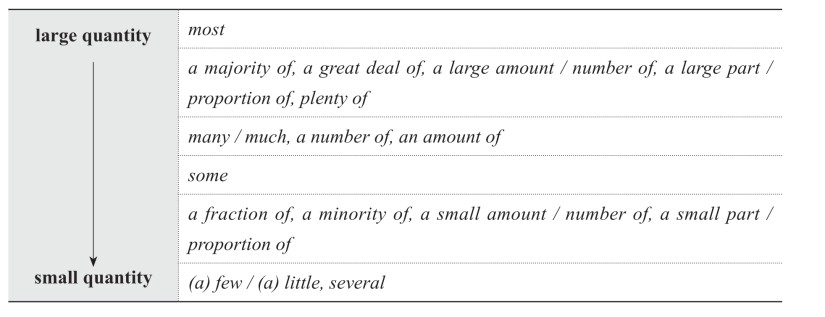
The above words or phrases are also called “quantifiers”, which show
an amount of something without being precise. Some quantifiers can only be
used with countable nouns, such as: (a) few,several, many, a (small / large)
number of, a majority / minority of.
Some quantifiers can only be used with uncountable nouns, such as: (a)
little, much, a (small /large) amount of, a great deal of.
Others can be used before either countable or uncountable nouns, such
as: most, some, plenty of,a (small / large) part / proportion of, a fraction of.
Note that the quantifiers a lot of and lots of can also be used with both
type of nouns, but they are often regarded as colloquial expressions which
are not suitable to be used in academic writing.More examples below will
illustrate how to use appropriate quantifiers to hedge your arguments.
- His comments were offensive to a large number of single mothers.
- Stationary cars in traffic jams would cause a great deal of pollution.
- Many youngsters lack the ability to communicate with others face-
to-face.
- The use of seat belts can reduce some types of physical injuries in
car accidents.
In these examples, you may find quantifiers used to qualify either the
subject (e.g. Example 3) or the object (e.g. Examples 1, 2, and 4). In
Example 2, a great deal of is used to qualify the uncountable noun pollution,
while in the other examples, a large number of, many and some are used to
qualify the countable nouns.
If you use all / every / each which describes a 100% quantity to replace
the quantifiers in these examples, the resulting arguments will be too strong
and absolute, and possibly not justified. For instance, if Example 3 states:
All youngsters lack (Every youngster lacks) the ability to communicate with
others face-to-face, it may not be true because there are also many
youngsters who like to talk and are good at communicating with other
people. Similarly, if Example 4 states: The use of seat belts can reduce all
types of physical injuries in car accidents, it actually exaggerates the effect
of using seat belts. Sometimes wearing a seat belt might save your life, but it
can cause physical injuries such as bruises, scrapes and fractures, especially
when you make a sudden stop, the speed from the car causing you to hit the
seat belt with significant force, which can leave you with injuries.
Besides, in the previous section, we introduced two usages of reporting
verbs that can hedge your arguments. There is a third way: combining the
use of quantifiers and reporting verbs, as the following examples show. In so
doing, you avoid attributing the ideas to yourself, and also avoid making too
absolute and extreme statements.
● Some nutritionists believe that…
● Many economists argue that…
● Most people agree that…
6.3.2 Qualifying the frequency
In terms of frequency, there are a range of adverbs indicating the
frequency from 0% to 100%.In academic writing, you should avoid using all
the time, constantly, or always which show a 100%frequency, as well as
never, which shows a 0% frequency. It is more cautious to use other adverbs
of frequency: If something is very likely to happen or frequently happens,
you may use usually,normally, frequently, and often, etc.; if something
happens less frequently, you may use sometimes,occasionally, or even
seldom. Besides the adverbs, the verb phrases tend to or have a tendency to
can also be used to describe something that usually happens. In general, you
can use the following words or phrases to qualify the frequency.
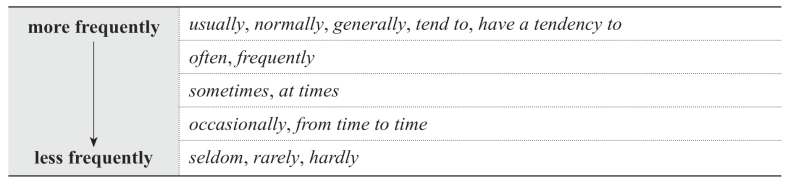
As in the example mentioned at the beginning of this section (Women
are constantly discriminated in their jobs.), the adverb constantly is used to
describe the frequency of women being discriminated in their jobs. It is too
extreme to state that women are subjected to discrimination all the time —
because of the enforcement of relevant laws and the change of the public’s
perception,women are not always discriminated; instead, they are favored in
some professions and their rights are guaranteed in many companies. So it is
more cautious and precise to state: Women are sometimes /often subjected to
discrimination in their jobs. The following are more examples to illustrate
how the appropriate use of adverbs or expressions of frequency can tone
down your arguments.
- Drinking to excess, or “binge drinking” is often the cause of
inappropriate behavior among teenagers.
- Playing video games sometimes distracts students from their
homework.
- Doctors usually believe that smoking is harmful to one’s health.
- As people get older, they tend to have more difficulty remembering
things.
In Example 1, often is used to indicate that drinking to excess will
frequently, but not always,cause inappropriate behavior among teenagers.
Likewise, in Example 2, the adverb sometimes shows an opinion that
playing video games does not distract students from their homework all the
time. If you state that playing video games always / constantly distracts
students from their homework, some students might protest that a short
period of game playing can help refresh their minds and boost concentration.
In Examples 3 and 4, although it is commonly acknowledged that smoking is
harmful to one’s health or old people have more difficulty remembering
things, it is still cautious to use expressions indicating a high frequency
rather than expressing a 100% frequency.
Exercises
Complete the following hedged statements by choosing the appropriate
expression.
- The best information about hotels ________ comes from friends and
acquaintances who have been there. (seldom / usually)
- ________ of her interpretation can be supported by evidence. (Most /
All)
- ________ young people who frequently use social media may suffer
from shorter attention span.(A large amount of / A large number of)
- Old technology ________ continues to exist because of its reliability.
(sometimes / always)
- Adults with higher BMI values ________ be more obese. (should
/ tend to)
6.4 Combining the use of different
hedging
So far, we have presented all the three ways of hedging, i.e. expressing
probability, showing distance, and qualifying the quantity or frequency. In
the process of essay writing, it is more common to combine the use of
different types of cautious language to make your arguments tentative, as
shown in example below.
Research conducted by Yen (2005) appears to indicate that, for a large
proportion of students, extensive reading may contribute to an improvement
in their active vocabulary.
In this example, the writer uses all the three means of hedging:
expressing probability (appear to and may), showing distance (research…
indicate…), and qualifying the quantity (a large proportion of ). Therefore,
such hedged argument is more persuasive and precise than the bold claim
Extensive reading helps students to improve their vocabulary.
Exercises
- Underline the cautious expressions in the following sentences and
identify which are expressing probability, showing distance, or qualifying
the quantity or frequency.
- The reality of mothering is frequently different from the romantic
ideal.
- It seems that the experiment conducted confirms suspicions held by
most scientists.
- Most economists would claim that the project has been a success.
- It is commonly agreed that children are often defensive about their
private lives.
- This study indicates that there is a growing tendency for women to
have children later in life.
- Use combined ways of hedging to make the following statements
more tentative.
- Without a doubt intelligence is nurtured and is not a natural
phenomenon.
______________________________________________
- Class size is the most significant factor affecting student
performance.
______________________________________________
- The team failed because they are untalented, spoilt and over-paid.
______________________________________________
- Male gorillas are more aggressive than female gorillas.
______________________________________________
- Smaller shops suffer a decline in trade when a supermarket opens
nearby.
______________________________________________
【注释】
[1]linking verb: a verb such as be or become that connects a subject with
the adjective or noun (called the complement)that describes it 连系动词
[2]preparatory subject: In grammar, a preparatory subject is a subject
which represents a verb clause later in the sentence. It as a preparatory
subject is commonly used in speech and writing. 先行主语