Chapter 3 Essay Structure
Chapter 3 Essay Structure
Objectives
√ Learn to write the introduction
√ Learn to write body paragraphs
√ Learn to write the conclusion
√ Learn to link your ideas together
√ Get familiar with the structure of different essay types
3.1 The basic structure
As mentioned in Chapter 1, an essay is usually persuasive and
argumentative. To make your argument convincing, you have to present a set
of ideas and facts inside a well-structured piece of writing. Successfully
structuring an essay requires you to pay attention to a reader’s logic. It is
easier for the reader to follow ideas that naturally develop in a clear
progression. For example, if you offer a list of facts in a random order, the
reader will understand the facts themselves, but not your main point, or why
you are telling them. However, if you present them in such a way that they
elegantly interconnect, and build upon each other, then the reader
understands not only the details but your reasoning.
Therefore, the essay form matters as much as the content itself. A good
essay usually has three basic parts
[1]: an introduction, a body, and a
conclusion. Although different essay types may have slightly different
structures (which will be elaborated in Section 3.3), all essays share the same
basic structure as shown in the following:
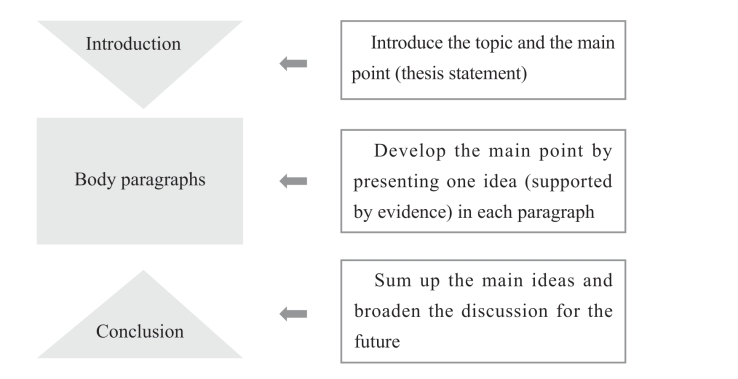
3.1.1 The introduction
The first part of your essay should be an introduction, in which you let
the reader know about the topic under discussion, as well as your viewpoint
regarding it. The introduction normally consists of one paragraph, but if the
essay is of a significant size, the introduction may have several paragraphs.
Generally speaking, the introduction is no more than 10 percent of the total
length of your essay.
The importance of an introduction to an essay is like your first
impression left on others when you meet. If others have a good impression
of you, they would feel like establishing a good relationship with you.
Similarly, if your introduction to the essay is effective, readers would be
interested and eager to continue their reading.
A good introduction has three main functions:
● to grab the reader’s attention;
● to acquaint the reader with the essay topic / question;
● to present the writer’s main argument.
At the very beginning of your introduction, you need to grab your
reader’s attention with a“hook”. A hook could be a quote from authority or
experts, an anecdote, or astonishing statistics.The hook needs to be concise
and highly relevant to the topic you are writing about. As the following
example shows, a student indirectly quotes from an authoritative document,
The Outline of China’s Medium- and Long-term Talent Development Plan
(2010-2020), when he is discussing how Chinese colleges and universities
can cultivate high-quality talents. It catches the readers’attention and makes
them realize the significance of this topic.
The Outline of China’s Medium- and Long-term Talent Development
Plan (2010-2020) strengthens that the overall goal of Human Resource
Development is to cultivate a talent with excellent quality and
comprehensive development.
Next, you need to provide enough background information on the topic
to help the reader form a basic understanding of the subject. It lays a good
foundation for what is to come. In other words,you are explaining in broad
terms what the situation or problem is, and preparing the reader for what you
are going to expound in the body paragraphs. For example:
In recent years, with breakthroughs in related technologies (especially
when deep learning algorithms have achieved remarkable achievements),
Artificial Intelligence had developed rapidly. When a machine behaves more
and more like humans, when the wisdom of a computer surpasses human
brains, our seemingly lofty status as a “person” is unprecedentedly
threatened.
This is part of an introduction to an essay about Artificial Intelligence
(AI). It makes the reader acquainted with the essay topic — it briefly
describes the fast development of AI and then mentions the threat caused by
AI to human beings. So the reader would expect what will follow: The writer
is likely to further explain how people should react to this kind of “threat”.
Finally, in the last sentence of an introduction, clearly show your
position on the topic concerned. Do not wait until the middle or even the end
of your essay to put forward your opinion.Instead, show it in the
introduction; then readers can easily follow you and understand how you
develop your argument in the body paragraphs. Compared with the general
description of the background information, your main argument, also called
the thesis statement, needs to be specific.That is why we use an inverted
triangle to illustrate the layout of an introduction: It develops from the
general to the specific.
In fact, not all introductions must have an “attention-grabber”. But each
introduction should include two components: a general description or
explanation of the topic and a thesis statement(thesis for short). The thesis
statement is the most important part of an introduction and it is also the heart
of any essay. The essence of an essay is for you to put forward an argument
and make it convincing to the reader. With a thesis in mind, you can focus
your effort on elaborating this controlling idea throughout the writing.
Therefore, how to write a strong thesis statement in your essay?
First, the thesis statement must be related to the rest of the introductory
paragraph. If you have been introducing some background information about
Ancient Rome and then your thesis statement is about Ancient Greece, the
readers will be confused.
Second, keep in mind the features of a thesis statement. It should be:
● arguable (a thesis is an opinion rather than a fact);
● clear (do not use a metaphor or a question to formulate your thesis);
● specific (do not make a broad statement which is difficult to defend).
Compare the following pairs of examples and you can distinguish
between a strong thesis statement and a weak one.
[Pair 1]
- There are large numbers of homeless people living in Los Angeles.
- Homeless people in Los Angeles should be given access to various
services — such as regular food donations, public restrooms, and camping
facilities — because it would improve life for all inhabitants of the city.
Example 1 is actually a fact: No one can argue for or against it. In
contrast, Example 2 shows the writer’s opinion: Homeless people in Los
Angeles should be given access to various services.Opponents could easily
argue that homeless people in this area have already received adequate
services or perhaps that they should not be entitled to services at all. Hence,
Example 2 is a stronger thesis because it is arguable or debatable.
[Pair 2]
- So how should we react to the fast development of AI?
- People do not need to be panic about the fast development of AI;
instead we should learn to make full use of the technology to make our life
more convenient and enjoyable.
In a question form, Example 3 serves as a weak thesis statement.
Although you may want to arouse the reader’s interest, asking a wh-question
is not a proper way to give your opinion. The reader will feel puzzled about
your point: So how to react? Your job is to persuade by presenting a clear
and concise argument that explains how. Example 4 uses a statement to
clarify your opinion,so the reader can clearly know your positive attitude
toward the fast development of Artificial Intelligence. Therefore, it is a
strong thesis statement.
[Pair 3]
- Eating fast food is bad and should be avoided.
- Americans should eliminate the regular consumption of fast food
because a fast food diet leads to preventable and expensive health issues,
such as diabetes, obesity, and heart disease.
Judging from the previous two standards, being arguable and clear,
Example 5 may seem to be a strong thesis — it directly shows the writer’s
position. However, there is another rule: Do not try to argue an overly broad
topic in your essay, or say it is important to stay focused. The more specific
your thesis is, the better, or else your following argumentation will be
disordered. You are going to feel confused and unsure about your direction
and purpose. Example 5 is too general and would be nearly impossible for
you to defend. It leaves a number of big questions to answer. Are all kinds of
fast food bad? (Notice the word bad is an informal word that is not
appropriate to be used in academic writing; you can use harmful or
detrimental instead.) Why is it bad? Who should avoid eating it? By
comparison, Example 6 narrows the argument to the health consequences
related to a diet of fast food, and the target is restricted to the Americans
rather than everyone on the Earth.
Finally, you have to realize the complexity and difficulty in developing
a good thesis statement.The process of developing your thesis is in fact the
process of forming your own argument. As discussed in Chapter 2, you
should conduct wide and scholarly research and also apply all the critical
thinking skills so as to form your main argument. Even when drafting your
essay, you need to keep refining your thesis to align with the rest of the essay
(see more in Section 3.1.2 and 3.1.3).
3.1.2 Body paragraphs
The paragraphs between the introduction and the conclusion are
referred to as the main body of an essay. The number of paragraphs in the
body may vary. If you choose to write your essay in the five-paragraph
structure, then the first paragraph is the introduction; the following three
paragraphs are the body; and the last paragraph is the conclusion.
Each paragraph in the body contributes to the overall argument that you
are trying to present.These paragraphs support and develop the thesis
statement outlined in the introduction and goes into details. Thus, the reader
will fully understand your opinion by following the body paragraphs. For
instance, if you propose in your thesis that there are three factors crucial to a
company’s success,you will go on elaborating these three factors one by one,
with each body paragraph focusing on one factor.
In addition, the main body also gives you a chance to fully show your
understanding and interpretation of the topic. If the thesis statement only
summarizes your opinion, you can go further to explain, to demonstrate, and
to convince readers.
In this section we will concentrate on how to write a body paragraph,
while in Section 3.2 you will learn more ways to organize and connect
different body paragraphs. Each body paragraph is made up of a collection
of related sentences. Experienced writers would suggest you write 5-7
sentences in each paragraph. There could be four types of sentences in a
body paragraph:
● a topic sentence that states the topic and your central idea in this
paragraph;
● the supporting sentences which support and develop your opinion by
providing evidence,examples or reasons;
● a concluding sentence which concludes or summarizes your idea;
● a transitional sentence that links this paragraph to the previous or the
next one.
Each body paragraph must contain a topic sentence and several
supporting sentences, whereas it is optional to include a concluding or
transitional sentence. A topic sentence is often the first sentence in the
paragraph, but it is not necessary so. It may appear in the second or the third
sentence sometimes, especially when you have put a transitional sentence as
the first sentence. A topic sentence expresses the main idea of the paragraph
and it controls the rest of sentences in this paragraph (i.e. other sentences
have to be relevant to the topic sentence). Therefore, each body paragraph
only has one topic sentence, in other words, each body paragraph only
focuses on one idea, and this idea is a partial idea of the overall opinion you
expressed as the thesis statement. For example, you can outline your essay in
the following way.
The thesis statement: Technology facilitates learning in higher
education in modern times.
Main body with topic sentences:
Paragraph 1: A large number of online resources allow college students
to learn anytime and anywhere.
Paragraph 2: The development of learning apps offers convenient and
interesting experiences for college students to learn by their mobile phones.
In this example, the thesis statement expresses the main point of the
essay: Technology facilitates learning. The following body paragraphs
support and develop the thesis by explaining how modern technology helps
college students to study in a convenient way. Each topic sentence focuses
on one way: online resources and learning apps.
Once the topic sentence has been formed, you should go on to back it
up with a series of supporting sentences. Usually you may provide evidence
which includes facts, statistics, examples,quotations, research findings,
arguments, etc. Also you need to further explain why and how you think
such evidence supports your point. As in the previous example, the topic
sentence of the first body paragraph is:
A large number of online resources allow college students to learn
anytime and anywhere.
So in the following supporting sentences, you can give a specific
example of online resources,such as online courses or MOOCs, and then
illustrate how MOOCs can allow a huge number of students to learn diverse
subjects conveniently.
You may or may not add a concluding sentence for your body
paragraphs. The concluding sentence sums up your main idea in another way
and tells the reader why the information in the paragraph helps defend your
thesis. For instance, you can conclude the first body paragraph in the former
example by the following sentence.
Therefore, if college students can make good use of online resources,
their learning process will become easier and more interesting.
Generally, you can follow the guidelines below for writing a good body
paragraph:
● Write a topic sentence which controls the paragraph and develops the
thesis;
● Support your idea with evidence or reasons;
● Only include relevant sentences in a paragraph;
● Present a new point or idea in each paragraph.
3.1.3 The conclusion
The conclusion is usually the last paragraph of your essay, but if the
essay is of several pages long, the conclusion may be the last few
paragraphs. Similar to the introduction, the conclusion should also be less
than 10 percent of the total word count.
If the introduction tries to attract and guide the readers, the conclusion
is intended to let readers remember your points and your essay. So you
should end your essay by:
● conveying a sense of completeness and closure;
● creating the lingering possibilities of the topic, e.g. showing its larger
meaning, or its implications.
In order to establish a sense of closure, you can link your conclusion to
the former parts of your essay, including the thesis statement and body
paragraphs. You have pointed out your thesis in the introduction, and used
the whole of the main body to elaborate your points. It is the right time to
restate your thesis in the conclusion. Do not repeat the thesis statement word
for word but use another way to express it. You may also briefly review and
evaluate the important sub-ideas or evidence that you have used to support
your argument. Take a look at the following example.The thesis statement:
There are distinct differences between the Chinese and American eating
habits, while Chinese eating habits are more beneficial to health.
Main body:
Paragraph 1: Selection of Ingredients
Paragraph 2: Selection of Seasoning
Paragraph 3: After-meal Foods
Conclusion: As what have been analyzed above, Chinese selection of
food and method of cooking food as well as the after-meal foods are
healthier than American. In a word, Chinese eating habits have a more
positive impact on health…
This is the brief outline of a student’s essay entitled A Comparison of
the Impact on Health of Chinese and American Eating Habits. In the thesis
statement, the writer points out: There are distinct differences between the
Chinese and American eating habits, and he argues for the Chinese eating
habits, which are more beneficial to health. In the body part, he makes
further comparison from three aspects: Selection of Ingredients, Selection of
Seasoning, and After-meal Foods. In the conclusion, the writer reviews the
three aspects being analysed in the body. Then he restates the thesis
statement in a different way (are more beneficial to vs. have a more positive
impact on). In this way, the conclusion helps convey a sense of
completeness.
If you want your topic to have a lasting and impressive effect on the
reader, you may add the following components in your conclusion:
● a brief discussion of the significance or implications of your ideas;
● predictions, recommendations or suggestions (e.g. if you have found
some limitations of your study, you can suggest further studies; if you have
pointed out some problems, you can suggest ways to improve them or take
certain actions);
● a quotation from a primary or secondary source;
● thought-provoking questions that keep the readers thinking further.
For example, in an essay whose main argument is that city parks may
mend people’s mind, the writer has used the findings of a research to support
her opinion. In the conclusion she writes:
Findings such as these could influence policy makers to increase access
to green spaces,in the hope that doing so might boost mental health in nearby
residents and improve academic achievement in children.
This example shows that the arguments presented in the essay are
expected to persuade the policy makers to plan more green spaces in the
cities. It means the writer’s ideas are probably significant in bringing some
changes to the society. Such a brief discussion of the significance or
implications of the ideas would undoubtedly leave a deep impression on the
reader.
So generally speaking, you begin your conclusion with a summary of
what you have discussed in the former parts and end the topic by looking
ahead in the future, in a broader context. That is why in Section 3.1 we use a
triangle to illustrate the layout of a conclusion: It develops from the specific
to the general. Finally, there are some suggestions on what not to do when
writing your conclusion.
● Avoid phrases such as in conclusion, to conclude, in summary, and to
sum up. These phrases are more suitable to be used in a speech to signal the
ending, whereas they are unnecessary to appear at the beginning of your last
paragraph.
● Do not add any new idea or evidence. It will confuse the reader.
Instead, the new idea or evidence should be put in the body part.
● Do not put forward the thesis for the very first time in the conclusion.
To write in an academic style, you should not try to keep the reader in
suspense, but rather, show your main point in the introduction.
Exercises
- Identify the function of each sentence in the following introduction
(one of the listed functions may not have the correspondent sentence).
Essay topic: Should parents let their children overly dependent on
smartphones?
Introduction:
(1) As technology keeps developing, numerous electronic products
come into people’s life every year. (2) Not only adults but also children
always over-depend on their smartphone, which is very likely to cause
children’s addiction to smartphone. (3) A large amount of research about
children’s smartphone addiction has been conducted and there are already
some convincing findings that excessive screen time for children may cause
damage and weakening to their health and intelligence. (4) Therefore, it is
necessary for parents to limit the screen time for their children and help them
make a reasonable and appropriate use of smartphones.
a.
to
grab
the
reader’s
attention:______________________________________________________
_______
b.
to
make
the
reader
acquainted
with
the
essay
topic:_________________________________________
c.
to
put
forward
the
writer’s
main
argument:_________________________________________________
- The following sentences in an introduction are in a jumbled order.
Put them in the proper order.
(1) It is now demonstrably true that Rock and Roll has a place in
mainstream culture. (2)However, in the decades since Rock and Roll was
first coined as a phrase, it has evolved into a genre of music enjoyed by
people of virtually all backgrounds. (3) Rock and Roll was once considered
revolutionary and shocking.
The correct order:____________
- Decide which of the following sentences are strong thesis
statements and which are weak thesis statements. Explain the reasons and
revise the weak ones.
- Evolutionary biology should not be viewed as a theory, but as an
essential fact.
___________________________________________________
- According to a recent survey, more than 280,000 Chinese students
went abroad for further studies last year.
___________________________________________________
- In modern society, it is no longer appropriate for gender roles to be
as rigid as they were once accepted to be.
___________________________________________________
- Compared with buying a new car, buying an old car has both benefits
and problems.
___________________________________________________
- What will happen if some countries continue expanding their use of
nuclear energy?
___________________________________________________
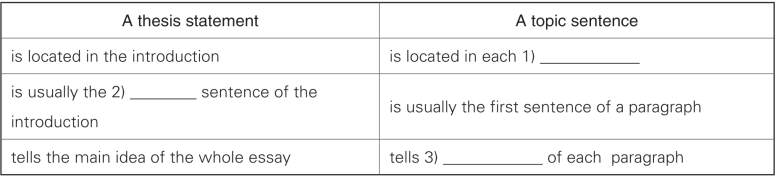
- Fill in the blanks in the following table to understand the
similarities and differences between a thesis statement and a topic sentence.
- Evaluate the following paragraph to decide whether it is a good
body paragraph. This paragraph is taken from a student’s essay arguing that
zoo conservation, in comparison with other means, is the most effective way
to protect the endangered animals.
(1) Additionally, zoos have the function to educate the animals,
which means the zoo will teach them the surviving skill in the wild. (2)
Because sometimes some baby animals are abandoned for a variety of
reasons. (3) They have no idea about how to prey. (4) In this case,
people need to teach and train them so that these animals can be released to
the wild again. (5) The training aims to cultivate their ferity (野性),
and the zoo will trace the released animals for a long time to know whether
they can survive successfully in the wild. (6) What’s more, the zoo can
bring benefits to zoologists who often need to conduct animal experiments.
(7) It helps scientists to have a more comprehensive understanding of
animals so that people can find more effective ways to save the animals.
- Identify different components of the following conclusion. It is
taken from an essay whose topic is“ Should nuclear weapons be banned in
all countries? ”.
(1) Because of the political tensions between different countries, it is
not likely that a worldwide ban on nuclear weapons would be followed by
every world leader. (2) Therefore, it is important that countries without
nuclear weapons should be able to protect themselves from potential attacks
with equally strong weapons. (3) More limitations on testing and launch
authorizations should be enforced to ensure hot-headed leaders do not use or
even advertise these dangerous weapons simply as a show of force.
3.2 Connecting different parts
After knowing how to write each part of an essay, it is important to
connect them in a unified,logical and skillful way. First, all parts of the
writing have to work to achieve the same goal:proving the thesis — this is
what referred to as unity. Second, your ideas in the essay need to flow
logically — this is coherence. Third, you can resort to linguistic strategies to
connect different sentences and paragraphs in your essay — this is cohesion.
3.2.1 Unity
Unity of an essay refers to the state of different parts being completely
united around the thesis statement. You put forward your main argument in
the introduction, then try to prove and support this thesis throughout body
paragraphs, and finally restate the thesis in the conclusion. In so doing,you
can achieve the wholeness of your essay. To ensure such macro-unity, after
finishing a draft of your essay, you must look for extraneous information in
any part which is not related to the thesis.Then delete the irrelevant
sentences or paragraphs.
Just as the content of an essay must focus on the thesis, the content of a
paragraph (i.e. a body paragraph) should focus on a topic sentence. This is
the unity of a paragraph. In order to achieve this micro-unity, it is vital to
express your central idea in the topic sentence, and support it with sufficient
evidence and logical reasoning. If necessary, sum up the main idea of the
paragraph in a concluding sentence. When checking for paragraph unity, you
should eliminate the irrelevant sentences or revise the main idea to include
those sentences.
3.2.2 Coherence
Coherence refers to the logical development of your ideas in the essay
or paragraph. You cannot jump to a new point suddenly; instead, you need to
decide on an order and follow it to present your ideas. There are several
frequently used orders that can make your argumentation logical:
● the chronological
[2] order, in which the information is connected
according to the sequence when it happened or will happen;
● the spatial order, in which the information is connected according to
its physical position or different steps in a process;
● the classified order, in which the information is connected based on
the groups or categories;
● the comparison / contrast order, in which the information is
connected based on how things are similar to or different from each other;
● the problem-solution order, in which you put forward a certain
problem first and then the solution(s);
● the cause-effect order, in which you mention causes first and effects
second or the other way around.
If you connect your paragraphs in this way, the reader can easily follow
you and understand how your ideas flow from one to another coherently.
Your argumentation will become clear and logical,thus convincing. For
example, you can describe the development of a theory or a technology in a
chronological order. You may draw people’s attention to some social
problems and call for their action to solve the problem in appropriate ways.
When you are discussing a complicated topic, you may even follow two
or more orders to arrange your ideas. For instance, if you are writing about
the negative impacts caused by noise on people’s health, you will mainly
follow the cause-effect order. But if you want to present a clearer analysis of
these negative effects, you may further adopt the classified order: divide the
health into physical health and mental health. Then you can analyze the
negative impacts of noise on people’s physical and mental health
respectively.
Once you have put your ideas and paragraphs in a proper order, it is
often necessary to demonstrate the connection between them by linguistic
means (see more in Section 3.2.3), such as using transitional words, phrases
or sentences to explicitly express the relationship. For example:
● expressions that show the time order: before, after, during, in the
meantime;
● expressions that indicate comparison and contrast: however, similarly,
on the other hand, the opposing view;
● expressions that indicate cause and effect: therefore, hence, as a
result, subsequently.
3.2.3 Cohesion
[3]
Cohesion of an essay refers to the state of sticking sentences and
paragraphs together by linguistic means. These grammatical and lexical
links, which are usually called cohesive devices,show the relationship
between sentences or paragraphs explicitly and help achieve coherence of
the essay. In essay writing, the frequently used cohesive devices include
reference
[4], substitution,reiteration
[5] and transition.
Reference
References have two purposes: (ⅰ) to refer back to the information
previously mentioned; (ⅱ)to refer forward to the information that will follow.
For example, pronouns are often used to refer back to the person or thing
that has been mentioned in the former sentences, such as he, she, it, this,that,
etc. Phrases like as stated in the introduction, as follows, we will discuss it
further in the next section can effectively connect the information that
appears in the different parts of an essay.
Substitution
Substitution is a way that replaces a word / phrase in the immediately
preceding clause or sentence with a more general one. Words like thing, so,
one or do can be used for the cohesive purposes. For example:
There are over 100 planes in our air base. We test each one to see that it
flies well.
In the first sentence, the writer mentions 100 planes. So in the second
sentence, to avoid repetition and also to indicate a close relationship between
these two sentences, the writer uses the more general word one to replace the
specific noun plane.
Similarly, the verb do can be used to substitute any specific verb or verb
phrase that has been formerly mentioned. For example, in the following
sentence, the general word did is used to replace the specific verb phrase
want a divorce.
One day he will want a divorce, just as his father did.
Reiteration
Reiteration is the act of restating an explicit item once or several times
in your essay. It mainly involves the devices of repetition and using
synonyms. First, you may repeat a key word or concept.Repetition keeps the
reader focused on the highlighted topics and shows logical connection
between the essay parts. Look at the following example:
The thesis statement: The children who spend more time on online
social networks feel less happy in almost all aspects of their lives.
Main body with topic sentences:
Paragraph 1: Children who use social networks are more likely to
make negative comparisons with others.
Paragraph 2: Cyberbullying could be another explanation for links
between unhappiness and children’s use of social networks.
From this outline, we see that the writer repeats the key term social
networks in the thesis statement and the topic sentence of two body
paragraphs. In this way, the reader will clearly understand that these different
parts
are
dealing
with
the
same
topic,
thus
helping
achieve
cohesion,coherence and unity of the essay.
Secondly, using synonyms is another effective way to realize lexical
cohesion, but it may be a little more difficult for the reader to recognize. A
synonym is a word or expression that has the same or nearly the same
meaning as another, for example, medicine and drug, big and large are
synonyms. Using synonyms in your essay cannot only keep the reader
focused on a topic, but also help to diversify the writing so as not to make
them feel boring. As in the previous outline, you may use the synonym
social media to refer to social networks, or kids or young people to refer to
children.
Transition
Transition refers to the use of transitional words, phrases or sentences
to connect clauses,sentences and paragraphs in an essay. These expressions
signal different relationship (e.g. cause and effect, addition, contrast)
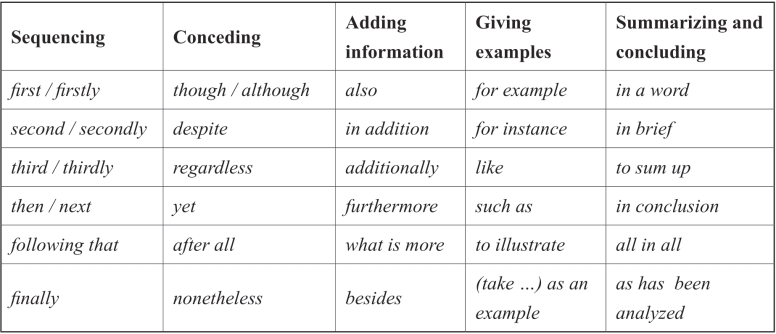
between two parts, making them more closely and explicitly connected.More
examples of transitional expressions are listed as follows:
Exercises
- Find a paragraph in the following essay that does not support the
thesis statement “Many people are changing their diets to be healthier”.
Mark a cross (×) in front of the sequential number of that paragraph.
______(1) People are concerned about pesticides (杀虫剂),
steroids (类固醇), and antibiotics (抗生素) in the food they eat.
Many now shop for organic foods since they do not have the pesticides used
in conventionally grown food. Meats from chicken and cows that are not
given steroids or antibiotics are gaining in popularity even though they are
much more expensive. More and more people are eliminating pesticides,
steroids, and antibiotics from their diets.
______(2) Eating healthier is also beneficial to the environment since
there are less pesticides poisoning the Earth. Pesticides getting into the
waterways are creating a problem with drinking water.Historically, safe
drinking water has been a problem. It is believed the Ancient Egyptians
drank beer since the water was not safe to drink. Brewing beer killed the
harmful organisms and bacteria in the water from the Nile.
______(3) There is a growing concern about eating genetically
modified foods, and people are opting for non-GMO diets. Some people say
there are more allergic reactions and other health problems resulting from
these foods. Others are concerned because there are no long-term studies
which clearly show no adverse health effects such as cancers or other
illnesses. Avoiding GMO food is another way people are eating healthier
food.
- Analyze the following paragraph to decide whether it is a coherent
paragraph or not.
(1) The human body is a wonderful piece of work that nature has
created. (2) It is not beautiful like the body of a butterfly or peacock. (3)
However, its practical shape enables it to do many types of work which other
animals cannot. (4) It is not strong like the body of a tiger. (5) But in place of
physical strength it has a big and sharp brain. (6) By using this brain, the
human physique has been able to overcome many of its limitations. (7) For
example, by sitting in a plane, it flies faster than a bird; by riding a
motorcycle, it travels faster than a leopard; and by firing a machine gun, it
fights much better than a tiger.3. Use appropriate transitional expressions
to connect the following sentences.
- The best way to get rid of procrastination is to make a reasonable
plan. ________, talking to the people who can inspire you to take action will
also be effective in preventing procrastination.
- Due to the fact that the courses in college are very informative, most
students are not able to note down everything in the class. ________, many
of them choose to take photos of the blackboard or PPT slides instead of
taking notes.
- Those schools emphasize the usefulness of iPhone, ________, online
research in class and instant polling of students. ________, a bigger part of
the attraction is, undoubtedly, that the iPhone is cool and a hit with students.
- There could be many challenges as demonstrated. But ________, the
application of technology in education is the irresistible trend, ________ the
challenges we faced are being solved step by step.
- Her hometown is famous for several amazing natural features.
________, it is noted for the Wheaton River, which is very wide and
beautiful. ________, on the other side of the town is Wheaton Hill, which is
unusual because it is very steep. The ________ amazing feature is the Big
Old Tree.
3.3 The structure of different essay
types
The five common types of essays include the analytical essay, the
argumentative essay, the comparison and contrast essay, the problem and
solution essay, the cause and effect essay. Each type follows the basic
structure, namely, introduction — body — conclusion. But the organization
of the body part in different essay types might be slightly different.
3.3.1 Analytical essays
An analytical essay addresses the questions which ask you to analyze,
discuss, investigate,explore or review. You will always need to break the
topic into different components and discuss them in separate paragraphs or
sections. Each body paragraph will focus on one component to discuss or
describe in detail. For example, if you are analyzing or discussing the factors
that lead to a company’s success, you may come up with several important
factors after thorough research. Then describe them carefully one by one.
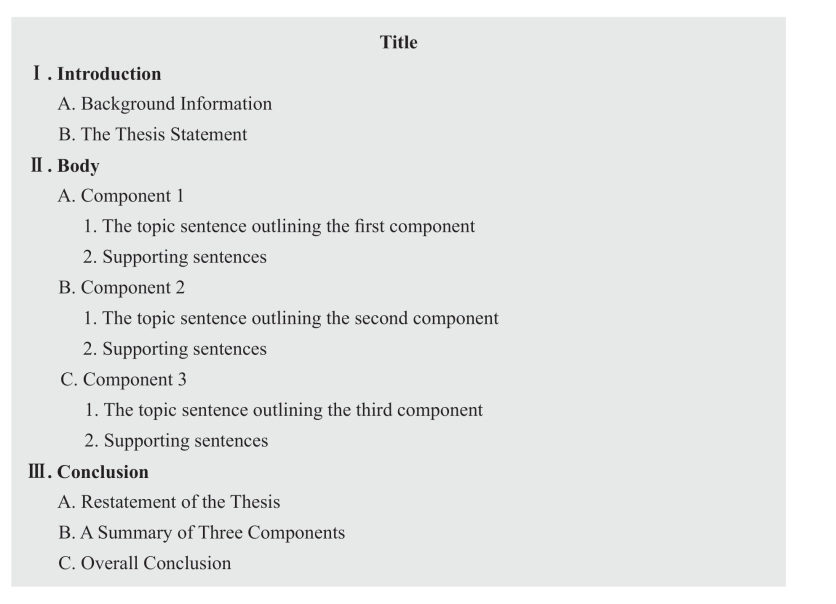
The typical five-paragraph structure of an analytical essay is shown in the
following outline.
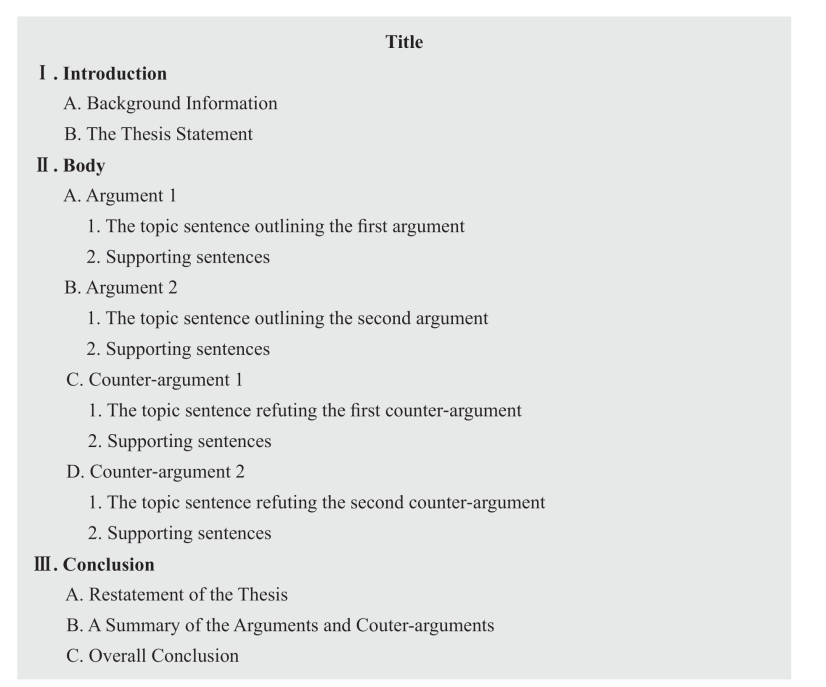
3.3.2 Argumentative essays
Argumentative essays require you to choose a side on a particular issue
(mostly controversial)and present evidence or reasons which support your
position. Sometimes it is also necessary to point out the opposing views and
then refute or counter these views with solid evidence. For instance,if you
are arguing for the use of smartphones for college students, you should not
only present evidence to support how smartphones benefit students, you also
have to address and refute the opponents’ concern, e.g. the distraction, the
health problems caused by smartphones. One suggested structure of an
argumentative essay is shown in the following outline (you may adapt the
number of body paragraphs according to the amount of arguments and
counter-arguments).
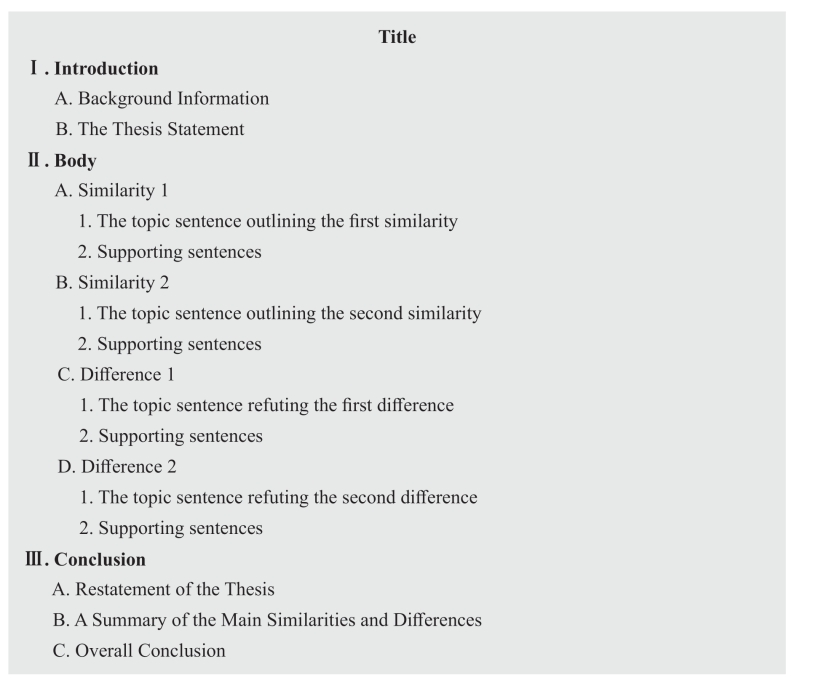
3.3.3 Comparison and contrast essays
This type of essay aims to find out the similarities and differences
between two or more items,usually with the ultimate purpose to determine
which item is better. For example, if you are asked to make comparisons
between Chinese herbal medicines and Western medicines, you may point
out the similarities and differences of these two kinds of medicines one by
one in the body part.The following outline illustrates a possible structure of
the comparison and contrast essay (you may adapt the number of body
paragraphs according to the amount of similarities and differences).
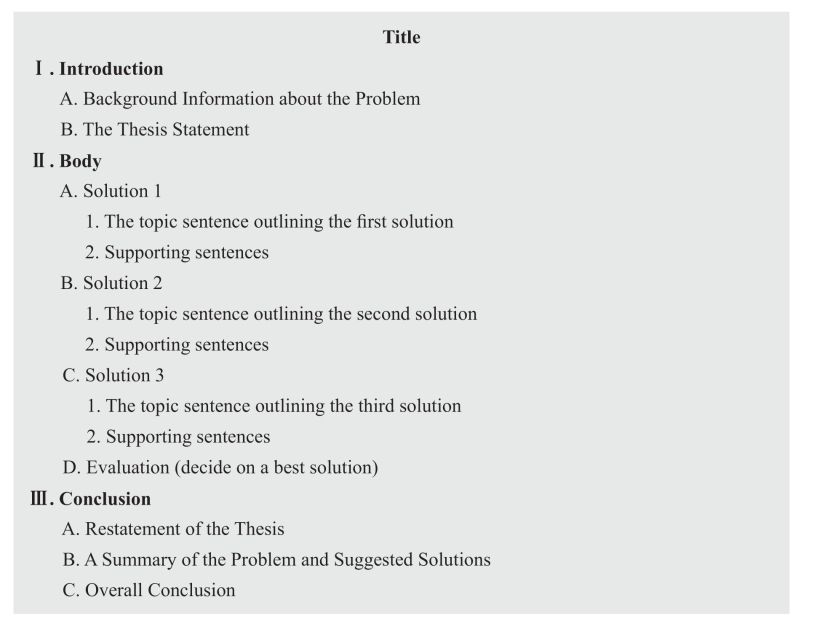
3.3.4 Problem and solution essays
A problem and solution essay mainly addresses the question of how to
solve a problem /issue. You describe the problem and explain why it is
serious in the introduction; then explore a range of solutions in the body.
However, it is not enough to only propose several solutions. In the last few
body paragraphs, you should try to evaluate all the suggested solutions or
recommendation to decide on a best option (e.g. which is most cost-effective
or feasible to implement). A suggested structure of the problem and solution
essay is illustrated in the following outline (you may adapt the number of
body paragraphs according to the amount of solutions).
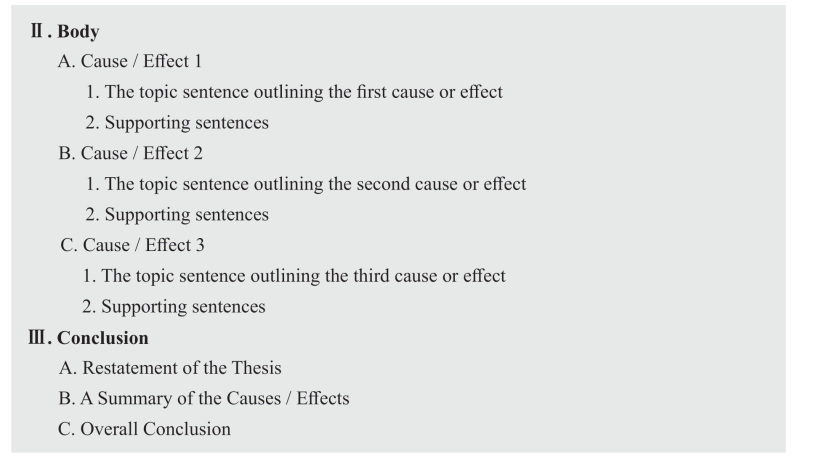
3.3.5 Cause and effect essays
The goal of a cause and effect essay is to investigate the effects (or
consequences, impacts,influences) of the topic or to outline its causes. If
your essay emphasizes the effects, the body part will elaborate on each effect
individually; if your essay emphasizes the causes, the body paragraphs will
deal with these causes one by one. For example, you may be required to
write about the impacts of over-population in the cities. Each of your body
paragraphs will focus on one impact and give sufficient evidence and
analysis to support it. Besides, some essays may address both the causes and
effects, so you can discuss the causes first and the effects second, or the
other way round. The following outline demonstrates the structure of the
first type of cause and effect essays.

Exercises
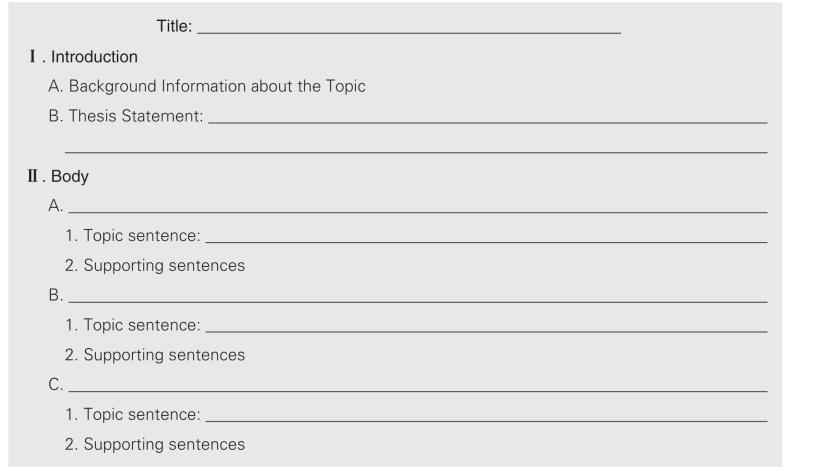
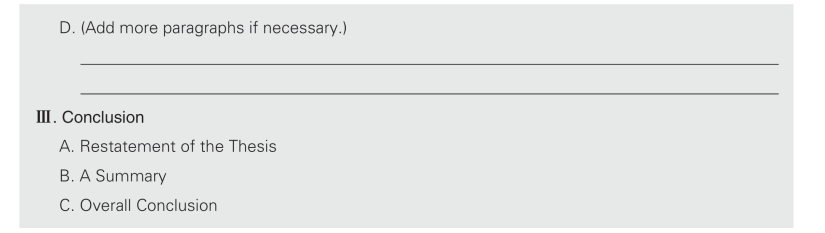
You are given an essay topic “Should college students keep a pet in
their dormitories?”. Decide on a suitable essay type and finish the following
outline.
The suitable essay type:_________________________________
【注释】
[1]In fact, there is a fourth important part of an essay, i.e. the references or
bibliography, which is the list of books,articles, etc. that have been cited by
the writer. But this part is not directly related to the content and
argumentation;therefore, we will not include it in this chapter (see more in
Chapter 8).
[2]chronological: a. arranged in the order in which they happened 按发
生时间顺序排列的
[3]lexical a. connected with the words of a language 词汇的
[4]reference n. the act of mentioning somebody / something 照应
[5]reiteration n. the act of repeating something that you have already
mentioned 重复
Features of Essay Language
Language features are the significant distinguishing factor between
academic writing and non-academic writing. Academic essay writing has a
target audience—scholars, i.e. your professor or your classmates. For this
specific audience, you need to write in the language that follows the
required style. Generally speaking, essay language is formal in tone, mainly
achieved by lexical choice and sentence structures. The language of
academic essays should also be efficient by reducing redundancy, using an
appropriate number of nouns or noun phrases and passive voice.
Cautiousness is a characteristic of academic language demonstrating that
writers are cautious and modest in their arguments. Last but not least, essay
language should be accurate. If your professor reads your essay which is
full of lexical or grammatical errors, they will become confused and fail to
understand your purpose.
In the following chapters, you will get familiar with four major
features of essay language:formality, efficiency, cautiousness, and accuracy.
Many examples will be given and analyzed.Learn to use the appropriate
language style by following these examples when you are practicing
academic writing.