Chapter 5 Efficiency
Chapter 5 Efficiency
Objectives
√ Understand efficiency
√ Avoid repetition and wordiness
√ Use nominalization appropriately
√ Use a mix of active and passive voice
Besides being formal in tone, academic writing is also characterized by
the efficient use of language, also called the economy of words — you use
the fewest possible words to express maximum meaning. Some students tend
to use more words than necessary for fear of not writing enough words for
their essay. Hence, they produce repetition and wordiness, which must be
avoided in academic writing. Changing the sentence components or structure
can make your writing concise,and you can be an efficient writer by
adopting the following methods:
● avoiding repetition and wordiness;
● using nouns or noun phrases;
● using a mix of active and passive voice.
5.1 Avoiding repetition and
wordiness
5.1.1 Avoiding repetition
Repetition is the repeated use of words / phrases or the restating of the
same meaning more than once. It could be a commonly used literary device
in prose and poetry; however, it is inappropriate for academic writing, which
requires conciseness. An effective way to test whether or not some words,
phrases, or even sentences are redundant is to see if the meaning is kept the
same when the part in question is deleted. Careful proofreading would help
to eliminate repetition or redundancy in your essay. In English, there are
dozens of redundant expressions that people use constantly without realizing
it. The following table lists part of such expressions and explains why they
are repetitive.You should recognize them and avoid using them when
writing.
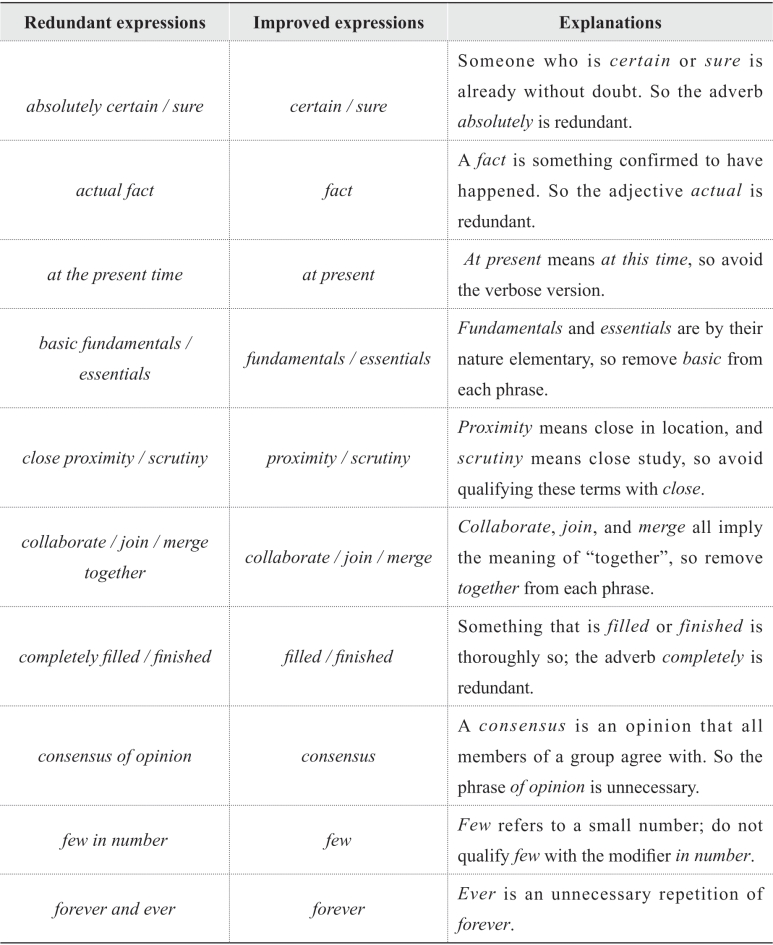
In the redundant expressions of the above table, one part of the phrase
actually implies the meaning of the other part , resulting in repetitive
meanings. In many cases , modifiers
[1] are used redundantly , such as
absolutely in absolutely certain, actual in actual fact, in number in few in
number , etc. Therefore , when using modifiers , you need to be
extremely careful and avoid unnecessary repetition. In addition , some
words or phrases have similar meanings, such as carefully think about,
ponder on and reflect on. You should not put all of them in one sentence:
only choose one phrase (notice that ponder on or reflect on is more formal
and suitable for academic writing).
5.1.2 Avoiding wordiness
Wordiness refers to the use of more words than required to express an
idea. Some words serve no purpose in the sentence — they are used just for
increasing the word count of an essay. For instance:
in order to / so as to — to
last but not least — last / finally
due to the fact that — because
in the recent time — recently
Because some expressions have been overused by people, they become
clichés which are ineffective and add to wordiness, like last but not least, so /
as far as I am concerned, as a coin has two sides. You can simplify them
(e.g. use last / finally instead of last but not least) or remove them (e.g. when
expressing your opinion in an essay, there is no need to use so / as far as I
am concerned). A specific example is shown below.
Original example 1: As a coin has two sides, the Internet has both its
advantages and disadvantages.
Improved version: The Internet has both its advantages and
disadvantages.
In the original example , the first clause serves as an analogy
[2] to
express the same meaning as the second clause : Things have both
advantages and disadvantages. The idiom a coin has two sides has been used
too often and does not add any new idea to the sentence; thus it can be
omitted. The improved version keeps the same meaning as the original
sentence, while becoming more concise.
Wordiness may also result from some descriptive or modifying phrases.
An effective way to avoid such verbosity
[3] is to replace the phrase with one
word. As seen in the following example , the modifying phrase
sympathizing with her concerns functions as an adverb to describe the action
of nodding. So for efficiency, you can reduce the phrase to a simple adverb
sympathetically following the verb nodded.
Original example 2: Sympathizing with her concerns, he nodded in
response to her complaint.
Improved version: He nodded sympathetically in response to her
complaint.
We mentioned in Section 4.2 that writers can use complex or complex-
compound sentences to increase the formality of an essay. Dependent
clauses are essential for constituting complex sentences. But for the purpose
of conciseness, one type of the dependent clause, i.e. the adjective(relative)
clause following a noun, sometimes can be reduced to a phrase. For
example:
a balloon which is red → a red balloon
a movie that is interesting → an interesting movie
people who are experienced at traveling → experienced travelers
Another form of the reduction of relative clauses is to omit the relative
pronoun and the following be (in any form, e.g. is, was, are). In the
following examples , the phrases which is , who are , that is in the
brackets can be deleted to make the sentences more concise without
changing their meaning. You may notice that such phrases are usually
followed by the past participle
[4] or the present participle
[5] of a verb, e.g.
written, living, subjected, causing, which can function as adjectives
modifying the preceding nouns. Hence , to avoid wordiness , look for
relative pronouns in your essay and reduce relative clauses where possible.
It is a book (which is) written by Alexandre Dumas.
Students (who are) living on campus will receive a refund.
This method can deal with response of structure (which is) subjected to
random excitation.
A situation (that is) causing a major problem in the auto industry is the
popularity of Japanese cars.
Exercises
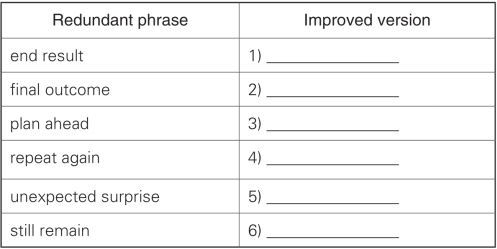
- The phrases in the following left column are redundant. Write
down the improved versions in the right column.
- Rewrite the following sentences to avoid wordiness.
- People who are experienced at traveling would check in online 24
hours before their flight’s scheduled departure time.
___________________________________________________
- Due to the fact that some competitors paid no attention abroad, the
rumors intensified.
___________________________________________________
- Library books which are overdue will incur a fine.
___________________________________________________
- Many employees will be forced to change jobs when the merger
takes place between the two companies.
___________________________________________________
- The waterfront workers who were taking part in a demonstration
blocked the entrance to the dock.
___________________________________________________
5.2 Using nouns or noun phrases
Academic writing uses nouns more than verbs. In the Academic Word
List (AWL), among the 570 word families which appear with high frequency
in English-language academic texts, most of them are nouns instead of
verbs, adjectives or other word classes. Using nouns or noun phrases can
make the text concise by packing a great deal of information into a few
words. Compare the sentences in the following two pairs of examples:
[Pair 1]
- Organisms reproduce. This is a major characteristic of life.
- Reproduction is a major characteristic of life.
[Pair 2]
- Crime was increasing rapidly and the police were becoming
concerned.
- The rapid increase in crime was causing concern among the police.
In Pair 1, the two examples convey the same meaning, but Example 2 is
more concise because it combines the two simple sentences in Example 1 by
transforming the verb reproduce into its noun form reproduction. The
resulting sentence structure becomes compact. In Pair 2, the first sentence is
a compound sentence with two different subjects in the two independent
clauses — crime and the police. So the relationship between these two
clauses is not very clear. Example 4 condenses the first clause of Example 3
into a noun phrase by using increase as a noun and transforming the adverb
rapidly into the adjective form rapid to modify increase. Compared with
Example 3, Example 4 is grammatically simplified and becomes more
logical. In both pairs, the second sentence containing the noun or noun
phrase transformed from its correspondent verb form uses fewer words than
the first sentence, which is an efficient way of language use.
Using nouns or noun phrases can also convey an objective and
impersonal tone. When a verb is nominalized
[6], it becomes a concept rather
than an action. As a result, the tone of the writing will sound more abstract
and also more formal. In the following examples, Example 5 mentions the
first person us who perform the action to formulate. Academic writing
should minimize the use of first or second person pronouns to maintain
objectivity, so by using the noun form of formulate, Example 6 avoids
mentioning the agent
[7] of the action, and formulation becomes a concept,
which makes the sentence more objective and formal.
[Pair 3]
- This piece of information enables us to formulate precise solutions.
- This piece of information enables the formulation of precise
solutions.
In the above examples, the process of transforming a verb or other
word classes into a noun or noun phrase is called nominalization , an
integral feature of academic writing. There are generally three types of
nominalization. One requires the addition of a derivational suffix
[8] to create a
noun ,such as achieve→achievement , connect→connection ,
nervous→nervousness, find→finding. Another type does not involve any
transformation — some verbs and adjectives can be used directly as nouns
without adding a derivational suffix, such as change, result, final, and
potential. The third type involves irregular transformation , e.g. choose
→choice, believe→belief.
In many cases, noun phrases instead of an isolated noun, are frequently
used in academic writing, e.g. the rapid increase, distribution of wealth,
social mobility, differences between genders,etc. Such noun phrases allow
you to pack a lot of information in a few words. The strings of words(noun
phrases) usually represent ideas which cannot be broken down, thus making
the sentence structure denser and clearer.
When attempting to make your essay concise, you may look for verbs
or adjectives, try nominalization and then restructure the sentence. But in
this process, be wary of overusing the nouns or noun phrases. As shown
below , there are two sentences and three verbs / verb phrases in the
original example : invaded , caused , and break out. If you try to
nominalize all of them, the resulting Transformed version 1 may appear
concise: Two sentences are combined into one. But a close examination
reveals that the structure of the noun phrase which serves as the object
[9] is
too complicated — the head noun cause is heavily modified, with the pre-
modifiers the + immediate and the two post-modifiers linked by the
preposition of. A better solution is to keep the verb caused while
nominalizing the other two verbs , as seen in Transformed version 2.
Hence, three more words are reduced compared to Transformed version 1.
Original example 1: Germany invaded Poland in 1939. This
immediately caused the Second World War to break out.
Transformed version 1: Germany’s invasion of Poland in 1939 was
the immediate cause of the outbreak of the Second World War.
Transformed version 2: Germany’s invasion of Poland in 1939
immediately caused the outbreak of the Second World War.
A similar example is illustrated as follows. There are two sentences in
the original example which can be made more concise by nominalization.
Two possible words to be nominalized are the adjective relevant and the verb
illustrate. If we transform both of them, as shown in Transformed version 1,
the resulting sentence contains more words than the original example. Most
importantly,the object is heavily modified, which makes it difficult to
understand, although the original two sentences become one. Instead, if we
only nominalize the adjective relevant and keep the verb illustrate, then the
transformed sentence (Transformed version 2) is in a compact structure
which reads more clearly and concisely.
Original example 2: Intercultural theory is highly relevant to the
business world. Chapter 6 of that book illustrates this relationship.
Transformed version 1: Chapter 6 of that book is an illustration of the
relevance of intercultural theory to the business world.
Transformed version 2: Chapter 6 of that book illustrates the
relevance of intercultural theory to the business world.
Generally speaking, using nouns or noun phrases is an efficient
language use which can make your sentences compact, e.g. squeezing the
information of two sentences into one sentence, or transforming a compound
sentence into a simple sentence. However, you need to ensure the right
balance between nominalization and clarity. Do not overuse the noun
phrases that are heavily modified, as shown in the above two examples. Also
avoid the structure of “meaningless verb +nominalization”, for instance, use
decide instead of make a decision, use investigate instead of conduct an
investigation, or use consider instead of take into consideration.
Exercises
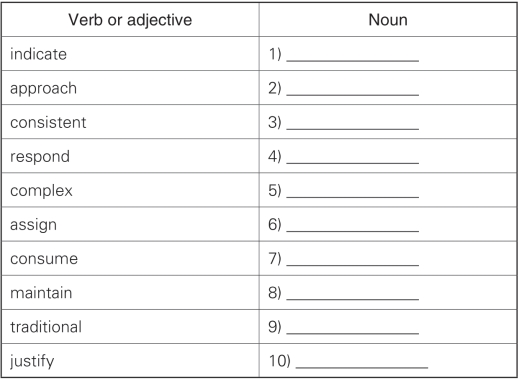
- The verbs or adjectives in the following left column are academic
words taken from the Academic Word List (AWL). Write down the
corresponding noun form of these words in the right column.
- Nominalize the following sentences appropriately to make the
language more concise.
- Since many people are lacking exercise, they often feel depressed
and exhausted.
___________________________________________________
- We analyzed the data from the experiment, and it revealed that
patients have recovered sooner.
___________________________________________________
- Europeans invaded Australia and they destroyed many sacred sites.
___________________________________________________
- If they plan in a sensible way, they may have reduced the cost.
___________________________________________________
- People tend to convey the information that one has desirable
characteristics. This is beneficial in a social environment.
___________________________________________________
5.3 Using a mix of active and
passive voice
Active voice refers to a sentence format in which the grammatical
subject of the verb is performing the action. It is usually a direct and
straightforward way to describe actions, emphasizing the doer of an action.
For example:
Vitamin A increases the risk of hair loss.
In this study, we present our design of recycled packaging products.
I found a strong correlation between the two sets of measurements.
While in passive voice, the subject of the sentence receives the action
of the verb. The action being performed or the recipient of the action is
emphasized, instead of the doer. The doer is placed at the end of a sentence
following the preposition by, or it may even be omitted in passive voice.You
can identify a passive voice by the form of be + past participle, for example:
The town was invaded by reporters.
100 votes are required to pass the bill.
An efficient teaching methodology is developed in this study.
Both active voice and passive voice can make your language efficient
and concise. In passive voice, the performer of the action may be unknown,
irrelevant or obvious to the reader, so it is often omitted. In fact, leaving out
the doer in passive voice is a kind of efficient language use: Less words are
needed.
The following examples demonstrate when the doer / performer of the
action can be omitted in passive voice. First, the doer of an action is possibly
not always known; then it can be left out. As in Example 1, since the action
took place too long ago (in the Upper Old Stone Age), it is unknown or
uncertain who made the cave paintings. Therefore, the performer is not
mentioned in this sentence.In Example 2, the action of hacking is performed
by the hackers who secretly find a way of looking at or changing
information from the computer. The hackers may have not been traced or
arrested by the police, and thus are unknown.
- The cave paintings of Lascaux were made in the Upper Old Stone
Age.
- The information was hacked from the computer.
Second, if the performer of an action is irrelevant (not important to or
connected with the situation), it can also be omitted in passive voice. In
Example 3, the action of building a solar power plant is more important than
who will build it. Readers may not be interested in who is building or will
build the power plant, so the doer of the action is left out. Similarly, in
Example 4,the people using the powers are irrelevant to the information.
There is no need to distract the reader by clarifying the users of wind power
or solar power in the area. If the doer of action is mentioned here, the
sentence will become wordy.
- An experimental solar power plant will be built in the Australian
desert.
- More wind power is used than solar power in this area.
Third, in passive voice, if the doer of an action is obvious to the reader,
it can be omitted. In Example 5, it is obvious that it is the author who will be
doing the discussing, so the doer is left out here. The emphasis is thus laid
on what is discussed, i.e. the recipient of the action (another type of
processed foods). Many similar examples can be found in academic essays.
When the author performs the action of illustrating, discussing, reasoning,
etc., the reader can easily know that.Hence, there is no need to mention the
performer “I”, such as in Example 6: It is apparent that the author has
divided the essay into five parts. By omitting the doer, the action of dividing
into five parts is emphasized, and the sentence is impersonal and concise.
- Another type of processed foods is discussed in a section later in this
chapter.
- This essay is divided into five parts.
In recent years, active voice has been advocated by many writing
guides (such as APA style)and journal editors for its clarity and conciseness.
Comparing the components of two constructions,a complete passive voice
contains two more words than its corresponding active voice: the verb“be”
(is, are, am, was, were, been, etc.) and the preposition by. Compare the
examples below, both sentences convey the same information, but the active
voice uses less words than the passive voice.In this sense, active voice is a
more concise language structure in contrast to passive voice.
Active voice: Reporters invaded the town. (4 words)
Passive voice: The town was invaded by reporters. (6 words)
In addition, writing in active voice means the subject of the sentence
clearly performs the action that the verb expresses. Who is doing the action
is clear and unambiguous, and such clarity and precision are required in
academic writing. In the past, students were encouraged to use passive voice
to avoid using “I” when writing research papers, especially in the section of
“methods and data collection”. For instance:
A survey in the form of questionnaires is conducted. 100 students were
requested to fill in the questionnaires that are distributed online via an app.
These students were randomly chosen on campus.
All the sentences in this example are in passive voice and do not
mention the doer of the actions.It then becomes unclear who has / have
conducted the research. Maybe it is the author or it might be a group of
researchers including the author. Such ambiguity is at odds with the goal of
clearly and concisely describing the process of data collection and analysis.
Suppose it is the author who performed the actions mentioned, we can
transform this paragraph in active voice:
I conducted a survey in the form of questionnaires. I distributed the
questionnaires online via an app and I requested 100 students to fill in the
questionnaires. I randomly chose these students on campus.
In this transformed paragraph, although it is clear that the author, as the
researcher, performed all the actions, the personal pronoun I seems to be
repetitive and redundant. Therefore, to make this paragraph clear and
concise, and make the sentence structures varied, we can use a mix of active
and passive voice, as the following example illustrates. The first sentence
should clearly state who the researcher(s) is / are by using an active voice;
then it will be obvious to the reader who the actor(s) in the remaining
sentences is / are. Using the passive voice that omits the doer of the action is
appropriate in the following sentences.
I conducted a survey in the form of questionnaires. 100 students were
requested to fill in the questionnaires that are distributed online via an app.
These students were randomly chosen on campus.
Exercises
- Change the active voice into the passive voice (avoid mentioning
the doer if necessary), or the passive voice into the active voice. Do you
notice that the transformed sentences become more concise than the original
sentences?
- Last year’s sales figures are illustrated in Figure 2.
______________________________________________
- Now people use social media more frequently than they did 10 years
ago.
______________________________________________
- Genetic information is encoded by DNA.
______________________________________________
- We will conduct a survey among 500 consumers about their using
experience.
______________________________________________
- The possibility of merging has been examined for many years by
these two companies.
______________________________________________
- Rewrite the following paragraph by using the appropriate voice to
achieve language efficiency and clarity.
We made observations during a 1-month period. We confirmed
interobserver reliability of 95%before the trial. We recorded all staff or
visitor touches that occurred to the infants under observation.We classified
touches by three additional variables: individual making hand contact, the
condition of the hands, and the level of contact. We defined cleaned hands as
use of either the alcohol-based product or handwashing with the cleansing
product immediately before the touch observed. We defined the levels of
contact as: Level 1, Level 2, and Level 3.
______________________________________________
______________________________________________
______________________________________________
______________________________________________
______________________________________________
______________________________________________
【注释】
[1]modifier n. a word, phrase, or clause which functions as an adjective
or an adverb to describe a word or make its meaning more specific 修饰语
[2]analogy n. a comparison of one thing with another thing that has similar
features 类比;比拟;比喻
[3]verbosity n. the use of more words than are needed 冗长,赘言
[4]past participle n. the form of a verb that ends in -ed, -en, etc. 过去分
词
[5]present participle n. the form of a verb that ends in -ing 现在分词
[6]nominalize v. to form a noun from a verb or an adjective, for example,
truth from true 使(动词或形容词)转变为名词;使名词化
[7]agent n. the person or thing that does an action (expressed as the subject
of an active verb, or in a by phrase with a passive verb) 施事者;行为主
体
[8]suffix n. a letter or group of letters, for example -ly or -ness, which is
added to the end of a word in order to form a different word, often of a
different word class 后缀
[9]object n. a noun, noun phrase or pronoun that refers to a person or thing
that is affected by the action of the verb, or that the action is done to or for
宾语