Chapter 8 Citing Sources
Chapter 8 Citing Sources
Objectives
√ Avoid plagiarism
√ Know why and when to cite
√ Learn how to quote, paraphrase and summarize
√ Familiarize yourself with the APA citing and referencing style
8.1 Avoiding plagiarism
Plagiarism is the practice of using or copying someone else’s idea or
work and pretending that you thought of it or created it. You should realize
that ideas and any form of expressions of ideas can be owned, regardless of
where you find them — in books, journals, lectures, or on websites.When a
person uses a particular set of words, phrases, and sentences expressing a
specific idea for the first time, he / she in fact owns those words and that
idea. Besides, the research results presented in visual form like a table,
graph, or diagram are also owned by the researchers or authors who publish
those results. As a result, if you intend to include another person’s words,
ideas or other information in your essay, you must acknowledge the source
and tell the readers where you found it exactly — otherwise you are
committing plagiarism.
Plagiarism is regarded as academic fraud or deception. Consequences
of plagiarism can be serious, from getting a zero on the writing assignment,
to receiving a failing grade in the course, to being expelled from your
college or university. Therefore, you must have a better understanding of
what constitutes plagiarism and how to avoid it.
8.1.1 Types of plagiarism
[1]
Plagiarism can happen accidentally or intentionally. Due to the lack of
knowledge about the strict rules of citing and crediting sources , some
students may commit plagiarism unconsciously,while other students may
do it on purpose — mostly because they did not spare enough time to plan
and write the essay, they just copied from other people or used their own
previous work. There are four types of plagiarism that have been widely
recognized , i.e. direct plagiarism , self-plagiarism ,mosaic
plagiarism, and accidental plagiarism.
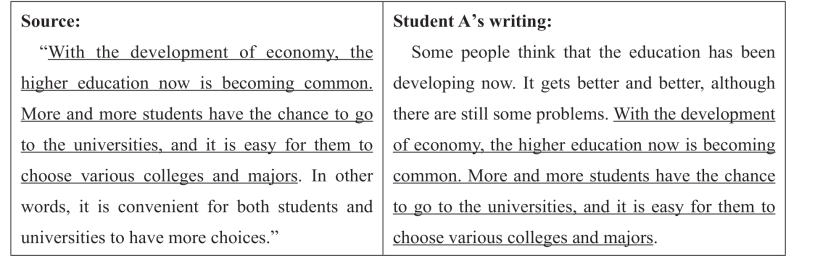
Direct plagiarism means direct copying. It is the most obvious type of
plagiarism. You use another person’s words without any change, without
quotation marks (“ ”), and without crediting the source. Such deliberate
plagiarism of someone else’s work is unethical. Looking at the following
example, Student A has included two word-for-word sentences from the
source article without any indication that the sentences are quoted from
others. In this way, the student pretends that he / she has created all these
words.
An example of direct plagiarism
Self-plagiarism occurs when you submit your own previous work, or
mix different parts of previous works, as your current assignment. It might
not seem wrong to reuse works that you have written in the past, but it
actually is, because these works have already been evaluated and you
received a grade. Without permission from all teachers involved, reusing
your previous work is also viewed as a form of plagiarism.
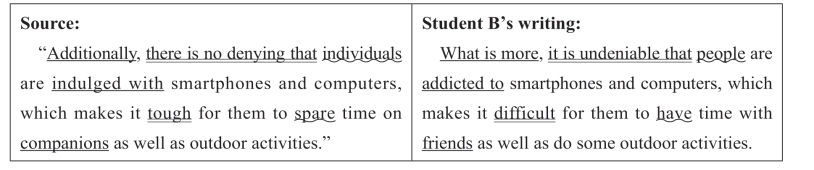
Mosaic plagiarism sometimes is also called “patch writing”. It mostly
occurs when you use synonyms to replace part of the original author’s
language while keeping the same sentence structure and meaning. This is in
fact a kind of improper paraphrasing. You may protest that “I didn’t copy the
original work word-for-word” — it only allows you not to use quotation
marks.However, you kept a similar sentence structure, and most importantly,
you borrowed other’s ideas. Under this circumstance, you still have to
acknowledge the original writer, or else it also is plagiarizing. As in the
following example, Student B keeps the same overall sentence structure as
the source, only replacing several words or phrases with their synonyms, e.g.
additionally vs. what is more, individuals vs. people, tough vs. difficult.
Without crediting the source, it still constitutes plagiarism. See Section 8.2.2
to learn how to paraphrase appropriately.
An example of mosaic plagiarism
Accidental plagiarism takes place in several situations, for example,
you forget to mention the original author and its publishing year (i.e. use in-
text citation; see more in Section 8.3.1) when you have quoted or
paraphrased other’s work; or you have an in-text citation, but carelessly miss
an item in the reference list to give more detailed information about your
cited source (see more in Section 8.3.2); or when you misquote the sources.
Although you may unintentionally forget to do something or do it
incorrectly, it would be difficult for your teacher to distinguish the
difference, and it will induce similar severe consequences as intentional
plagiarism.
8.1.2 Steps to avoid plagiarism
In order to avoid different types of plagiarism during your essay
writing, you may follow a set of scholarly procedures described below.
Step 1: Plan and manage your time properly.
The first thing before you start writing your essay is to plan your time.
As mentioned in Chapter 1, an equal allocation of time to each stage of pre-,
while- and post-writing would be suitable for a beginner. Once you have
planned in this way, try to manage your time carefully. You might be
tempted to do other more urgent tasks rather than planning your essay.
However, do not fancy that you can complete an essay within one or two
days, because it really takes much time to research,draft and revise. Most
cases of intentional plagiarism result from procrastination as the deadline
approaches. If for any reason you are unable to meet a deadline, apologize to
your professor or instructor and ask for an extension.
Step 2: Take notes accurately and appropriately when you do research.
During the research process, it is of vital importance to take effective
notes, or else your risk of plagiarism will be increased. The following are
some suggestions for your notetaking (see more in Section 2.1.4). After
critical evaluation of the sources, you will decide on the useful and reliable
sources. Carefully record all the publication or bibliographic information
you will need for your reference list (see more in Section 8.3.2), including
the author’s name, the title, the publisher, the date of publication, the website
address, the issue of a journal, the page numbers, etc. For example,when the
source is a book, you can find such information from the front pages. When
it is a journal article, you may look for the publication information in
headers, footers, or footnotes of the title page.
Then, consider how you are going to incorporate the information from
the sources into your essay. If you intend to include several sentences word-
for-word in your essay, you should use quotation marks to note these
sentences. Take accurate notes without missing any word or phrase,even
punctuations. If you just want to borrow certain ideas from the source, use
your own words to paraphrase the original sentences, but make sure you
correctly understand them (in this case you do not need to add quotation
marks). Therefore, quotation marks are actually helpful in distinguishing the
exact words used by the original author from your own words. When you
return to your notes later in the drafting process, you will not have to guess
which ideas are yours and which ones came directly from the source.
Step 3: When you are drafting your essay, include or incorporate
information from sources by quoting, paraphrasing and summarizing (see
more in Section 8.2).
An essay is a combination of your own arguments and ideas and
evidence from outside sources.In order to make your thesis convincing, it is
not enough to only rely on your previous understanding and knowledge
about the topic. Instead, you must quote authorities, use solid evidence or
proof to support the ideas you put forward, and add your analysis of other
people’s opinions, etc. All these elements require you to include relevant and
credible information from sources. Quoting,paraphrasing and summarizing
are the three commonly used practices to incorporate information.For this
step, you have to refer back to your notes. When drafting, use quotation
marks to label a quotation from the source and use your own words to
paraphrase or summarize the original author’s ideas.
Step 4: Acknowledge the source immediately after you have included
information from it by intext citations and end-of-text references, following
a suitable citation style (see more in Section 8.3).
This step can be the most crucial one to enable you to avoid plagiarism.
As mentioned in Section 8.1, you must acknowledge the source and tell the
readers exactly where you found it,otherwise you are committing plagiarism.
In-text citations and end-of-text references are the two best methods of
acknowledging sources. If you have included an idea or a sentence from a
source in your draft, an in-text citation immediately gives brief publication
information about the source,including the author’s name, the year of
publication, and / or the page number. The in-text citation closely follows a
quotation, paraphrase, or summary. An end-of-text reference contains all the
detailed publication information about that source, which you put at the end
of your essay. It tells the readers where you found the original material and
helps them to locate it if they are interested.
Notice that there are various citation styles (e.g. MLA, APA, Harvard,
or Chicago) or systems in different disciplines. Therefore, you should know
which style is required by your instructor or preferred in your discipline.
Follow the style manual / guideline which explains in detail how a source
can be properly cited and referenced. We will give examples of in-text
citations and end-oftext references following the APA style in Section 8.3.
Step 5: Carefully review your essay to make sure you have cited
everything correctly.
Once you have completed your draft, set it aside for one or two days
and then carefully review it. Check the following aspects:
● Have you included all the necessary information from the sources?
● Have you put an in-text citation and end-of-text reference once you
have used a quotation,paraphrase or summary?
● Are the formats of citing and referencing correctly following the style
manual?
Afterwards, if you are still not quite sure, you may submit your essay to
TurnItIn.com or similar websites to check for plagiarism before you turn it in
to your professor.
In fact, Steps 3 and 4 can be combined as one procedure, which is
called citing sources (or documenting sources). It refers to acknowledging
that you have borrowed information from someone else and incorporated it
into your own work. Citing sources is a most important feature and
convention of academic writing. It effectively prevents you from committing
plagiarism — you include information from a source by quoting,
paraphrasing or summarizing; then credit the source immediately by in-text
citations and later by end-of-text references.
8.1.3 Common knowledge
In your essay, when you are illustrating your own ideas, there is no
need to use such language as I think or in my opinion, because the borrowed
ideas from other people will be indicated by citations and references.
Naturally, the rest of ideas that are not cited will be attributed to yourself.
One exception to this rule is called common knowledge.
Common knowledge refers to facts that can be found in numerous
places and are likely to be known by most people. When you are referring to
a piece of common knowledge, you do not need to cite it. Generally
speaking, there are following types of common knowledge:
● a general fact that most people know, e.g., John F. Kennedy was an
American president.
● a generally accepted fact, e.g., Pollution is harmful for the
environment.
● a scientific consensus which is the collective judgment and opinion of
the community of scientists in a particular field of study, e.g., The Earth’s
climate is warming and the warming trends over the past century are mainly
caused by human activities.
● information that can be found in general reference works, e.g.,
Zoology is the scientific study of animals.
Notice that while the common knowledge itself does not have the
copyright, the exact wording of it has the copyright. So, when you read a
piece of common knowledge from a source, if you intend to include it in
your essay, try to use your own words to rephrase it. For instance, you may
find an explanation of scholar in the Oxford Dictionary, which says, a person
with much knowledge,usually of a particular subject and especially one who
gives careful attention to evidence, method,etc.. If you want to include this
definition, it is better to restate it in your own words.
When you have doubt about whether some information is common
knowledge or not, ask yourself the following two simple questions:
● Did you know such information before you read about it?
● Did you develop this idea in your own mind?
If the answer to these questions is yes, you do not need to cite the
source; if the answer is no,you should better cite. In case you are still not
sure, cite the source of such information. If the citation turns out to be
unnecessary, your teacher or instructor will inform you. You will not lose
points for “over-citing” in your essay. However, if you fail to acknowledge
the source when the information is actually not common knowledge, but
instead, say, the author’s original interpretation of a fact, you will be accused
of plagiarizing.
Exercises
- Read the following statements about plagiarism and determine
whether they are true (T) or false (F).
____1) Accidental plagiarism will be forgiven by your professors if you
explain to them.
____2) Using your own writing which has been submitted to another
course as your current assignment is not plagiarizing.
____3) Direct plagiarism occurs when you copy someone else’s writing
word-for-word without quotation marks.
____4) Plagiarism in any form will bring severe consequences to the
students involved.
____5) So long as you change part of the original language, you will
not be accused of plagiarizing.
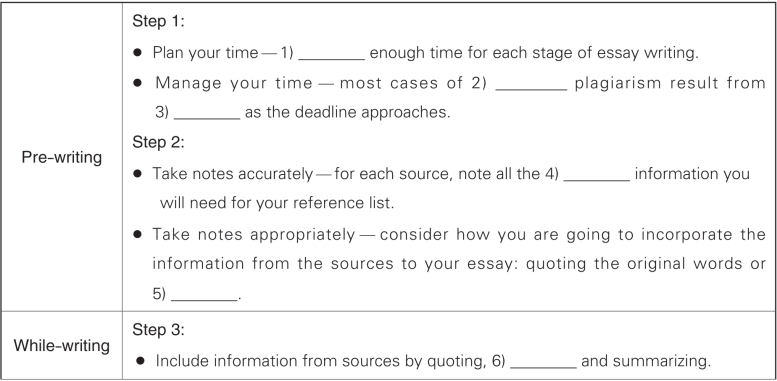
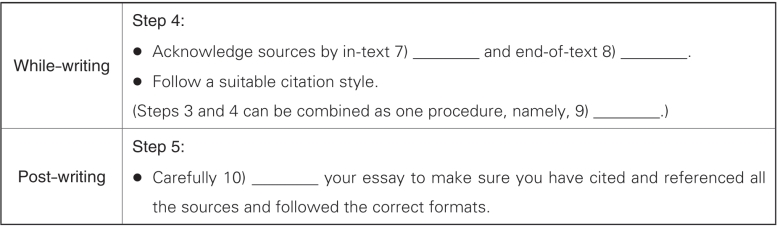
- The following table reviews the key points in the five steps that
may help you avoid plagiarism. Fill in the blanks with appropriate words or
expressions.
- Decide which of the following statements are expressing common
knowledge and thus do not require a citation.
- Shakespeare is considered one of the greatest writers in the world.
- Astronauts first landed on the moon in 1969.
- Addicting to video games can be as problematic as gambling and
affects players as young as 8 years old.
- 97% of the water covering the Earth is salt water found in the ocean.
- Cleopatra used her brains more than her beauty to become one of
Egypt’s most successful rulers.
- Artificial Intelligence studies how to make machines work in an
intelligent way, like a human mind.
8.2 Incorporating information from
sources
In this chapter, all the sources we refer to are credible sources, and all
information is relevant,authoritative and objective (see more in Chapter 2 for
knowing how to use critical thinking skills in the process of research to look
for qualified information from reliable sources). In this section,we will focus
on the first element of citing sources, namely, including or incorporating
information from the source materials. The second element —
acknowledging sources — will be elaborated on in Section 8.3. In fact, these
two elements are difficult to be separated from each other, but for a detailed
and thorough description of each, we intend to divide the concept into two
parts.
For beginners of academic writing, they may be reluctant to incorporate
information from sources. Some common confusions are: “Shouldn’t my
essay consist of all my own ideas,knowledge and experience?” “Wouldn’t it
weaken my essay if I incorporate too many ideas from others?” “What
types of information should be included from outside sources?” “How to
incorporate other’s words into my own work?” etc.
To clear your doubt, first, be aware of the advantages of citing ideas
and information from other people. For a college essay assignment, simply
relying on your own ideas and experience is far from enough. You must
connect information from outside sources to your own ideas in order to
establish credibility and make an effective argumentation. Instead of
weakening your essay or making it seem like you have fewer original ideas,
citing sources will strengthen your writing because it:
● demonstrates your capability to synthesize information or analyze
different ideas from different perspectives;
● provides outside support (e.g. research findings, quotations from
authorities) to your arguments, and thus reinforces your thesis;
● enhances the credibility of your essay (citing various sources proves
that you are well informed about the topic and your work can be trusted to
be accurate);
● leaves an impression of honesty on the reader by avoiding plagiarism.
As to the question of which types of information should be borrowed
and incorporated in your essay, the answer varies with the topic and
requirements of different essays. Frequently cited information includes:
● statements of authorities or experts;
● personal or unique opinions;
● research findings;
● official statistics or documents;
● visuals, e.g. pictures, charts, diagrams.
After deciding on the relevant information to be used, you have to
consider how to incorporate it into your own work. The three scholarly
ways, i.e. quoting, paraphrasing, and summarizing, have distinct features but
one thing in common — “loyalty to the original source”. In other words,
no matter which device you choose, you must keep the original meaning of
the source. Continue reading the following sections for a detailed
introduction to each procedure.
8.2.1 Quoting
Quoting is the process of taking the exact words from the original
source and enclosing them in quotation marks. An in-text citation should be
in the same sentence with the quotation — it is necessary to attribute the
quote to its author. Technically speaking, you should not include too many
direct quotations in your essay, and it is also not suggested to quote a long
text (usually longer than 40 words). As widely recognized, quoting does not
require as much cognitive work as paraphrasing or summarizing, and thus
would make the readers question your level of expertise. But there are some
exceptions. You may include information from outside sources by quoting in
the following situations.
When to quote?
When writing for some particular subjects, such as literature,
linguistics, etc.
In a literature course, you might be assigned to write a literature
analysis essay, which will heavily rely on direct quotations from the
literature work. In a linguistics course, you may need to write about the
different uses of language, such as language during specific period of
history, in a particular place,etc. For such topics, you will inevitably quote
words or sentences from the language users. An example of the essay topic
that would require frequent quotations is: A comparison of three British
poets and their use of rhyme. When writing this essay, you must quote lines
from poems to illustrate how these poets use rhymes.
When discussing different ideas of the same topic
In argumentative essays, you always need to put forward one or more
opposite arguments and refute them with solid evidence or logical reasoning,
so a quotation of the opponents’ idea is justifiable here. Without changing
the original words, the exact quote of an opposite argument will enhance the
credibility of your essay. For example, if you want to develop a counter-
argument to the statement “Traditional working environments are gradually
becoming a thing of the past.” made by Joel Sussman, a contributor to
Business News Daily, then you can quote this statement which you find
questionable and incorporate it in your essay to establish a dialogue between
yourself and Joel Sussman:
Joel Sussman argued that “traditional working environments are
gradually becoming a thing of the past” (2017, Para. 2). Yet in recent years
most companies and factories are still requiring their staff to stay in the
workplace for rigid working hours.
When seeking support from an authoritative source
In many cases, you will look for evidence to support your arguments in
an essay. Direct quotations from an authority or expert in the field will make
your arguments more convincing. For example, when writing an essay about
the differences between the lives of male and female slaves in the U.S.
South, it is effective to quote, rather than paraphrase, the words written by a
former slave,Harriet Jacobs, as follows:
Harriet Jacobs, a former slave from North Carolina, published an
autobiographical slave narrative Incidents in the Life of a Slave Girl. She
exposed the hardships of both male and female slaves but ultimately
concluded that “slavery is terrible for men; but it is far more terrible for
women” (Jacobs, 1987, p. 77).
In this example, Jacobs as a former slave is providing an authentic,
authoritative, first-hand perspective on slavery. Her original words are
trustworthy for the readers.
When the wording of the original statements is unique, impressive or
powerful
Well-known speakers or writers are good at expressing their ideas in a
special and impressive way. Therefore, any change of the words or sentence
structure might weaken its effect. If their statements are highly relevant to
what you are discussing, you may quote their words. For example,many
American presidents have uttered remarkable or inspirational statements in
their inaugural address, which deserve a quotation, such as:
“The only thing we have to fear is fear itself.” (Franklin Roosevelt,
1933)
“Ask not what your country can do for you — ask what you can do for
your country.” (John F. Kennedy, 1961)
How to quote
After identifying the occasions when it is suitable to use quotations, it is
necessary to think about how to fit those quotations in your own writing.
There is a simple method called ICE, which stands for Introduce-Cite-
Explain.
Introduce
The quotation should not be inserted into your text abruptly. Instead,
introduce it with the author’s name, any other necessary background
information (e.g. when and where the quote was stated), and a signal verb
[2].
These elements will provide your reader with basic context for the quotation.
So the reader will have better understanding of the quotation, and it would
not seem to be sudden or unexpected for a quotation to come in. For
example:
Cormac McCarthy stated in his 2006 novel The Road: “You forget what
you want to remember, and you remember what you want to forget.” (p. 12)
In this sentence, the writer gives essential information to introduce the
quotation — it is clear for the reader to know who (Cormac McCarthy)
wrote the quotation, when (2006) and where (in his novel The Road). The
writer also uses a signal verb stated to signal the reader of the following
quotation.
Pay attention to signal verbs, which are not only useful to introduce a
quotation, but are also frequently used when introducing a paraphrase or
summary. Some signal words are neutral and do not show your evaluation
toward the cited information, such as state, describe, discuss. Whereas if you
use the signal words allege, claim, assert, etc., you are probably disagreeing
with the original author’s opinion. Therefore, carefully choose a signal word
to introduce your quotation. Besides, the phrase according to can also
function as a signal verb. Examples of common signal verbs are listed
below:
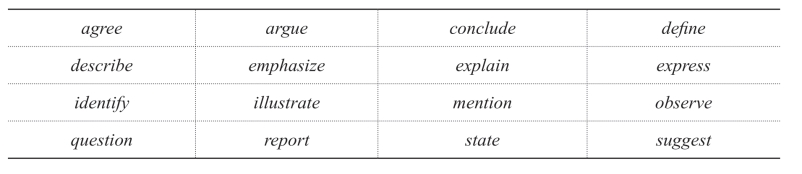
The signal verbs are used together with the author’s name (usually the
last name) to attribute the cited information to this author. In most cases,
signal verbs should be written in the past tense. For example:
Jacobs in her autobiographical novel concluded that “…” (1987, p. #).
Williams and Bartlett described in their article “…” (2015, p. #).
Smith agreed the proposal when he suggested “…” (2018, p. #).
Cite
Then, place the quotation between quotation marks and copy the text
from the source word-for word. Do not forget to provide an in-text citation
in the expected format for your quote. Different citation styles may require
slightly different formats of the in-text citation for a quotation, but there are
three basic elements generally needed, i.e. the author’s last name, the
publication year, and the page number. Usually, you need to put such
information in the brackets placed at the end of the sentence, after the closed
quotation mark, but when you have already mentioned the author’s name
and the year of publication previously, you only need to add the page
number at the end. The following two examples illustrate these two common
formats:
The homeless were typically neglected when growing up since they
“commonly come from families who are riddled with problems and marital
disharmony” (Rokach, 2005, p. 477).
As Rokach (2005) notes, the homeless “often have no one to care for
them and no one knows them intimately” (p. 477).
There are many complicated cases concerning the format of in-text
citations, such as when there are two or more authors, when the source is a
website and no page number can be found, etc. You can find more example
of the special cases in Section 8.3.1.
Explain
After inserting your quotation, along with its context and source, you
also need to provide your explanation of the quotation by answering one or
more of the following questions: What does the quotation mean? What is its
significance? How does it relate to what you are trying to prove in this
paragraph? Try to give your explanation or evaluation concerning these
questions. It will add more weight to your quotation. For instance:
John F. Kennedy in his 1961 inaugural address stated, “Ask not what
your country can do for you — ask what you can do for your country”. It
challenged each American to contribute in some way to the public good.
In this example, the last sentence explains the meaning and significance
of the previous quotation — the quotation means that people should
contribute in some way to the public good, and its significance is to call for
such action from each American.
When you are including a quotation to your essay, you should not make
any change to the original text, including capitals and punctuations. But
there are a few occasions when you want to make the quoted text fit better in
your writing; you can do few minor changes, such as changing verb tense or
pronouns in order to be consistent with the rest of the sentence, or leaving
out part of the text to make everything you quote closely relevant to your
own ideas. The bottom line is not to alter the sentence structure and the
meaning of the quotation. Whenever you change the original text from the
source, use proper symbols to indicate that you have done so:
● When you change a certain word, use a pair of square brackets “[ ]”
to enclose the substitution;
● When you leave out the middle part of the original text, use an
ellipsis “…” to indicate that part being omitted.
8.2.2 Paraphrasing
Paraphrasing refers to the procedure of using your own words to restate
another person’s idea,and acknowledging the source by appropriate in-text
citation. The length of the original text to be paraphrased should not be very
long (usually one sentence or several sentences). Since you are still
borrowing others’ thoughts by paraphrasing, it is crucial to attribute
borrowed ideas to the original authors immediately, or else you are
committing plagiarism.
The major difference between paraphrasing and quoting lies in whose
words you are using. In paraphrasing, you use your own way of expression
which is distinct from the original text in form,such as different sentence
structure, voice, and vocabulary, but keeping the same meaning. While in
quoting, you take the exact words from the source. Your instructor may
prefer you to use more paraphrases instead of quotations in your essay,
because the former demands more mental effort to process the borrowed
information. Other advantages of paraphrasing are listed below.
Simplify a text that may be originally difficult to understand
Suppose you are writing on the topic of healthy food and you plan to
include information related to food science from a journal article. However,
scientific writing usually involves a pile of professional knowledge which is
difficult to follow. In such a situation, paraphrasing allows you to simplify or
explain the information so the reader can have a better understanding of the
idea or theory. For example, if you want to include the following sentence
from a scientific paper which is closely related to your topic:
Freeze-drying coupled with a microwave heat source speeds up the
drying rate and yields good quality products provided the operating unit is
designed and operated to achieve the potential for an absence of hot spot
developments.
Unexperienced readers may have difficulty understanding this sentence,
since it involves the specialized knowledge of food heating process;
additionally, there are several technical terms(e.g. freeze-drying, hot spot)
and a complicated sentence structure (including a few clauses) of a
considerable length (the word count is 36). Directly quoting such a
complicated sentence in your essay would be meaningless. You must break it
down into several shorter parts, using a clearer way to express the idea
without using too many originals words.
Enhance your credibility
By simplifying and clarifying technical or complicated information via
paraphrasing, you demonstrate your capability to interpret difficult
messages, thus allowing the reader to count on your knowledge about the
topic. By contrast, if you directly quote difficult information in your
essay,without much explanation, it may appear that you do not understand it
at all. The readers will then lose their trust in you.
Keep the flow of your writing
The flow of your writing refers to the smooth and coherent way that
words and ideas are linked together in your essay. Using your own words to
restate someone else’s idea in fact gives you more freedom to convey that
idea — you can choose a suitable subject to link with a former sentence,
use either passive voice or active voice, have a variety of word choices,
keep a formal tone, or even skip irrelevant information. As long as you
maintain the original meaning, you have flexibility as you approach the
idea in your own words. Thus, the paraphrased text connects with former
and subsequent sentences more cohesively and coherently. On the other
hand, suppose your essay is full of quotations — it would seem choppy
[3] to
the readers. Overall, paraphrases will fit with the rest of your writing much
better than quotations.
Considering the above features, you may use paraphrases to incorporate
information from outsides sources when:
● you do not want to overuse direct quotations;
● making a difficult text easier to understand;
● you intend to demonstrate your ability to understand and synthesize
information;
● you want to keep your writing more cohesive and coherent;
● reporting numerical data or statistics (for this type of information, it
is the numbers rather than the exact words that you need to refer to, so
quoting a whole sentence is unnecessary).
Now that you understand the importance of paraphrasing, you should
know how to paraphrase.There are five commonly adopted steps.
Step 1: Read the original text several times until you are sure that you
have fully understood it.
Step 2: Put the original text aside and use your memory to note down
the key points in your own words. You may keep the shared language, e.g.
technical terms or conventional terms, but all the other words as well as the
sentence structure should not be the same as the original text. You also need
to consider how to link the paraphrase to the sentences around it.
Step 3: Compare your paraphrase with the original text and make
adjustments. Look for any consecutive words that are exactly the same
(except the shared language) and change those words with synonyms or use
quotation marks to identify any unique terms you have borrowed verbatim
from the source (the shared language does not require quotation marks).
Then, check the sentence structure. Make sure you use a different sentence
structure from the original.
Step 4: Check whether your paraphrase correctly conveys all the
essential information in the original text.
Step 5: Acknowledge the source with the in-text citation in the desired
format. Most citation styles require you to mention the author’s last name
and the publication year for a paraphrase. There are two common formats:
( ⅰ) mention the author’s name and use a signal verb (in present tense)to
introduce a paraphrase; (ⅱ) put the author’s last name and the publication
year in brackets and place them at the end of the paraphrase (see more in
Section 8.3.1). Notice that if your paraphrase contains two or more
sentences, each sentence should be attributed to the original author.
Among the five steps of paraphrasing, Steps 2 and 3 are most crucial.
You must avoid looking at the original text when you are paraphrasing, or
you will be tempted to copy from it word for word.Always remember that it
is the idea — not the language that you want to borrow. Then, you can focus
on using your own way to express borrowed ideas and adapting the
expressions to the rest of your writing.
In Steps 2 and 3, you need to pay attention to a notion called shared
language, i.e. a common vocabulary shared by a community of scholars. In
every discipline, there are some words or phrases which are so specialized
or conventional that can hardly be interpreted by other wordy and awkward
expressions. They are referred to as shared language, most of which are
nouns or noun phrases,including technical terms, e.g. amino acid (氨基
酸), acrylamide (丙烯酰胺), glucose (葡萄糖), and
conventional terms, e.g. chronic pain, shop assistant, processed food.
When paraphrasing a text, you can leave the shared language the same,
without using quotation marks to identify them. It will not constitute
plagiarism, but if you only change few words, leaving many other words
or phrases the same as the original text without using quotation marks, you
are still committing plagiarism, even when you use an in-text citation to
give credit to the source.
We will use an example to illustrate how to produce a legitimate
paraphrase by following the above five steps.
Original text: “Throughout the nineteenth century, stereotyping of work
by sex had restricted women’s employment.”(From Nancy Woloch’s book,
Women and the American Experience: A Concise History, published in
2002.)
Step 1: Reread this sentence many times, try to understand the phrase
stereotyping of work by sex. The word stereotype refers to a fixed idea about
a person or idea which may not really be true. Society often forms a biased
opinion towards women, regarding them as only suitable for few jobs like
nurses, kindergarten teachers — this is what stereotyping of work by sex
means.This kind of stereotype usually results in gender discrimination.
Step 2: Do not look at the original sentence, use your memory to record
your understanding of it. Maybe you will first write down some key words:
19th century, stereotypes, women,employment. Then develop a full sentence
based on them, such as:
Paraphrase 1: In the 19th century, social stereotypes limited women’s
work.
Step 3: Compare your paraphrase with the original sentence and check
for repetitions. Most parts of Paraphrase 1 sounds good. You will find 19th
century, women and work are general terms that you can directly use in your
paraphrase without changing. Limited is a synonym of restricted. The
problem may be the subject and the sentence structure. The subject of
Paraphrase 1 includes stereotypes, which is almost same as the original
subject stereotyping, just in a different word class. The sentence structure of
Paraphrase 1 is also similar to the original:stereotypes limited work vs.
stereotyping restricted employment. Therefore, you need to think of a better
way to avoid unnecessary replication while keeping the original meaning.
After adjusting, a better paraphrase looks like this:
Paraphrase 2: In the 19th century, women had few job opportunities due
to gender discrimination.
Step 4: Check the meaning of Paraphrase 2. It properly conveys the
original information:(ⅰ) had restricted women’s employment means women
had few job opportunities; ( ⅱ) since stereotyping often results in
discriminatory biases that affect employment, and thus stereotyping of work
by sex can be used to refer to gender discrimination.
Step 5: Add an in-text citation. By adopting the APA citation style,
provide the author’s last name and the publication year in brackets and put
them at the end of the paraphrase, as shown below:
Paraphrase 3: In the 19th century, women had few job opportunities due
to gender discrimination (Woloch, 2002).
In conclusion, the process of paraphrasing is not simply using
synonyms to replace the original words. The key to paraphrasing is to use
your own words to express your understanding of the original text, usually
with simpler language, and the principles are:
● using as few original words as possible;
● changing the sentence structure;
● adding an in-text citation to acknowledge the original author;
● if necessary, emphasizing the most relevant points while leaving out
unrelated information.
8.2.3 Summarizing
Summarizing refers to the process of using your own words to convey
the main ideas of a long text, and acknowledging the source by an in-text
citation. It is similar to paraphrasing, but the original text of a summary is
longer than that of a paraphrase. In other words, if you want to incorporate
the information in several paragraphs or even the entire article from the
source to your essay, you have to summarize the main ideas of that long text.
Your summary should be much shorter than the original material, because
you have condensed the information into one or several major points, and
left out those details which are not important to your writing. Since you are
still borrowing ideas from others when summarizing, it is essential to
attribute your summary to the original authors. Generally speaking, you can
include information from a source by summarizing in the following
situations:
● when the original text is too long to quote or paraphrase;
● when only the main ideas of a source are relevant to your essay;
● to offer an overview of a topic;
● to present an author’s opinions to support your arguments;
● to argue against an author’s opinions.
Summarizing has its own advantages. First, a summary benefits the
reader because it offers a clear, concise and general version of the original
information. Second, the process of summarizing demonstrates your
capability to extract the main points of a text, and use your own words to
present and fit them in your essay. In this way, teachers can check your
knowledge and understanding.Finally, summaries allow you to give an
overview of a particular topic, which is useful in writing your essay
introduction or the literature review section for a research paper.
You may adopt the following four steps to summarize a text and
incorporate the information in your essay:
Step 1: Read the original text several times. First, try to gain a general
understanding of the text;afterwards, read more carefully and look for
supporting arguments of the main idea.
Step 2: Underline or highlight what you regard as the main points in the
text. For instance, if you are summarizing one or more paragraphs, look for a
topic sentence in each paragraph. If you are summarizing a whole article,
you can first draw on clues from the title, the introductory paragraph and
concluding paragraph to find the thesis statement. Then look for supporting
arguments in each paragraph or section.
Step 3: Rewrite the main ideas of the original text by using your own
words to paraphrase its thesis statement or topic sentences. If you cannot
find these sentences in the text, you need to synthesize the major information
and express it in your own words. The summary to be included in your essay
is usually short — a sentence or several sentences long.
Step 4: Acknowledge the source by mentioning the author and the
publication year. For a summary, various citation styles have slightly
different requirements regarding the format of in-text citations. Generally,
when you are writing a summary of an article or a book, you may introduce
your summary with the full name of the author, the publication year, the title
of the article or book and a signal verb, such as suggest, argue, state, as
illustrated in Example 1 below.In order to save space, or when you are
summarizing a paragraph or two, you can only provide the minimum
information about the source, including the last name of the author and the
publication year, followed by a signal verb, as seen in Example 2. Notice
that in either case you need to use the present tense of the signal verb with a
summary.
- In Sex, Lies and Conversation: Why Is It So Hard for Men and
Women to Talk to Each Other?Deborah Tannen (1990) suggests that the
problems of communication in marriage can be solved if couples learn that
men and women have different styles of communication.
- Kahn (2017) concludes that carbon dioxide has reached its
historically high reading primarily due to the human activities of burning
large amounts of fossil fuels.
Exercises
- Identify which of the following texts are suitable for a quotation.
- Money is a mere side-show of the real happiness booster.
- The bombing of Pearl Harbor took place on December 7, 1941.
- Many able-bodied and healthy older adults are also choosing to
move into new apartment complexes tailored to the needs of older adults.
They may have wide hallways, ramps and accessible showers, for instance,
as well as social activities and even a cafeteria or restaurant on-site. These
options meet the basic needs of many elderly people but also cost far less
than nursing homes — making them easier to plan for — and afford older
folks more of their prized independence.
- A recent study done by scholars at the Brookings Institute found that
the number of people living in poverty in America grew by 12.3 million
between 2000 and 2010, so that by the end of 2010,15% of the population
was living under the poverty line.
- Political correctness is tyranny with manners.
- Put the following quotations in their corresponding texts.
a) “Businesses imposed clock time on their workforces.”
b) “More flexible hours means less time rushing around and more time
to take care of things just as important as your work.”
c) “As we come to rely on computers to mediate our understanding of
the world, it is our own___intelligence that flattens into Artificial
Intelligence.”
- Jonathan Wasserstrum (2017), CEO and co-founder of SquareFoot,
believes there’s a connection between job flexibility and enhanced employee
performance. He said, ________ (Para. 6)
- Carr (2008) mentioned, ________ (Para. 34) Although technology is
efficient, it may not always be the most effective when it comes to creating
overall well-rounded thinking.
- Tony Crabbe (2016) pointed out, ________ (Para. 1) They wanted
their employees to get more work done by controlling their work time. This
way turned out to be effective.
- Compare the following two paraphrases with the original text.
Identify a better paraphrase and explain why.
Original text: “Students frequently overuse direct quotation in taking
notes, and as a result they overuse quotations in the final paper. Probably
only about 10% of your final manuscript should appear as directly quoted
matter. Therefore, you should strive to limit the amount of exact transcribing
of source materials while taking notes.”(From James D. Lester’s book,
Writing Research Papers, published in 1976)
Paraphrase 1: Students often use too many direct quotations when they
take notes, resulting in too many of them in their paper (Lester, 1976). In
fact, probably only about 10% of the final writing should consist of directly
quoted materials (Lester, 1976). So it is important to limit the amount of
source materials copied while taking notes (Lester, 1976).
Paraphrase 2: When writing papers, students often quote excessively,
failing to keep quoted materials down to a desirable level (Lester, 1976).
Since the problem usually originates during note taking, it is essential to
minimize the material recorded verbatim (Lester, 1976).
Which is the better paraphrase?____________________
- Follow the five steps to paraphrase the following texts. Try to keep
the essential information and demonstrate your own understanding. Write
down your paraphrase on the line.
- “Employers’ growing tendency to hire consultants and other
temporary workers to complete projects and replace expensive full-time
staffers also has created new opportunities for older workers.” (From an
article written by Paul Davidson, published in 2017.)
______________________________________________
______________________________________________
______________________________________________
- “There are those who worry that Internet access can end up being
more of a distraction than a learning tool in the classroom, with games and
music and Facebook as easy to come by as population counts.” (From an
article written by Julia Layton, published in 2012.)
______________________________________________
______________________________________________
______________________________________________
- “The research suggests that parental guilt about how much time is
spent with their children may be misplaced.” (From an article written by
Luisa Dillner, published in 2016.)
______________________________________________
______________________________________________
- “At its most basic level, differentiation consists of the efforts of
teachers to respond to variance among learners in the classroom. Whenever a
teacher reaches out to an individual or small group to vary his or her
teaching in order to create the best learning experience possible, that teacher
is differentiating instruction.” (From an article written by Carol Tomlinson,
published in 2000.)
______________________________________________
______________________________________________
- Follow the four steps to summarize the following paragraphs. Write
a one-sentence summary on the lines.
______________________________________________
America has changed dramatically during recent years. Not only has the
number of graduates in traditional engineering disciplines such as
mechanical, civil, electrical, chemical, and aeronautical engineering
declined, but in most of the premier American universities engineering
curricula now concentrate on and encourage largely the study of engineering
science. As a result, there are declining offerings in engineering subjects
dealing with infrastructure, the environment, and related issues, and greater
concentration on high technology subjects, largely supporting increasingly
complex scientific developments. While the latter is important, it should not
be at the expense of more traditional engineering.
Rapidly developing economies such as China and India, as well as other
industrial countries in Europe and Asia, continue to encourage and advance
the teaching of engineering. Both China and India, respectively, graduate six
and eight times as many traditional engineers as does the United States.
Other industrial countries at minimum maintain their output, while America
suffers an increasingly serious decline in the number of engineering
graduates and a lack of well-educated engineers.
(From Ernst G. Frankel’s MIT Faculty Newsletter article Change in
education: The cost of sacrificing fundamentals,_published in 2008.)
______________________________________________
______________________________________________
______________________________________________
8.3 Acknowledging sources
After incorporating the words or ideas of someone else into your essay
by quoting, paraphrasing or summarizing, you need to acknowledge the
source in two forms: an in-text citation and an endof-text reference. The in-
text
citation
immediately
follows
a
quotation,
paraphrase
or
summary,notifying readers that you are borrowing information from others
and directing them to a reference at the end of your essay. The end-of-text
reference gives detailed publication information on the original source of the
borrowed material.
The exact contents and formats of both the in-text citation and the end-
of-text reference vary from discipline to discipline. Your instructors will
usually tell you which citation style to follow when citing sources in your
essay. A citation style prescribes the information necessary for citations and
references and how the information should be ordered, as well as
punctuation and other formatting. Popular citation styles include APA,
MLA, Harvard, Chicago, etc. as listed in the following table.
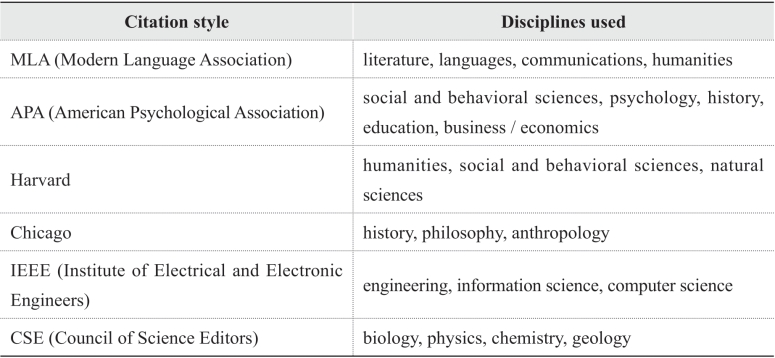
In the following two sections, we will present examples conforming to
the APA style guidelines to illustrate how to acknowledge sources by in-text
citations and end-of-text references. For more specific information about the
format of your citations and references, you may visit the official website of
the APA style (https://apastyle.apa.org/).
8.3.1 In-text citations
An in-text citation gives credit to the source immediately after you have
borrowed words or ideas from others in your writing. It shows where you
found the quotes, information, ideas or research, etc. The APA style
guidelines require you to provide basic information about the source in an
in-text citation:
● the last name of the author (no first names or initials);
● the year of publication;
● the page or paragraph number (for direct quotations only).
There are two major ways to cite information. First, put all the
information at the end of the sentence, using brackets to enclose it. As the
following example shows, the writer quotes a phrase from the source, and
then encloses the last name of the author (Pepper), the year of
publication(1961) and the page number (p. 49) in the brackets which are
placed at the end of this sentence.
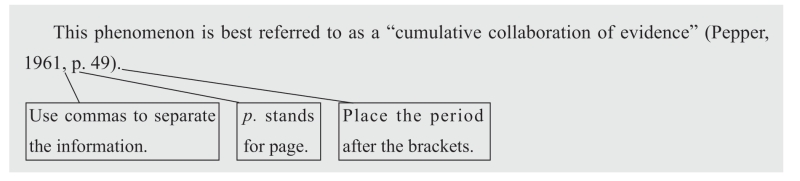
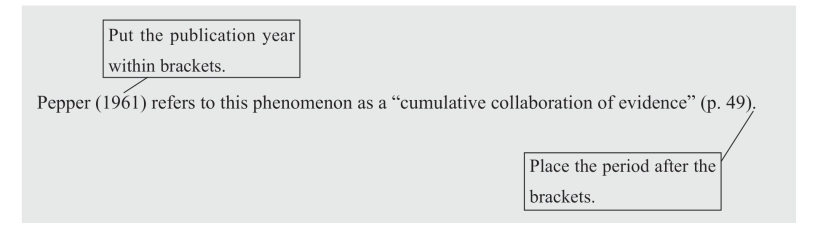
The second way is to include some citation information as part of the
sentence. As illustrated in the example below, the author’s name (Pepper) is
used as the subject of the sentence, and the publication year (1961)
immediately follows it. After the quote, the page number (p. 49) is provided
at the end of the sentence, being enclosed in brackets.
The previous two examples illustrate how to use in-text citations for
quotations. While for paraphrases or summaries, you only need to provide
the last name of the author and the year of publication when giving the
citations, for example:
Some argue that relying too much on the Internet for information might
hinder our mental capacities and our ability to read books and other long
pieces (Carr, 2008).
Carr (2008) argues that relying too much on the Internet for information
might hinder our mental capacities and our ability to read books and other
long pieces.
Two or more authors
When the source has two or more authors, the rules of in-text citation
will be more complicated.
When there are two authors, use the ampersand
[4] (&) for your end-
of-sentence citation, but use the word and to connect the last names of the
two authors when their names are a part of your sentence. For example:
Research has found the importance of redefining expectations for
faculty work (Rose &Weiser, 2010).
Rose and Weiser (2010) note the importance of redefining expectations
for faculty work.
For three to five authors, list every author (only the last name) the first
time you refer to them in the text. Use the ampersand (&) before the last
author’s name for your end-of-sentence citation. If you are using the authors’
last names as part of the sentence, use the word and between the last two
names. For example:
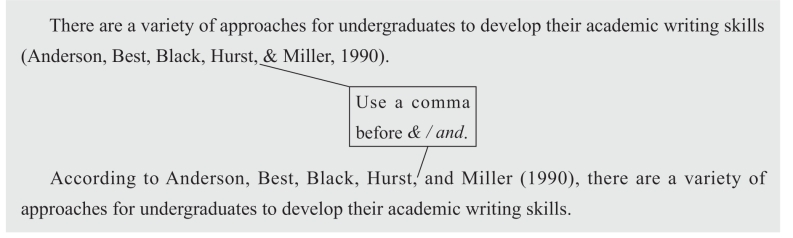
Subsequent citations in the same text should use only the first author’s
name, followed by et al.(the Latin abbreviation for and others). For example,
if you continue to cite the previous source in your essay, you can use
Anderson et al. to refer to all the five authors, as shown below:
… (Anderson et al., 1990).
According to Anderson et al. (1990), …
For six or more authors, include only the last name of the first author
listed, followed by et al.no matter whether you refer to them the first time or
the second time in your essay. For example:
Calvert et al. (1987) argued that the concept of social class is rapidly
becoming obsolete.The concept of social class is rapidly becoming obsolete
(Calvert et al., 1987).
Unknown authors
In some cases, you may have found articles on a webpage with
unknown authors. You can use the article title to replace the author; then
provide the year of publication for a paraphrase or summary. Add the page
number or paragraph number for a direct quotation (most articles on
webpages do not contain page numbers, so it is acceptable to provide the
paragraph number). Use quotation marks (“ ”) to enclose the article title. If
the title is too long, you can only include the first few words in the title. For
example, if you are quoting an online article entitled “With So Little
Housing for the Homeless, Can Outreach Workers Really Help?”, with the
unknown author, the intext citation should be like this:
As an outreach worker, “telling someone that you’re putting him or her
on a mythical waiting list for housing is the worst kind of betrayal.” (“With
So Little Housing”, 2010, para. 5)
If you cannot find any author, but it is clear that an organization or
group is responsible for the content of a webpage, then cite that group or
organization, e.g. a university, a government agency,a corporation, or an
association as the author. For example, when you are searching for relevant
information on the website of the U.S. Department of the Treasury, if a
document or article does not show the author’s name, you can use U.S.
Department of Treasury to replace the author’s last name when citing, for
example:
The U.S. government has refocused its counterterrorism efforts to
constantly adapt to emerging threats (U.S. Department of Treasury, 2019).
When you are citing a book or eBook with no author, include the book
title in italics, for example:
Andragogy is the method and practice of teaching adult learners
(Merriam-Webster’s Collegiate Dictionary, 2005).
8.3.2 End-of-text references
After you complete your writing (including the essay introduction,
body, and conclusion),you should put together a full, detailed list of the
sources that you have cited. This list is called a“References” list, which is
placed at the end of your essay. For each of the in-text citation, there should
be a corresponding entry in the references list (i.e. a reference) to provide the
essential publication information of that source so that your readers can
more easily locate the sources if they need to. For instance, if you have
quoted from Darwin (1859) in your essay, it is necessary to include an entry
in your references list to give the complete publication information of this
source.The APA style guidelines require you to include the following
information about each source in the end-of-text references:
[5]);
● the author’s name (the last name + initials
● the year of publication (the date of publication for online sources);
● the title of the material cited;
● the physical or online place of publication.
When referencing different sources, you may need to provide slightly
different information with unique formatting rules according to the APA
style manuals. We will illustrate how to format the reference entry for
several major types of sources, i.e. books, journal articles, newspaper
articles,and websites. Pay special attention to the punctuations, italics,
capitals, and other formatting. There are two unified format requirements
for each reference entry : (ⅰ) double space every line; (ⅱ) the
second and all the following lines of an entry should be indented
[6] more than
the first line.
Books
For a printed book, the format of the reference entry is as follows.

Note that the book title needs to be italicized and only the first word
and proper nouns are capitalized, no matter it is a printed book or e-book. An
example of the reference entry for a printed book is illustrated as follows:
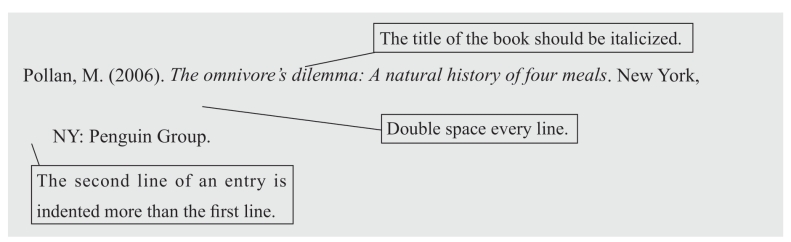
Since for each reference entry, you should double space every line and
indent the second and all the following lines, we will not mark these two
format requirements in the following examples.
For an e-book , the information required for the reference entry is
differentiated when the book is with or without a DOI
[7]. With a DOI, the
format is as follows:

For example:

If the e-book is without a DOI, you need to provide the website address
where the book can be retrieved or re-found. Its format is as follows.

For example:

Journal articles
For a printed journal article, you need to provide both the article title
and the journal’s name.For the article title, you do not need to use italics
and only the first word and proper nouns are capitalized. Whereas the
journal’s name is italicized and written in title case
[8]. The format of a
reference entry for a printed journal article is illustrated below:

For example:
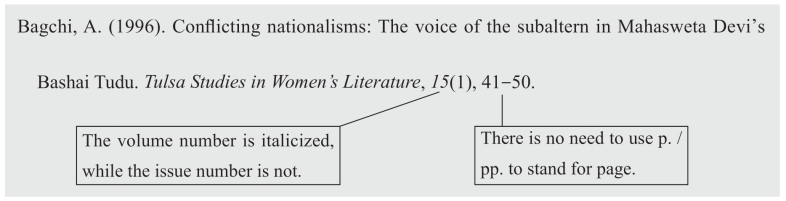
For an online journal article, you need to add the DOI or URL (i.e. the
website address). With a DOI, the reference format is:

For example:
Florian, R. V. (2010). Challenges for interactivist-constructivist
robotics. New Ideas in New Ideas in Psychology, 28(3), 350-353. doi:
10.1016/j.newideapsych. 2009.09.009
If there is no DOI for the online journal article, you must provide the
website address to inform others where you found it. The format for such a
reference entry is shown below.
Author’s Last Name, Initials. (Publication Year). Title of the article.
Name of the Journal,___Volume#(Issue#), page range. Retrieved from http://
For example:
Comforton, M. (2007). Bedside manner in the modern hospital. Nursing
Theory Today, 8(9),56-61. Retrieved from http://nursingtheorytoday.com
Newspaper articles
For a printed newspaper article, you should not only mention the year
of publication, but also specify the date, because most newspapers are
published daily. Provide both the article title and the name of the newspaper.
Only the newspaper’s name needs to be italicized and written in the title
case.While for the article title, you do not need to use italics and only the
first word and proper nouns are capitalized. The format of a reference entry
for a printed newspaper article is illustrated below:

For example:

For an online newspaper article, you must add the website address to
indicate where you found it; there is no need to mention the page number.
The exact format is shown below.

For example:
Brody, J. E. (2007, December 11). Mental reserves keep brain agile.
The New York Times.Retrieved from http://www.nytimes.com
Websites
Nowadays, more people tend to use websites as their major source of
information. If a webpage on the website has an author, your reference entry
should contain the following information and be formatted as follows:
Author’s Last Name, Initials. (Publication Year, Month Day). Title of
the webpage. Title of the___Website. Retrieved from http://
Since some webpages are frequently updated, it is necessary to inform
the reader the exact date when it was published. The basic rule is to provide
as much of the date as you can. If the webpage does not have the publication
year, month and day, say, it only has a month and year of publication, or only
the year, then provide whatever you can find. If the webpage does not have a
publication date, use n.d. for no date. The title of the webpage refers to the
title of the article on that webpage; the title of the website refers to the text
that appears at the top of your browser when you visit a website (e.g. the
website title for https://www.answers.com/ is Answers). An example of the
reference entry for this type of source is illustrated as follows:
Lad, K. (2016, September 4). An overview of the colorful traditional
Mexican clothing. Buzzle.
Retrieved from http://www.buzzle.com/articles/traditional-mexican-
clothing.html
As we have mentioned in Section 8.3.1, some webpages do not have an
author. In this case, use the group or organization responsible for the content
in the place of the author’s name. Its format is as follwos.

For example:
U.S. Department of Labor, Bureau of Labor Statistics. (2019,
September 4). Employment projections:2018-2028 summary. Retrieved from
https://www.bls.gov/news.release/eco-pro.nr0.htm
In the other case, if there is no author and no responsible organization,
you can replace the author’s name with the title of the webpage (i.e. the
article title). Its format is as follows.

For example:
Freud’s structural theory: The id, the ego, and the superego. (n.d.).
Retrieved from http://www.vakkur.com/psy/freud.html
It is not recommended to use such a source (i.e. a webpage with no
author and no date) unless it is very important for your essay and the website
is reliable.
Two or more authors
Most of the previous examples involve only one author. However,
many sources may have two or more authors. When there are two authors,
use a comma (,) to separate and an ampersand(&) to connect these two
authors, for example, Bell, J. K., & Cohn A. (1968)…, and the rest of the
reference entry is exactly the same as that with one author.
For three to seven authors, list the last name and initials of each author.
Use commas to separate every author and an ampersand (&) should come
before the last author’s name. For example:
Kernis, M. H., Cornell, D. P., Sun, C. R., Berry, A., Harlow, T., & Bach,
J. S. (1993). There’s more to self-esteem than whether it is high or low: The
importance of stability of self-esteem.Journal of Personality and Social
Psychology, 65, 1190-1204.
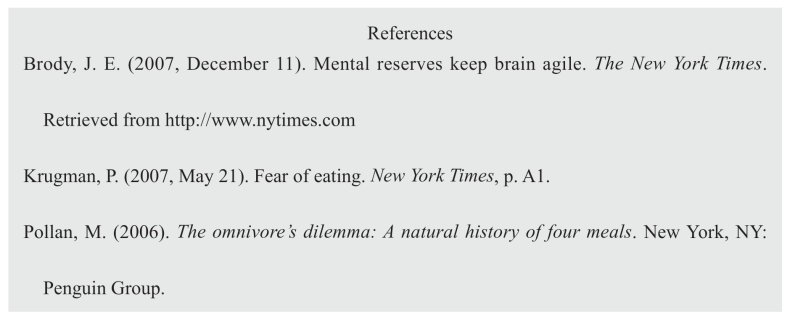
Designing a reference list
After writing all the references for your essay, you should design a
“References” list to include them. First, center the word “References” at
the top of a new page. Then, arrange the references in alphabetical
[9] order
according to the first author’s last name (if there is no author, alphabetize
the title of the work or the organization’s name). For example, suppose
you have cited from the following three sources:
Krugman, P. (2007, May 21). Fear of eating. New York Times, p. A1.
Pollan, M. (2006). The omnivore’s dilemma: A natural history of four
meals. New York, NY:Penguin Group.
Brody, J. E. (2007, December 11). Mental reserves keep brain agile.
The New York Times.Retrieved from http://www.nytimes.com
A correct way to arrange them in a reference list according to the APA
style guidelines is shown below:
Exercises
- Check whether the following in-text citations are correct according
to the APA style guidelines. Revise the incorrect parts.
- According to Jones (1998), “students often had difficulty using APA
style, especially when it was their first time.” (19)
- Consumers experience greater risk for online purchases (Porter et al,
2016).
- Roose & Kang (2018) explain that such technologies now extend
beyond what these parties are able to manage, due to their immense
influence, potential for exploitation and sophistication.
- Smith states that plagiarism is an increasingly big problem (2014).
- “As natural selection acts solely by accumulating slight, successive,
favourable variations, it can produce no great or sudden modification; it can
act only by very short and slow steps.” (Darwin,1859, p. 510)
- If a source does not have an author, how can you use in-text
citations to acknowledge the source?Choose the appropriate ways by ticking
(√) in the box before the corresponding sequential number.
□ 1) You can omit the author’s name and just provide the year of
publication and page / paragraph number.
□ 2) You can use the title of the article or book to replace the author’s
name.
□ 3) You can use the name of the organization or group that is
responsible for the content of the source.
□ 4) You can write unknown author in the place the author’s name.
- For each of the following sources, choose a reference entry with
the correct format abiding by the APA style guidelines. Circle your answer.
- A printed book:

- An online newspaper article:
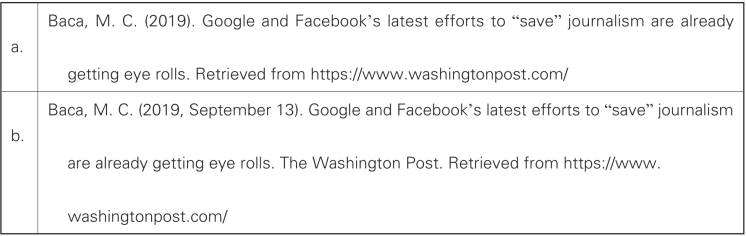
- A printed journal article:
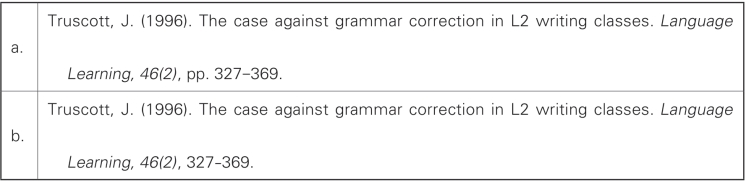
- A webpage with an author:
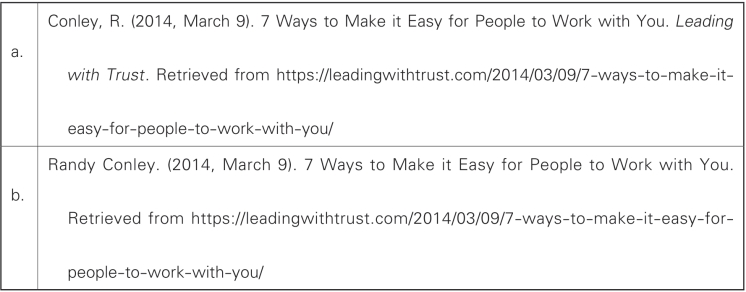
- Suppose your essay has citations from the following four sources.
Design a reference list to
appropriately arrange them in accordance with the APA style
guidelines.
- Shoop, B. (2013, February 26). Weather effects on small businesses:
Why it pays to be small. The Chicago Tribune. Retrieved from
http://www.chicagotribune.com
- Johnson, D. W., Johnson, R. T., & Holubec, E. J. (1993). Circles of
learning. Edina, MN: Interaction Book Company.
- U.S. Department of Justice. (2006, September 10). Trends in violent
victimization
by
age,
1973-2005.
Retrieved
from
http://www.ojp.usdoj.gov/bjs/glance/vage.htm
- Carolina, D. (2014). A model-driven methodology for developing
secure data-management applications. IEEE Transactions of Software
Engineering, 40(4), 324-337.
【注释】
[1]mosaic a. composed of a combination of diverse elements 拼接的
[2]signal verb: a signal verb used to signal or inform the readers that the
following information is words, sentences, or ideas from another source, e.g.
state, claim, argue
[3]choppy a. (North American English ) containing a lot of short
sentences and changing topics too often 不连贯的;支离破碎的
[4]ampersand n. the symbol (&) used to mean and 表示and的符号
[5]initial n. the first letter of a person’s name (名字的)首字母
[6]indent v. to start a line of print or writing further away from the edge of
the page than the other lines 将(印刷或书写的行) 缩进,缩格
[7]DOI n. digital object identifier (a series of numbers and letters that
identifies a particular text or document published in electronic form on the
Internet) 数字对象识别码
[8]title case: One of the conventions used for capitalizing the words in a
title, subtitle, heading, or headline: use capital letters to start all
major words; articles, conjunctions, and prepositions are written with a
lowercase letter unless they start the title. 标题大小写
[9]alphabetical a. according to the correct order of the letters of the
alphabet, e.g. a, b, c, d, …, x, y, z 按字母(表)顺序的